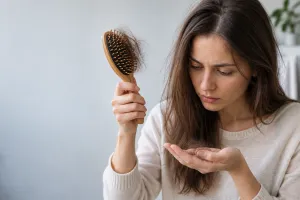







On Ozempic, Wegovy, Mounjaro, and other weight-loss medications, the kilos sometimes come off quite quickly, and the changes become noticeable not only on the scale. The cheeks lose fullness, the cheekbones and under-eye area become more defined, and the skin may look drier and less firm. On social media, all of this is often called Ozempic face, although the same changes also happen after major weight loss without GLP-1.
We cannot force the body to lose weight everywhere except the cheeks and temples. But we can influence what really matters during weight loss: adequate nutrition, muscle preservation, hydration, and skin condition. If the face has already started to change, there is no need to postpone the first consultation with a cosmetologist until the very last kilo is gone.
Can Ozempic face be avoided?
It is impossible to fully guarantee that the face will not change during significant weight loss. Along with the overall reduction in fat tissue, some of the fullness may disappear from the cheeks, temples, and under-eye area. In some people, this is barely noticeable; in others, the features become more “sharpened” fairly quickly, and the face starts to look more tired. Age, baseline anatomy, skin elasticity, the distribution of subcutaneous fat, and the amount of weight lost all play a role. We discussed in more detail separately why the face may look older after weight loss.
The advice to “just lose weight more slowly” sounds more convincing than it works in practice. Slower weight loss may indeed be more comfortable, but it does not guarantee that the cheeks or temples will stay the same. Unfortunately, there is no established, proven rate of weight loss at which the facial fat compartments are guaranteed to be preserved.
The pace of treatment should be chosen based on medical indications, therapy tolerability, and overall condition, not adjusted to the fear of “losing your face.” So instead of trying at all costs to “save your cheeks,” it is more practical to focus on what can actually be controlled: nutrition, muscle preservation, and skin condition.
What to do from the first months of weight loss
Protein: with reduced appetite, it is better to plan it deliberately
GLP-1 can reduce appetite and usual portion sizes so much that, along with overall calorie intake, the amount of protein in the diet also quietly drops. But during significant weight loss, the body loses not only fat, but also some muscle mass. That is why adequate protein is especially important — it is needed to preserve and rebuild muscle.
In the joint recommendations of профильних organizations for the period of active weight loss, a target of 1.2–1.6 g of protein per kilogram per day is discussed. But calculating this simply from actual body weight in obesity is not always a good idea: the number may turn out too high. As practical alternatives, the authors suggest 80–120 g of protein per day or calculating based on lean body mass. These are useful working targets to keep in mind.
In practice, the problem is often simple: a person taking, say, Ozempic feels full quickly and simply cannot manage to eat what used to seem like a normal portion. That is why it is better not to leave the protein part “for later,” but to eat it first. Fish, eggs, Greek yogurt, cottage cheese, poultry, legumes, nuts, and seeds help distribute protein throughout the day without requiring very large meals. If it is difficult to reach the needed amount through regular food, part of it can be covered with high-protein products or drinks.
There is another side to this as well. Against the background of reduced appetite, a person often simply starts eating less of everything: less protein, fewer vegetables, and fewer foods containing iron, zinc, and essential fatty acids. For hair, skin, and muscles, this kind of “saving” can be very noticeable.
Strength training: protein alone is not enough
To preserve muscle mass, nutrition needs to be combined with exercise. The same recommendations note that simply increasing protein and stopping there is probably not enough for optimal muscle preservation. As a practical benchmark, the authors suggest strength training at least three times a week and at least 150 minutes of moderate aerobic activity per week, if health and physical ability allow it.
Strength exercises will not make the cheeks fuller. But they do give the muscles a stimulus that helps preserve functional tissue better during an energy deficit. For a person going through significant weight loss, this is much more practical than looking for a special supplement “for Ozempic face.”
Water: do not confuse hydration with volume
On GLP-1, some people reduce not only the amount of food they eat, but also their fluid intake. If nausea, vomiting, or diarrhea are added, water losses may be even greater. Lack of fluids can make dryness and fine lines more noticeable, and the face may look more tired. There is no special “water intake norm for Ozempic face.” The task here is simple: do not allow a fluid deficit, especially if the medication has made it harder to eat and drink normally.
Skincare: work with the skin, not try to restore volume with a cream
A separate shelf of cosmetics “for GLP-1” is not needed. During weight loss, the skin primarily needs a healthy barrier, enough hydration, and protection from ultraviolet radiation.
A basic routine can be very simple:
- in the morning — a moisturizer as needed and a broad-spectrum SPF;
- in the evening — gentle cleansing, a cream, and a retinoid if the skin tolerates it.
For topical tretinoin, there is a good accumulated evidence base regarding photoaging: a systematic review of randomized studies showed its effectiveness for wrinkles and other manifestations of photoaging.
A retinoid can affect texture, some signs of photoaging, and the dermal matrix. It will not compensate for deep soft-tissue changes. That is why skin quality after rapid weight loss should be assessed separately from how the contours and fullness of the face have changed.
Below, we have collected the main things that may help support the skin and the overall appearance of the face during weight loss — and separately noted what you should not expect from them.
| What to do | What it actually does | What not to expect from it |
|---|---|---|
| Plan adequate protein intake | Helps preserve muscle and lean mass | Preserve fat specifically in the cheeks and temples |
| Add strength training | Gives muscles a stimulus for preservation during weight loss | Stop changes in facial contours |
| Monitor hydration | Prevents lack of fluids from further worsening the appearance of the skin | Restore cheek projection |
| Use SPF daily | Protects against additional photodamage | Prevent the reduction of subcutaneous fat tissue |
| Support the skin barrier | Helps control dryness and irritation | Tighten a significant excess of skin |
| Use a retinoid if it suits your skin | Works on some signs of photoaging and the dermal matrix | Restore lost deep volume |
Practical tip: if significant weight loss lies ahead, take several photos of your face — front view, profile, and at about a 45° angle. No filters, preferably in the same lighting. Repeat the photos a few months later. This makes it much easier to understand what has actually changed: the temples, the midface, the under-eye area, the jawline, or mainly the condition of the skin itself.
Collagen, gua sha, and face yoga: can they help preserve the face?
There is no point arguing about collagen supplements in categories like “they work” or “they don’t work.” Some clinical studies do indeed find small improvements in skin hydration and elasticity. But even if this effect exists, it has no direct relation to preserving fat compartments. There are no grounds for buying collagen specifically as prevention for Ozempic face. There are no studies showing that oral collagen can preserve the fat tissue of the cheeks or temples during weight loss on GLP-1.
Firming and lifting creams solve a completely different problem. A good product may moisturize well, support the barrier, and make the skin surface look smoother and more cared for.
Gua sha, rollers, massage, and face yoga can be used. However, it is important to clearly understand what can actually be achieved with their help. In a small randomized study from 2025 involving 34 women, after eight weeks of using gua sha or a facial roller, changes were observed in some contour parameters, muscle tone, and elasticity. At the same time, a 2025 systematic review covering 12 studies and 321 women showed the other side of the issue: the samples are small, the methods are very different, and the data are still insufficient to speak confidently about the rejuvenating effect of such practices.
For a person losing weight on GLP-1, the conclusion is specific: there is no convincing evidence that gua sha, massage, a roller, or face yoga can preserve facial fat tissue. If you like gua sha as part of your skincare or massage routine, you can use it. But it is not worth expecting it to keep your cheeks from changing during weight loss.
When to see a cosmetologist if the weight is still going down
There is no need to wait for stable weight just for the sake of the first consultation. A 2025 international Delphi consensus allows aesthetic work already during medication-driven weight loss, including skincare, biostimulation, HA fillers, intradermal hyaluronic acid, and device-based methods.
There is also no need to start procedures together with the first GLP-1 injection. It is much more important to understand what stage of weight loss you are in and what is already happening to the face.
If you are just starting GLP-1. Take baseline photos, think through your diet and protein intake, add manageable strength training, and do not neglect SPF and basic skincare. There is no point in prophylactically injecting a large volume of filler “just in case”: no one yet knows exactly how your face will change or whether it will change noticeably at all.
If you are actively losing weight and already see changes. At this stage, a consultation already makes sense. The doctor can assess what is coming to the forefront: loss of fullness, changes in skin quality, laxity, or a combination of several factors. Some interventions are possible already now, but it must be taken into account that the face may continue to change along with the weight.
If the weight has approached the target or stabilized. The picture becomes much clearer. It is already possible to assess more precisely where projection has truly been lost, where tissue properties have changed, and where the problem is mainly laxity. With volume deficit and changes in tissue properties, the question arises of fillers or biostimulators after GLP-1; if laxity is more concerning, RF, HIFU, laser, and the limits of device-based correction are evaluated separately.
The face rarely changes according to just one scenario during major weight loss. In one person, the temples become noticeable first; in another, the under-eye area; in a third, the volume hardly changes at all, but dryness or laxity becomes more pronounced. That is why there is no point in trying to “insure” the face in advance with a single procedure or supplement. It is better to observe the changes step by step. First, go through the weight-loss process itself properly, without losing sight of nutrition, muscles, and skin. Then see what remains after the weight stabilizes. And only then decide, based on that specific picture, whether correction is needed at all and what kind.
Sources
- Nutritional priorities to support GLP-1 therapy for obesity: a joint advisory from the American College of Lifestyle Medicine, the American Society for Nutrition, the Obesity Medicine Association, and The Obesity Society. 2025. DOI.
- Sitohang IBS, et al. Topical tretinoin for treating photoaging: A systematic review of randomized controlled trials. International Journal of Women's Dermatology. 2022. PubMed.
- Comparative Effects of Facial Roller and Gua Sha Massage on Facial Contour, Muscle Tone, and Skin Elasticity: Randomized Controlled Trial. Journal of Cosmetic Dermatology. 2025. Full text.
- Efficacy of Conservative Techniques for Mechanical Facial Rejuvenation: A Systematic Review. 2025. PubMed.
- Consensus Statements on Managing Aesthetic Needs in Prescription Medication-Driven Weight Loss Patients: An International, Multidisciplinary Delphi Study. Journal of Cosmetic Dermatology. 2025. Full text.
- Managing Aesthetic Needs in Prescription Medication-Driven Rapid Weight Loss Patients: Results of an International Consensus. The Clinician Perspective. 2026. Full text.