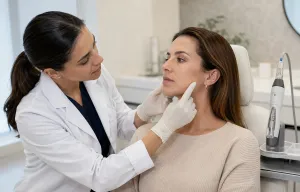







Tras perder peso, la pregunta «cómo tensar la piel» puede significar cosas muy distintas. ¿La piel se ha vuelto más fina y menos elástica? ¿Se ha formado un pliegue en el abdomen? ¿El rostro ha perdido volumen y el tercio inferior empieza a verse más pesado? En estas situaciones se necesitan enfoques diferentes. Por eso no tiene sentido elegir entre RF, HIFU y láser solo según el criterio de «qué equipo es más potente». Primero conviene determinar qué está causando el problema: la calidad de la piel, una flacidez moderada, la pérdida de volumen subcutáneo o un exceso físico de tejido. Sobre cómo cambian el rostro y la piel después de adelgazar, lo analizamos en detalle en un material aparte.
Cuándo tienen sentido los procedimientos con aparatología después de adelgazar
Los métodos basados en energía (RF, HIFU/MFU, radiofrecuencia con microagujas, procedimientos láser) son procedimientos con aparatología que transmiten energía controlada a los tejidos: radiofrecuencia, ultrasonido o láser. Según la tecnología, esta energía calienta distintas capas de la piel y de los tejidos subyacentes, activando la remodelación del colágeno. Como resultado, la piel puede volverse más densa, algo más elástica, y los pequeños pliegues y la flacidez moderada pueden hacerse menos visibles. Estos métodos funcionan mejor cuando, tras la pérdida de peso, la piel todavía sigue en general el contorno del rostro o del cuerpo, pero se ha vuelto menos elástica, más fina o ha empezado a descolgarse ligeramente. Es decir, cuando el problema está sobre todo en la calidad y el tono de los tejidos, y no en un exceso de los mismos.
Después de una gran pérdida de peso, la situación puede ser distinta: físicamente queda más piel de la que necesita el nuevo volumen corporal. Entonces aparece un pliegue marcado o un «delantal» en el abdomen, un exceso visible de tejido en brazos y muslos, y una flacidez importante en el rostro y el cuello. Un dispositivo puede mejorar en cierta medida la densidad de esa piel, pero no es capaz de eliminar su exceso. Por eso, cuando hay pliegues pronunciados, el límite de las posibilidades de la RF, el HIFU o el láser no lo determina la potencia del equipo, sino la propia anatomía del problema.
La base de evidencia en este ámbito es desigual. La RF, el ultrasonido microfocalizado y los métodos láser se han estudiado bien en la flacidez cutánea relacionada con la edad, pero mucho menos específicamente después de una gran pérdida de peso. Por eso, los resultados de estos procedimientos no deberían extrapolarse automáticamente a personas con un exceso marcado de piel tras adelgazar.
| Qué cambió después de adelgazar | Qué se puede comentar con el médico | Qué no conviene esperar |
|---|---|---|
| Flacidez leve o moderada del rostro y el cuello | RF, MFU/HIFU | El efecto de un lifting quirúrgico |
| Flacidez + textura irregular, arrugas finas | RF con microagujas | La eliminación de un gran exceso de tejido |
| Piel fina con pequeños pliegues, fotodaño | Láser fraccionado, a veces RF con microagujas | Un desplazamiento importante de los tejidos |
| Pérdida de volumen en mejillas, sienes, zona bajo los ojos + flacidez | Primero valorar el papel de la pérdida de volumen | Que el tightening por sí solo devuelva las proporciones anteriores |
| Flacidez leve del abdomen, brazos o muslos | Algunos métodos de RF y otros basados en energía | La desaparición de un gran pliegue cutáneo |
| Exceso marcado de piel | Consulta con un cirujano plástico | Que un ciclo de procedimientos con aparatología sustituya la escisión del tejido sobrante |
La RF, la RF con microagujas, el HIFU y el láser resuelven problemas diferentes
La palabra «lifting» en el nombre de un procedimiento dice poco sobre su efecto real. La energía de radiofrecuencia, el ultrasonido focalizado y el láser actúan de manera diferente, a distintas profundidades, y no deberían considerarse automáticamente intercambiables.

Fig. Procedimientos con aparatología después de adelgazar: RF, HIFU, láser y cirugía
RF: cuando se necesita densificar moderadamente los tejidos
La terapia de radiofrecuencia no invasiva calienta los tejidos sin perforar la piel. Los sistemas monopolares, bipolares y otros sistemas de RF se diferencian en la distribución de la energía y en la profundidad de acción, por lo que no es correcto valorar la «RF» como un único procedimiento universal. En casos de flacidez leve o moderada del rostro, estas tecnologías pueden mejorar la densidad de la piel y modificar ligeramente el contorno. Después de adelgazar, este es el escenario más lógico: los tejidos se han vuelto menos elásticos, pero no existe un gran exceso de piel. El resultado, por lo general, no debería medirse con el lenguaje de un lifting quirúrgico. Se trata más bien de una mejora gradual de la calidad del tejido y de una contracción moderada, no de reposicionar las mejillas, el cuello o el óvalo facial.
RF con microagujas: flacidez más textura
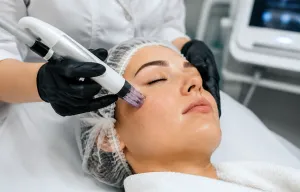
En la RF con microagujas, unos electrodos finos se introducen en la piel a una profundidad determinada, y la energía de radiofrecuencia calienta el tejido a su alrededor. Este efecto activa la remodelación del colágeno, por lo que el método se utiliza cuando se necesita trabajar al mismo tiempo la textura, las arrugas finas, las cicatrices y la flacidez moderada. Después de adelgazar, esta tecnología requiere una selección de parámetros especialmente precisa. Si el rostro ya ha perdido parte del volumen subcutáneo, el objetivo no es trabajar lo más profundo o lo más potente posible, sino actuar exactamente sobre la capa adecuada. Una pérdida adicional de tejido graso en zonas de mejillas hundidas o sienes puede, por el contrario, acentuar aún más un aspecto facial demacrado.
La piel fina y la pérdida de volumen previa pueden cambiar el equilibrio entre beneficios y riesgos. Consulte también nuestra guía sobre quién es un buen candidato para el microneedling RF y cuándo conviene posponerlo.
Una revisión sistemática de 2026 incluyó 20 estudios y 558 participantes. En ellos se describían de forma recurrente mejoras en la textura de la piel y una reducción de la flacidez, y las reacciones más frecuentes fueron enrojecimiento e hinchazón temporales. Al mismo tiempo, la mayoría de los estudios eran pequeños, por lo que no son adecuados para valorar complicaciones graves poco frecuentes. Por eso merece atención aparte la advertencia de la FDA del 15 de octubre de 2025. El regulador informó de casos de quemaduras, cicatrices, daño nervioso, deformación y pérdida de grasa subcutánea tras algunos usos de la RF con microagujas. Esto no significa que esas complicaciones ocurran con frecuencia, pero en un rostro ya adelgazado el propio riesgo de perder volumen adicional tiene importancia práctica.
HIFU y MFU: no es lo mismo que un lifting SMAS quirúrgico
El ultrasonido focalizado crea pequeñas zonas de efecto térmico a una profundidad determinada. Algunos sistemas utilizan ultrasonido microfocalizado con visualización de los tejidos: MFU-V. En la publicidad, estos procedimientos suelen llamarse «lifting SMAS». El término es cómodo, pero puede exagerar su similitud con una cirugía. Durante un facelift quirúrgico, el cirujano accede a los tejidos, los moviliza y los reposiciona. Un dispositivo de ultrasonido no despega los tejidos ni los traslada a otro lugar. Crea puntos controlados de calentamiento a una profundidad concreta, tras lo cual se produce la remodelación.
Hay evidencia de efecto. Un metaanálisis sobre MFU-V, que incluyó 42 estudios, mostró cierto grado de mejora estética en el 89% de los pacientes según la valoración de los médicos y en el 84% según la valoración de los propios pacientes. Pero estas cifras pueden interpretarse fácilmente de forma errónea. Se refieren a cualquier nivel de mejora, no a un 89% de liftings marcados. De los 42 trabajos, solo dos eran estudios clínicos controlados; la mayoría eran observaciones simples antes y después del procedimiento. Cuando el cuestionario permitía a los pacientes responder de forma neutral, la proporción de satisfechos bajaba al 62%.
Una revisión sistemática de seguridad del MFU-V encontró en la literatura científica solo un caso de atrofia subcutánea; sin embargo, en la base de datos poscomercialización MAUDE también había informes de lipoatrofia, entumecimiento, disestesia, ptosis y otros fenómenos neurológicos. Con este tipo de notificaciones no es posible determinar la frecuencia de las complicaciones, pero sí confirman que la profundidad de acción y la anatomía de la zona importan.
Por eso, después de adelgazar, el HIFU/MFU puede ser adecuado en casos de flacidez moderada del tercio inferior y del cuello, pero no bajo el principio de «cuanto más profundo, mejor». Si el rostro ya está delgado y ha perdido volumen, esto debe tenerse en cuenta antes del procedimiento, no después.
Láser: más orientado a la calidad de la piel que al descolgamiento
Los láseres fraccionados ocupan un lugar aparte en este esquema. Su punto fuerte es la remodelación de las estructuras superficiales y dérmicas: fotodaño, arrugas, textura irregular, cicatrices, cambios pigmentarios. Las técnicas ablativas, en particular el láser de CO₂, también pueden producir cierta contracción del tejido. Pero si la queja principal es «después de adelgazar se me ha desdibujado el óvalo facial», el láser por sí solo rara vez será la primera respuesta evidente. En el caso del resurfacing fraccionado no ablativo, el efecto específicamente sobre el skin tightening fue inconsistente en los estudios. Su lugar se vuelve mucho más claro cuando, junto con una pequeña flacidez, hay piel fina con pequeños pliegues, fotodaño o cambios marcados de textura.
En otras palabras, el láser puede mejorar la piel, pero no es lo mismo que elevar tejidos que se han desplazado visiblemente hacia abajo. Sobre la diferencia entre tecnologías ablativas y no ablativas, su eficacia, riesgos y recuperación, ya escribimos por separado en el material sobre el resurfacing láser fraccionado.
Por qué un rostro delgado no debe simplemente «tensarse más fuerte»
Después de una pérdida importante de peso, el rostro cambia no solo por la piel. Una revisión sistemática de 2024 mostró que el cambio más característico tras una massive weight loss es la pérdida de volumen del tercio medio facial; también suele aumentar la flacidez de la parte central del cuello. Pueden hacerse más evidentes los surcos nasolabiales, el hundimiento bajo los ojos y en las sienes. Precisamente aquí, la lógica simple de «vemos flacidez: hacemos tightening» puede dar un resultado pobre. Por ejemplo, una mejilla puede parecer caída no solo porque la piel se ha vuelto menos elástica, sino también porque debajo hay menos volumen. Un dispositivo puede mejorar la parte relacionada con la piel, pero no devolverá los compartimentos grasos a su nivel anterior.
El consenso Delphi internacional de 2025 también considera los cambios tras la pérdida de peso farmacológica como un proceso de varios niveles: entre las estructuras más afectadas, los expertos mencionaron la piel y los compartimentos grasos superficiales y profundos. Los energy-based devices pueden formar parte del plan incluso durante el proceso de adelgazamiento, pero eso no significa que todo el mundo necesite el mismo procedimiento.
Por eso, en la consulta tiene sentido evaluar el rostro en su conjunto. ¿Existe un verdadero exceso de piel? ¿Hasta qué punto se ha perdido volumen en mejillas y sienes? ¿Cuál es el grosor del tejido subcutáneo en la zona que se va a tratar? ¿A qué llama exactamente el paciente «descolgamiento»? De la respuesta a estas preguntas depende si se necesita calentar los tejidos en absoluto y a qué profundidad. Esto también explica por qué una secuencia del tipo «primero HIFU, luego RF, luego láser» no constituye por sí sola un plan de tratamiento. Solo enumera tecnologías.
Qué hacer con la piel del abdomen, los brazos y los muslos después de adelgazar
En el cuerpo, el límite de las posibilidades de los dispositivos suele verse aún con más claridad. Si tras una pérdida de peso moderada la piel del abdomen se ha vuelto un poco más blanda, han aparecido pequeños pliegues en la cara interna de los brazos o los muslos, pero los tejidos en general conservan el contorno, los procedimientos de remodelación del colágeno pueden tener sentido. El resultado debería valorarse como una mejora de la densidad y una contracción moderada, no como una «eliminación de la piel sobrante sin cirugía».
Después de una gran pérdida de peso, a veces la superficie de la piel simplemente deja de corresponderse con el nuevo volumen corporal. Aparecen grandes pliegues en el abdomen y exceso de piel en brazos, pecho o muslos. Aquí la cuestión ya no es si la RF puede estimular el colágeno. Aunque pueda hacerlo, la cantidad de tejido sobrante no desaparecerá por ello. Precisamente en estos casos conviene comentar antes la situación con un cirujano plástico. Esto no significa que toda persona que haya adelgazado mucho necesite automáticamente una operación. Pero la consulta permite comprender la magnitud del problema antes de invertir tiempo y dinero en una serie de procedimientos cuyo resultado, desde el principio, no podía ajustarse a las expectativas.
Para las cirugías estéticas definitivas, la estabilidad del peso es importante. En el consenso internacional para pacientes tras pérdida de peso farmacológica, se recomendaba considerar las intervenciones quirúrgicas definitivas al menos seis meses después de la estabilización del peso. En las grandes cirugías de body contouring también importan el estado general de salud y la capacidad de una cicatrización adecuada.
Antes de cualquier procedimiento con aparatología, resulta más útil preguntar no «cuál es su lifting más potente», sino qué está generando exactamente mi problema, a qué capa de tejido irá dirigido el procedimiento, qué resultado puedo esperar de forma realista y qué no corregirá este método. Después de adelgazar, esto es especialmente importante. Una flacidez cutánea leve realmente puede mejorar. La textura, también. Pero si el rostro ha perdido mucho volumen, un simple tensado puede ser el objetivo equivocado. Y cuando, después de una gran pérdida de peso, queda un verdadero exceso de tejido, la RF, el HIFU o el láser no se convierten en una alternativa a la cirugía solo porque se les llame «lifting sin cirugía».
Fuentes
- Jafar AB, Jacob J, Kao WK, Ho T. Soft Tissue Facial Changes Following Massive Weight Loss Secondary to Medical and Surgical Bariatric Interventions: A Systematic Review. Aesthetic Surgery Journal Open Forum. 2024.
- Nikolis A, Enright KM, Fabi SG, et al. Consensus Statements on Managing Aesthetic Needs in Prescription Medication-Driven Weight Loss Patients: An International, Multidisciplinary Delphi Study. Journal of Cosmetic Dermatology. 2025.
- Kumar N, Suh DH, Lee SJ, et al. Radiofrequency Microneedling for Facial Rejuvenation: A Systematic Review. Journal of Cosmetic Dermatology. 2026.
- U.S. Food and Drug Administration. Potential Risks with Certain Uses of Radiofrequency (RF) Microneedling. Safety Communication. October 15, 2025.
- Systematic review and meta-analysis of microfocused ultrasound with visualization for noninvasive skin tightening.
- Humphrey VS, Rambhia PH, Gmyrek R, Chapas A. Microfocused Ultrasound With Visualization: A Systematic Review of Adverse Events and Risk of Subsequent Facelift Compromise. Dermatologic Surgery. 2025.
- Fanelli B, Maullu G, Onesti MG, Scuderi N. Aesthetic and regenerative medicine can improve results and satisfaction during and after weight lost in obese patients: preliminary clinical evaluation using subdermal induced heat (S.I.H.) technology. Plastic Reconstructive and Regenerative Surgery. 2024.
- Kauvar ANB. Fractional nonablative laser resurfacing: is there a skin tightening effect? Dermatologic Surgery. 2014.