






A person loses 15 or 20 kilograms, looks in the mirror, and sees more than just a slimmer face. The temples look hollower, the cheeks flatter, the under-eye area more pronounced, and the skin seems to have lost support. This raises a very practical question: should the lost volume be replaced with filler, or is it better to stimulate collagen?
The choice starts with identifying what exactly has changed. Significant weight loss affects the face on several levels at once. In one patient, volume loss may predominate; in another, laxity and changes in the soft tissues; in a third, these issues may overlap. A separate consideration is the condition of the skin itself: its hydration, smoothness, and texture. If weight is still decreasing, another factor comes into play: facial proportions are continuing to change.
After weight loss, the face loses more than just fat
The popular term “Ozempic face” creates the impression that there is a special type of aging caused by one specific medication. In reality, similar changes have long been seen after substantial weight loss, regardless of its cause. GLP-1 therapy has made this situation much more common, and rapid, significant weight loss can make existing age-related changes more noticeable. We have written separately about how the face and skin change after weight loss.
The changes do not occur in a single layer. A 2026 anatomical review devoted to the face after GLP-1-associated weight loss discusses volume loss in fat compartments, changes in soft tissues, and the increased visibility of skin laxity. In a 2025 international Delphi consensus, experts also identified the skin, superficial fat pads, and deep fat pads as the tissues that change the most during medication-driven weight loss.
This is especially visible in the midface. The cheek becomes flatter, transitions between areas become sharper, and the infraorbital region and nasolabial fold become more prominent. The cause is not necessarily the fold itself. The tissue system around it has changed.
This is where the concept of structural support comes in. Facial shape depends on the interaction between the bony framework, deep and superficial fat compartments, ligaments, and skin. Deeper volumes help create facial projection, while superficial fat contributes to soft contours and smooth transitions. When part of this volume disappears, the cheek does not simply become less full. Its projection changes, and with it, the appearance of neighboring areas.
What fillers do: volume and projection
Filler works in the most direct way: the injected material physically occupies a certain volume within the tissues. But in aesthetic correction, what matters is not merely the fact that volume is being added, but where exactly it is placed and how it changes facial projection.
A structural HA filler does not necessarily have to be injected directly into every fold or hollow. Restoring volume in an anatomically appropriate area can bring back the necessary projection and change the way the surrounding tissues look. After weight loss, this is especially important: the goal is not to replace all the lost fat with filler, but to determine where added volume will genuinely improve facial proportions.
Fat compartments are located at different depths and perform different functions, so the logic of “a lot of volume was lost, so we will inject a lot of filler” can easily lead to over-volumization and unnatural proportions. In addition, fat deficiency is often only one part of the changes that become visible after major weight loss.
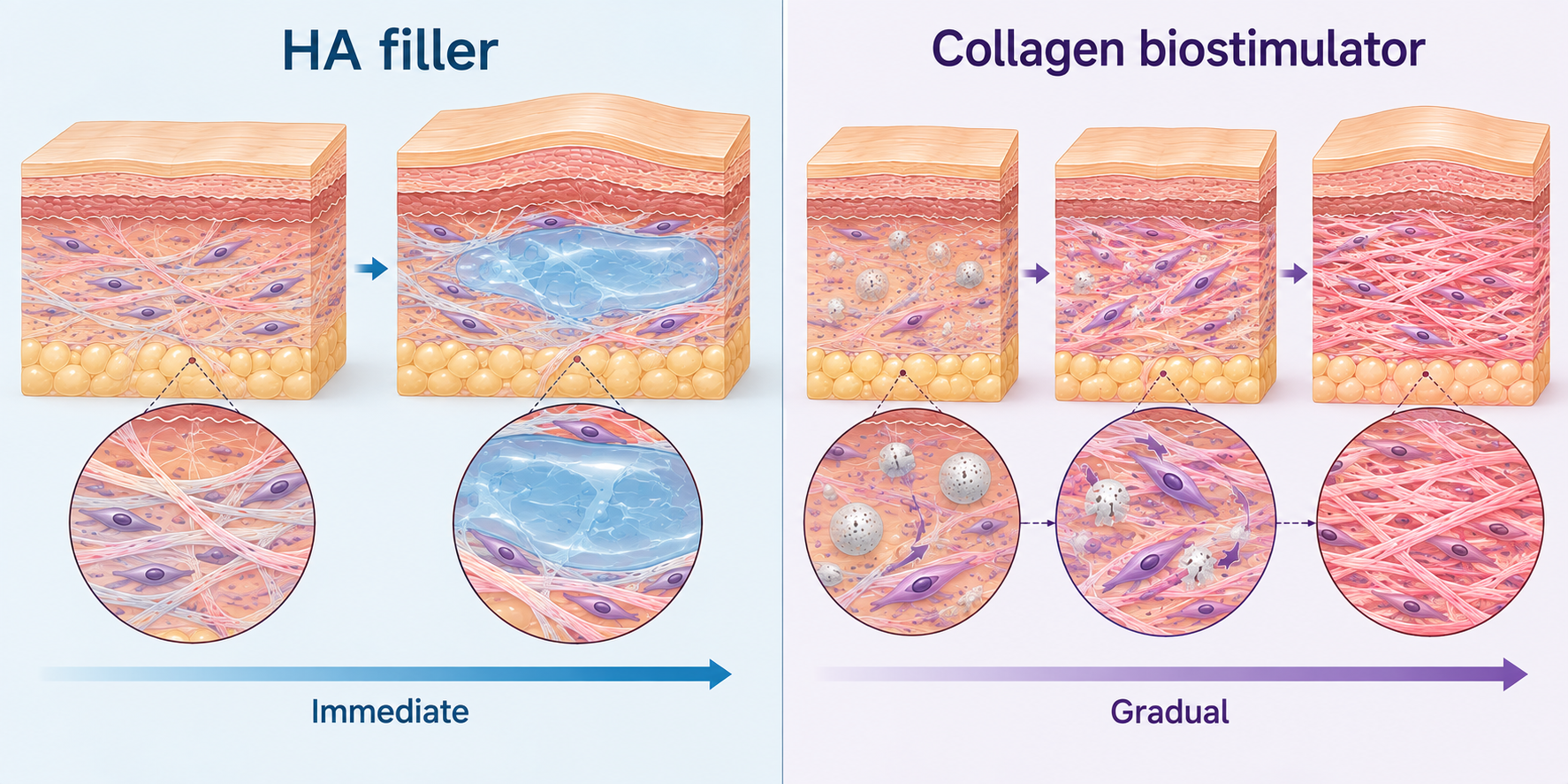
Fig. Volume restoration with hyaluronic acid filler and tissue remodeling with a collagen biostimulator
What biostimulators actually do
The phrase “biostimulators stimulate collagen” is correct, but it explains very little. They do not inject ready-made collagen into the tissue and are not simply slow-acting fillers. The injected material interacts with the tissue, triggering cellular and mechanical signals that ultimately affect fibroblasts, collagen synthesis, and extracellular matrix remodeling.
In simplified terms, this process can be imagined as a gradual restructuring of the tissue’s own collagen framework. “Framework” here is a metaphor. No separate rigid structure is being built inside the skin. The extracellular matrix is a complex environment made up of collagen and other components that surrounds cells and contributes to the mechanical properties of the tissue.
The mechanism depends on the material. PLLA, CaHA, PCL, and other products grouped under the term collagen biostimulators do not interact with tissues in the same way. A 2026 review covering 43 studies of six classes of biostimulators found different mechanotransduction profiles and substantial differences in the strength of evidence for individual materials.
It is also important to understand that biostimulation does not mean there is no volumizing effect. It may develop gradually along with the tissue response and the formation of new matrix. Some materials also have an immediate physical component after injection. Therefore, the boundary between “creating volume” and “working with tissue” is not absolute.
Even so, a biostimulator should not be viewed as a delayed-action filler. HA filler allows the physician to place a specific volume directly in a chosen anatomical area and control projection more precisely. Biostimulation develops gradually and depends to a large extent on the response of the patient’s own tissues. It can add fullness, but it does not literally recreate a lost fat compartment.
This is the practical dividing line between the methods. If, after weight loss, the temple has become hollow or midface projection has been lost, precise volume restoration may be needed. If the changes are more diffuse and concern the properties of the soft tissues, biostimulation addresses a different task. Quite often, both tasks are present at the same time.
The level of evidence is not the same for all of this. The mechanisms of action of collagen biostimulators are being studied quite actively, but the 2026 review states directly that none of the included studies specifically enrolled patients with GLP-1-associated facial changes. Thus, the biological rationale for using biostimulators in this situation is currently stronger than the clinical evidence base specifically for patients after GLP-1 therapy.
Where skinboosters and biorevitalization fit into this model
Loss of deep volume, remodeling of soft tissues, and the condition of the skin itself are different processes. After weight loss, they may be visible at the same time, which makes it easy to lump everything together under the vague phrase “skin quality has worsened.”
Intradermal hyaluronic acid products, often called skinboosters or classified as biorevitalization, occupy a separate place here. They do not recreate a lost fat compartment and do not provide the structural projection for which fillers are used. Their area of action is primarily hydration and certain parameters of the skin’s own condition. Skinboosters and intradermal HA were also included among the methods that the Delphi expert group considered for patients undergoing medication-driven weight loss.
This leads to a fairly practical model of combined correction. Biostimulators help remodel the patient’s own extracellular matrix and may gradually add fullness to tissues. Fillers restore precise volume and projection where these have been lost. Skinboosters work closer to the level of the skin itself — primarily with hydration and selected characteristics of its condition.
This is not a three-step protocol that everyone must follow. The functions of these methods partially overlap, and the needs of different faces after weight loss vary. A combination makes sense when each procedure has a specific task.
If laxity predominates, injection options are not the only possible approach. RF, HIFU, microneedling RF, and laser technologies have their own indications and limitations — we discussed them separately in an article on skin tightening after weight loss. Changes in texture, hydration, and other skin characteristics are covered in the article on skin quality after rapid weight loss.
Should you wait until your weight stabilizes?
The rule “first lose all the weight, then do any aesthetic procedures” does not reflect how experts currently approach non-surgical correction. In the 2025 Delphi study, injectable methods — including fillers, collagen biostimulators, and skinboosters — as well as energy-based procedures were considered acceptable at different stages of weight loss. Experts recommended at least six months of stable weight before definitive aesthetic surgical procedures, not before all treatments.
There is, however, a practical reason not to rush into major volumization. During active weight loss, the anatomy continues to change. After another five or ten kilograms, the temples may become more hollow, the midface may flatten further, the jawline contour may change, or excess skin may become more noticeable. A correction planned for today’s proportions may find itself in a different anatomical context a few months later.
For this reason, a staged approach with repeated facial assessment is more logical during active weight loss. This applies primarily to attempts to restore a large lost volume all at once. With regard to biostimulation, expert opinions allow for an earlier start. In a 2026 international consensus, experts allowed for the initiation of biostimulation in parallel with weight loss, while acknowledging that the optimal timing and dosing have not yet been established and require further study. This is an expert consensus, not proof that early biostimulation has already demonstrated an ability to prevent facial changes in large randomized trials. The authors explicitly point to the need for long-term studies to test this hypothesis.
The closer a person is to their target weight, the clearer it becomes which changes remain. After stabilization, it is easier to assess the final volume deficit, the degree of laxity, the condition of the skin, and the limits of non-surgical correction. Subsequent major weight fluctuations also matter: injectable procedures do not fix facial proportions regardless of what later happens to the surrounding tissues.
What exactly needs to be restored?
After major weight loss, the most noticeable problem often seems to be a lack of volume. This creates a temptation to treat every hollow with additional filler. But changes that look similar on the surface may have different anatomical causes and require different solutions.
| What predominates | What the task is |
|---|---|
| Hollow temples, flattened cheeks, reduced midface projection | Precise restoration of volume and projection, including with HA filler |
| Laxity and diffuse changes in the soft tissues | Assessment of whether biostimulation and/or device-based methods are appropriate |
| Volume loss combined with tissue changes | Selective volumization combined with remodeling methods |
| Reduced hydration and deterioration in the condition of the skin itself | Skin care and, when indicated, intradermal HA / skinboosters |
| Weight is still actively decreasing | Staged correction with repeated assessment of facial proportions |
| Significant excess skin | Assessment of the limits of non-surgical correction and, if necessary, consultation with a plastic surgeon |
An important conceptual mistake is to view laxity only as a lack of volume. Filler can restore projection where it has been lost, but it does not remove excess skin. If sagging is compensated for with increasing amounts of gel, the face will become fuller, while the actual cause of the sagging remains.
Biostimulation has different limits. Matrix remodeling and a gradual increase in tissue fullness do not provide the same degree of control over the projection of a specific anatomical area as targeted HA filler placement. And a skinbooster’s work on skin hydration cannot replace restoration of lost cheek volume.
A combined approach after weight loss makes sense not simply because procedures are being combined. It allows the clinician to separate the different changes that have occurred in one face and not demand from one product something it cannot do. The anatomical 2026 review supports combining collagen-stimulating and volumizing methods, but there is still no ready-made universal protocol for patients after GLP-1 therapy.
The question “filler or biostimulator?” is too narrow after significant weight loss. First, it is necessary to see where projection has been lost, where tissue properties have changed, what is happening to the skin itself, and whether weight loss has ended. Only then does the choice of method become a consequence of anatomy rather than the starting point of treatment.
Sources
- Nikolis A, Enright KM, Fabi SG, et al. Consensus Statements on Managing Aesthetic Needs in Prescription Medication-Driven Weight Loss Patients: An International, Multidisciplinary Delphi Study. Journal of Cosmetic Dermatology. 2025;24(4):e70094.
- Frank K, Guertler A, Hoffmeister V, et al. GLP-1-Induced Weight Loss and the Face: Anatomical Mechanisms and Rationale for Collagen-Stimulating and Volumizing Aesthetic Treatments. Dermatologic Surgery. 2026;52(6S):S55-S60.
- Nikolis A, Somenek MT, Dayan S, et al. Managing Aesthetic Needs in Prescription Medication-Driven Rapid Weight Loss Patients: Results of an International Consensus. The Clinician Perspective. Journal of Cosmetic Dermatology. 2026;25(1):e70644.
- Cho CH, Yanagawa A, Kim B. Mechanotransduction of Collagen Biostimulators: Comparative Signaling and Implications for GLP-1 RA-Associated Facial Aging. Journal of Cosmetic Dermatology. 2026;25(8):e71105.
- Correction to “Managing Aesthetic Needs in Prescription Medication-Driven Rapid Weight Loss Patients: Results of an International Consensus. The Clinician Perspective”. Journal of Cosmetic Dermatology. 2026;25(3):e70781.