







The number on the scale has gone down, clothes fit better, and yet the face in the mirror suddenly feels less pleasing. The cheeks may look more hollow, shadows under the eyes may be more pronounced, folds may become more noticeable, and the skin on the face, neck, or body may seem less firm. This can feel especially unexpected when the weight loss was intentional and the overall result is satisfying. These changes are often called “sagging skin,” although after weight loss it may not be only the skin that has changed. The volume of subcutaneous fat decreases, facial contours look different, some muscle mass may be lost, laxity may become more visible, or excess skin may form. Some age-related changes that were previously masked by volume can also become more apparent.
Why the face may look older after weight loss
Facial fat helps create volume in the cheeks, temples, under-eye area, and lower third of the face. When body weight decreases significantly, some of this volume may also disappear. On the face, even a small change in volume is easy to notice. The cheek becomes less rounded, making the transition to the under-eye area look sharper. The midface loses softness, so the nasolabial fold appears deeper. Hollow temples make the bony contours more pronounced.
A systematic review of studies after significant weight loss found the most noticeable volume loss in the central cheek area and skin laxity in the central neck. In some studies, perceived facial age also increased after major weight loss. These data mainly relate to significant weight loss, or massive weight loss, often after bariatric procedures, so losing a few kilograms and losing several dozen kilograms are different situations.
Hollow cheeks and temples are primarily the result of a loss of subcutaneous volume. Neck folds may be a sign of laxity or excess skin. Dryness and roughness relate to the skin’s surface, hydration, and barrier function. On the body, contours may also change because of muscle mass loss. All of this may look like one sudden “aging” effect, but the causes are different.
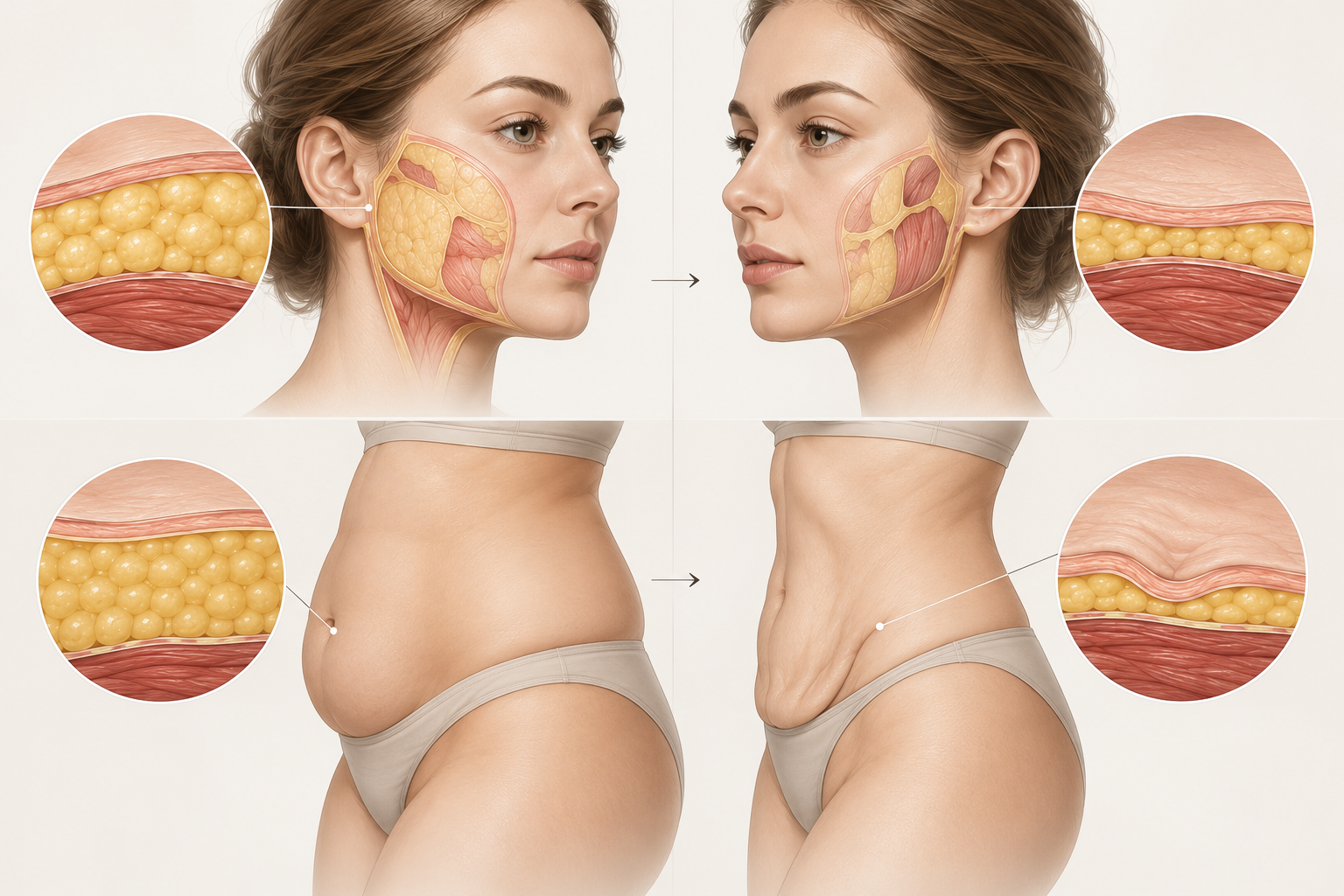
Fig. Schematic illustration of changes in tissue volume in the face and abdomen after weight loss.
What determines whether skin tightens after weight loss
After weight stabilizes, appearance can continue to change gradually. How the skin adapts to the new volume depends on the extent of weight loss, how long the tissues were previously stretched, age, and the body area involved.
After how many kilograms lost does excess skin remain?
There is no single number. In some people, noticeable excess skin appears after losing several dozen kilograms; in others, even major weight loss leaves far fewer folds. In general, the risk increases as total weight loss increases. The difference between losing 7 kg and losing 40 kg is fundamental. After moderate weight loss, the skin needs to adjust to a relatively small change in volume. After losing several dozen kilograms, the tissues that previously covered a much larger body volume may remain excessive.
How long the skin was stretched also matters. Prolonged tissue stretching is associated with a higher likelihood that excess tissue will remain after major weight loss. With age, the skin’s ability to remodel also changes; chronic ultraviolet damage and smoking additionally affect its structure.
How much time does skin need after weight loss?
Changes do not end on the day weight stops decreasing. After weight stabilizes, body contours and skin appearance may continue to change gradually, especially if the person is also restoring or building muscle mass. Pronounced excess skin after major weight loss often does not disappear simply with time. If a large fold has formed on the abdomen, arms, breasts, or thighs, it may remain even after weight has stabilized.
On the face, a different change is often more noticeable: loss of volume, with flatter cheeks, hollow temples, and stronger under-eye shadows. That is why simply trying to “tighten facial skin” may not address the main cause.
Structural changes may also occur in the skin itself after significant weight loss. A histological study of skin after significant weight loss found differences in elastic fibers, but it does not support the simplistic idea that “weight loss destroyed collagen.” The skin can remodel after a change in volume, but after marked stretching this may not be enough.
Can slower weight loss help prevent excess skin?
Slower weight loss does not guarantee that excess skin will not occur. A reasonable pace helps preserve muscle mass and maintain adequate nutrition, but for the skin, the overall extent of weight loss, age, and the duration of previous tissue stretching are very important. After very major weight loss, excess skin may be more than an aesthetic concern. Large folds can rub, retain moisture, become irritated, and interfere with movement or exercise.
What can be done without cosmetic procedures
Water, collagen, creams, and exercise are often grouped together under the idea of “tightening the skin.” In reality, they address different issues.
| What can be done | What it may help with | Where the limits are |
|---|---|---|
| A balanced diet with enough protein | Helps preserve muscle mass and provide tissues with nutrients | Does not restore lost facial volume or remove excess skin |
| Strength training | Helps maintain or build muscle and improve body contours | A pronounced skin fold may remain |
| Moisturizing skincare | Improves comfort, smoothness, and the appearance of dry skin | Works on the skin surface, not on lost subcutaneous volume |
| SPF | Reduces further photodamage to the skin | Does not remove excess tissue that has already formed |
| Retinoids, primarily tretinoin | May improve certain signs of photoaging, texture, and fine lines | Their effect concerns skin quality, not loss of fatty tissue or a substantial excess of skin |
Does water help?
Drinking extra liters of water does not tighten the skin after weight loss. Normal hydration is necessary for the body, but it does not restore subcutaneous volume or shrink excess tissue. If the skin has become dry, it makes more sense to assess skincare and the condition of the skin barrier.
Does collagen help?
Collagen supplements do not remove excess skin after weight loss. Some meta-analyses find small improvements in hydration and elasticity, but in an analysis of 23 randomized trials published in 2025, the convincing effect disappeared when higher-quality studies and studies without industry funding were evaluated separately. Even a possible small improvement in elasticity does not restore lost cheek volume or shrink a large skin fold.
Can strength training tighten the body?
Yes, strength training can noticeably improve body contours after weight loss by preserving or building muscle. The arms, legs, buttocks, and torso may look firmer and better defined. But strength training does not remove pronounced excess skin. Facial exercises also cannot restore the fat compartments that have decreased after weight loss.
What is “Ozempic face” and what does GLP-1 have to do with it?
“Ozempic face” is not a separate disease and is not a proven specific effect of Ozempic itself. The term refers to facial changes that may become noticeable after significant weight loss: hollow cheeks, sharper contours, skin laxity, and neck changes. Such changes were described long before GLP-1 medications appeared. Their widespread use has made the topic much more visible, because many people are now losing substantial weight with medication. A 2025 international expert consensus identified the skin and superficial and deep fat compartments as among the tissues that change the most with medication-driven weight loss. If weight loss occurs while using GLP-1 medications, weight stabilization, the timing of result assessment, and planning of aesthetic correction become important. We discussed this in detail in the article “GLP-1 and the face: how the approach to aesthetic correction changes after weight loss”.
When skincare, exercise, and time are no longer enough
Dryness, roughness, and dullness are skincare issues. Loss of muscle mass is addressed through nutrition and training. Hollow cheeks and temples indicate volume loss. A large fold after significant weight loss means excess tissue. Device-based treatments can work with texture, certain signs of laxity, and tissue remodeling, but their effectiveness depends on the specific problem. With a pronounced volume deficit or significant excess skin, a different strategy is needed, and with a large amount of excess tissue, a surgical assessment may be necessary.
Sometimes new, sharper features simply need time to feel familiar. Not every change after weight loss is a defect that needs correction. But if it is bothersome, it is worth first understanding what exactly has changed: volume, skin condition, muscle, or the amount of tissue.
Sources
- Jafar AB, Jacob J, Kao WK, Ho T. Soft Tissue Facial Changes Following Massive Weight Loss Secondary to Medical and Surgical Bariatric Interventions: A Systematic Review. Aesthetic Surgery Journal Open Forum. 2024.
- Hany M, Zidan A, Ghozlan NA, et al. Comparison of Histological Skin Changes After Massive Weight Loss in Post-bariatric and Non-bariatric Patients. Obesity Surgery. 2024.
- Nikolis A, Enright KM, Fabi SG, et al. Consensus Statements on Managing Aesthetic Needs in Prescription Medication-Driven Weight Loss Patients: An International, Multidisciplinary Delphi Study. Journal of Cosmetic Dermatology. 2025.
- Sitohang IBS, Makes WI, Sandora N, Suryanegara J. Topical Tretinoin for Treating Photoaging: A Systematic Review of Randomized Controlled Trials. International Journal of Women’s Dermatology. 2022.
- Myung SK, Park Y. Effects of Collagen Supplements on Skin Aging: A Systematic Review and Meta-Analysis of Randomized Controlled Trials. The American Journal of Medicine. 2025.