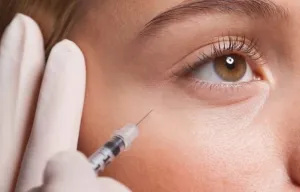







GLP-1 class drugs and other weight loss medications have introduced a new type of consultation in aesthetic medicine. A patient might be completely satisfied with how their body has changed, yet feel disappointed with how their face looks after weight loss. Instead of the expected lightness, other feelings emerge: the face may appear more gaunt, harsher, older, or less harmonious than the person imagined before starting therapy.
This is why the topic of GLP-1 in aesthetic medicine has long surpassed the popular "Ozempic face" cliché. For clinical practice, it's a much more complex story. The doctor deals not with a single external effect but with a combination of changes in several tissue layers: reduction of superficial and deep fat pads, loss of softness in the midface, sharper transitions under the eyes, weaker support in the lower third, neck changes, and often - deterioration of skin quality. This is the clinical situation described by the authors of a publication on non-surgical treatment of the face and neck in GLP-1 patients and an international consensus on aesthetic needs in medication-induced rapid weight loss.
The main change is that after rapid medication-induced weight loss, the doctor evaluates not just a single wrinkle or hollow, but the face and neck as a unified system: volume, support, contours, skin quality, expression, weight stability, and the patient's realistic expectations.
Why GLP-1 has changed the conversation about the face in aesthetic medicine
Faces have always changed after weight loss, but with GLP-1 and similar drugs, doctors are seeing faster, more noticeable, and often uneven changes. Weight loss occurs not only in numbers but also in a person's visual perception. It’s not just the overall volume that decreases, but also tissue support, softness of transitions, and the balance of light and shadow on the face. Because of this, a patient may perceive themselves differently even when they have objectively achieved the desired weight.
It's important to distinguish these changes from normal aging. Age-related changes usually accumulate gradually, and the patient partially adapts to them psychologically. After rapid medication-induced weight loss, the transformation can be more abrupt: the face seems to change faster than the person can get used to the new body. This is why the emotional reaction can sometimes be stronger than with classic age-related changes.
For some patients, the face becomes the main psychological marker of weight loss. A person might be happy with their waistline, silhouette, and overall well-being, but the face starts to raise doubts: has everything changed too drastically, do I now look more tired than before losing weight? For aesthetic medicine, this means a change not only in technical approaches but also in the tone of the consultation itself.
It's no longer enough to simply offer a correction. It's necessary to explain what has happened to the tissues and why the face after weight loss often requires a different logic of assessment than a face with typical age-related changes. The patient needs to understand that changes are not always "unsuccessful weight loss" or a sign of rapid aging. Often, it's an expected consequence of rapid tissue restructuring that can be corrected, but not always appropriately fixed with a single drastic intervention.
The stage at which the patient comes to the doctor is also significant. If a person is just planning medication-induced weight loss, the consultation can be preventive: the doctor explains what changes are possible, what should be documented, and why it's not advisable to rush with corrections until the weight stabilizes. If the patient is actively losing weight, monitoring, assessing dynamics, and very cautious planning become key. If the weight has already stabilized, a more comprehensive plan for restoring volume, skin quality, contour, and facial harmony can be developed.
How exactly do the face and neck change after rapid weight loss
Several typical patterns are repeated in specialized studies. Most often, doctors see a loss of volume in the midface, a flatter midface, sunken temples, deepening under-eye hollows, and sharper transitions in the cheek and nasolabial areas. These changes often create the impression that the face has become harsher, more rigid, or more exhausted. For the patient, this rarely sounds like an anatomical description. They usually say that "the face seems to have sagged," "the softness is gone," "the eyes have become deeper," "the cheeks seem to have sunken."
The temple area can alter the overall contour of the upper third of the face. When the temples become more sunken, the face sometimes looks not just thinner, but more exhausted. The area under the eyes also reacts very noticeably: shadows deepen, the transition between the lower eyelid and cheek becomes more pronounced, creating a tired look. In the midface, volume reduction can make the face less soft and less supported, even if the patient's overall body mass has changed in the desired direction.
Changes in the lower third can be equally important. After rapid weight loss, sagging may increase, the jawline contour may be less defined, and the sense of overall tissue support may decrease. If the neck is added to this, it often starts to visually "reveal" rapid weight loss even more than the area under the eyes or cheeks. Some patients come with a complaint about one area, but upon examination, it becomes clear that the problem is broader: it's not just one area that has changed, but the overall architecture of the face.
An additional layer of the topic is skin quality. The authors emphasize that patients are concerned not only with volume deficiency. They often complain about dullness, texture changes, loss of density, less elastic appearance, and reduced "liveliness" of the skin. The combination of volume loss and skin quality deterioration makes this clinical situation more complex than the standard age-related correction scenario. If the doctor only sees hollows and responds with volume restoration without considering the skin condition, the result may be technically correct but visually incomplete.
It's also important that changes are rarely uniform. One patient may experience more significant changes in the temples and under-eye area, another in the midface, and a third may suffer most in the neck and lower third. Because of this, a patient may focus on the most noticeable point for themselves, while the doctor must see the broader scenario. This is where one of the most important clinical moments arises: a correction plan cannot be built solely around the area the patient first complained about.
During the consultation, it's important for the doctor to assess the face not only at rest but also in expression. After weight loss, some areas may look acceptable in a static position but become more pronounced during smiling, talking, or turning the head. The same applies to the neck: in a straight projection, changes may be moderate, but in profile or movement, they become much more noticeable. This is why photo documentation and careful assessment from different angles become not a formality but a part of proper planning.
Why typical spot correction may not always suit these patients
One of the key points of both publications is that with rapid medication-induced weight loss, the doctor deals not just with local volume loss. Projection, support, contour, light-shadow balance, skin quality, and the perception of the entire face change. This is why spot correction based on "filling the deepest hollow" does not always yield a harmonious result. Sometimes it even enhances disproportions if volume is restored without considering the overall pattern of changes.
Another reason for caution is the instability of the situation. Some patients come when the weight is still decreasing. The face may continue to change, so overly aggressive correction at an intermediate stage may not be appropriate in a few months. This is why professional works emphasize the value of a phased approach. It's not a "weaker" tactic, but a more precise and controlled one. It allows for not rushing with excessive intervention while tissues are still adapting to the new weight.
For these patients, it's especially important not to try to restore the face to its pre-weight loss appearance at any cost. Firstly, it's not always realistic. Secondly, excessive volume restoration can result in an unnatural effect that no longer matches the new body proportions. Thirdly, the patient often wants not a literal "return back," but a fresher, softer, and less exhausted look. These are different goals, and this is what determines the choice of tactics.
Among typical mistakes in such cases are excessive volume restoration where the problem is partly related to skin quality or sagging; correcting one hollow without assessing the entire face; attempting to do everything before weight stabilization; ignoring the neck; and underestimating the patient's expectations. If a person expects to "return to pre-weight loss," and the doctor plans only partial harmonization, disappointment can arise even after a technically high-quality procedure.
The authors describe a combined approach for such cases. It's not about one dominant procedure but a combination of tools depending on what prevails in the clinical picture: volume deficiency, sagging, skin quality deterioration, contour changes, or several problems simultaneously. In this context, fillers, biostimulatory approaches, skin quality procedures, energy-based hardware methods, and sometimes botulinum toxin as part of a broader plan may be considered. The essence is not in the combination itself, but in the fact that the solution is formed from tissues and expectations, not from the doctor's habit of working with one favorite method.
In such a plan, fillers can help with restoring support, softening transitions, and more harmoniously distributing volume. Biostimulatory methods may be appropriate when not only form but also gradual work with tissue quality is important. Energy-based hardware methods are more often considered where sagging, contour, or skin condition come to the forefront. But none of these tools is a universal answer. Each patient will have a different problem ratio.
This is why phased correction seems most appropriate. For some patients, it's advisable to first wait for weight stabilization, for others to start with delicate support and volume restoration, and then move on to skin quality or the neck. For some, the main focus will be on softening transitions in the midface, for others - more restrained overall harmonization without trying to "fill everything." This approach better suits this type of patient than a one-time aggressive correction.
What is important to discuss with the patient and what this topic changes for aesthetic medicine
For this group of patients, consultation is especially important, during which the doctor explains that the face changes after rapid weight loss not only due to "less fat," but because of a complex change in proportions, tissue support, and skin quality. This helps avoid overly simplistic expectations like "add a little filler and give me back my old face."
During the consultation, it's important for the doctor to assess not only the complaint area but the entire dynamics: how quickly the weight was lost, whether it has stabilized, how the face looks at rest and in expression, what's happening with the neck, whether there's sagging, how the skin quality has changed, and how the patient's expectations align with the real possibilities of correction. Such an assessment allows for not confusing a local deficit with a broader change in facial architecture.
It's also useful to discuss the timing logic. If the patient is still actively losing weight, a full correction plan may be premature. If the weight has already stabilized, the doctor can more accurately assess what truly needs correction. If the patient is just starting therapy, it's worth explaining what changes may appear later and why there's no need to panic over every interim change in the mirror. This approach reduces anxiety and makes future correction more conscious.
It's equally important to discuss the limits of the result. For some patients, the best solution will be not maximum correction but more delicate harmonization, which reduces the tired look, softens hollows, and improves skin quality, but does not attempt to completely recreate the pre-weight loss face. This logic appears most mature and clinically honest. It allows for not promising the impossible while not devaluing the person's real discomfort.
The authors also emphasize the value of photo documentation, realistic planning, and careful assessment of the entire face and neck, not just the area the patient first complains about. This is especially important because visually, a person often focuses on the most noticeable hollow or "tired" look, while the real problem is broader and includes overall volume redistribution, loss of support, and skin quality changes.
There are also limits to aesthetic medicine that should not be hidden. Not everything can be solved with injections. Rapid volume restoration is not always the right choice. For some patients, the degree of tissue sagging, neck condition, or the need for other methods, including surgical solutions, may play a significant role. This is why an honest consultation should not only offer options but also explain what a specific method will not achieve.
In conclusion, GLP-1 and rapid medication-induced weight loss have already changed not only metabolic medicine but also daily aesthetic practice. The doctor's task in this situation is not just to "restore volume" and not to try to recreate the former face at any cost, but to help the new face align with the new body mass without overloading with fillers, without excessive correction, and without losing naturalness.