





After rapid or significant weight loss, not only does the volume of the face change, but also the quality of the skin. It may appear thinner, less dense, duller, less elastic, and more "tired," even if the person is generally satisfied with the weight loss results. This is a separate topic in aesthetic medicine: it's not about "restoring volume," but about assessing the condition of the skin, its support, texture, elasticity, and the limits of possible recovery.
This issue should not be reduced to the popular conversation about GLP-1 or the "Ozempic face." A broader picture is described in a systematic review on changes in facial soft tissues after significant weight loss: the authors indicate that massive weight loss can manifest as accelerated facial aging, reduction in fat volumes, and increased skin laxity. For medication-induced rapid weight loss, separate guidelines are provided by the international Delphi recommendations on the aesthetic needs of such patients.
The main change is that after rapid weight loss, the doctor evaluates not just one wrinkle or one hollow, but the skin, face, and neck as a single system: density, elasticity, laxity, texture, facial expressions, weight stability, home care, and the patient's realistic expectations.
Why the quality of the skin changes after rapid weight loss
The skin does not exist separately from the tissues that support it. When weight decreases gradually, the tissues have more time to adapt. When weight loss is rapid or significant, the face and neck can change more abruptly. Not only does the volume decrease, but also the support that maintained smoothness, tension, and soft transitions.
This does not mean that the skin "aged" in a few months. Often, the patient sees a combination of several processes: less subcutaneous support, contour changes, decreased visual density, more noticeable fine lines, and different light distribution on the skin surface. That's why the face may look not just thinner, but more exhausted or less fresh.
It's important to distinguish between two concepts: volume loss and change in skin quality. Volume is responsible for shape, projection, and support. Skin quality is about how it looks up close and in motion: whether it appears dense, smooth, elastic, even, hydrated, and capable of reflecting light well. After weight loss, these issues often occur together, but they are not the same.
This is where a typical expectation error arises. A patient may think that the skin looks worse only due to dryness or "fatigue." But if the changes are related to the loss of tissue support, decreased density, and contour restructuring, regular care may not always restore the previous appearance. It can improve comfort and surface condition but does not replace a comprehensive tissue assessment.
How these changes appear in real life
Patients rarely describe changes in professional terms. They are more likely to say that the skin has become "thinner," "drier," "dull," "papery," "less elastic," "as if tired." Sometimes a person cannot precisely explain what has changed but sees that the face looks less fresh after weight loss, although the figure, on the contrary, looks better.
On the face, such changes can manifest differently. Some may notice dullness and loss of radiance more prominently. Others may see fine lines that were almost invisible before. Another may feel that the skin has become less dense and less able to "hold" soft tissues. The neck area often stands out separately: after weight loss, it may look more lax, even if the face has changed moderately overall.
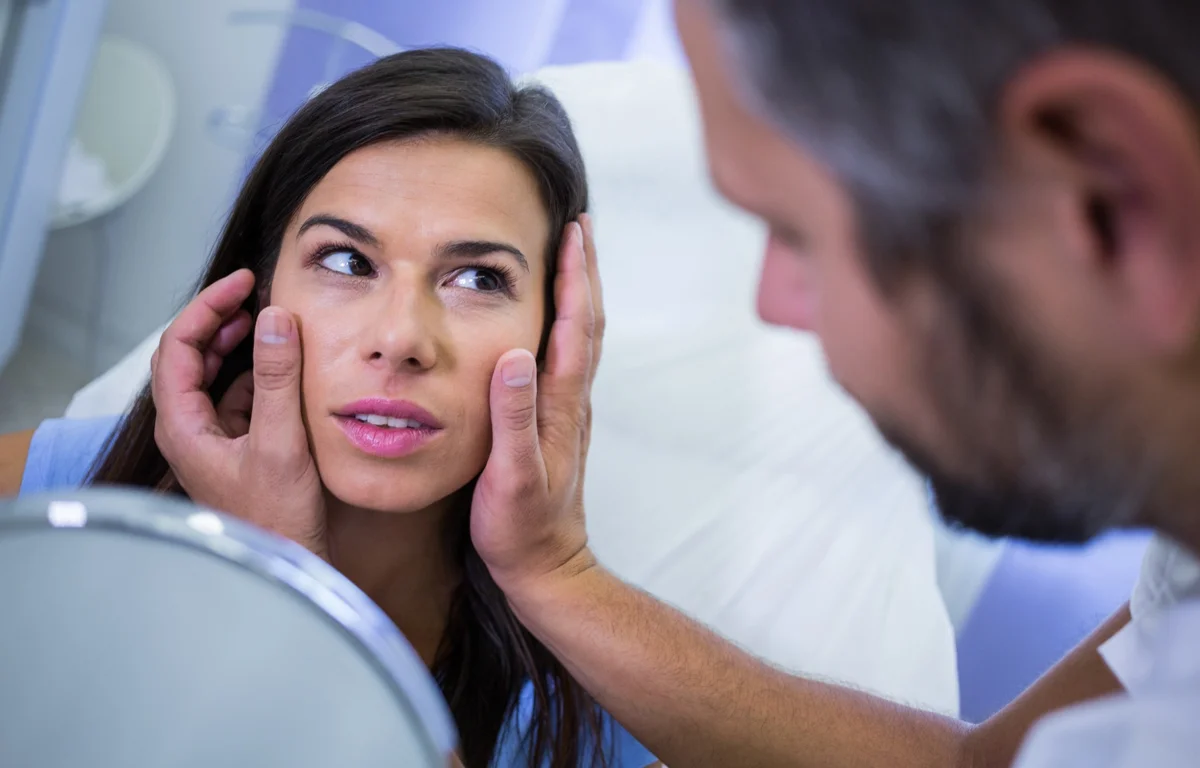
An important detail is that these changes often become more noticeable not in photos with perfect lighting, but in real life: during conversation, smiling, turning the head, tilting the neck, and in daylight. That's why it's not enough for a doctor to look only at a static photo. It's necessary to evaluate the face and neck in motion, from different angles, and considering how the patient perceives the problem.
Another reason why patients find it difficult to accept such changes is the contrast between expectation and result. A person often starts therapy or a weight loss program hoping to look healthier, lighter, younger. When the body indeed changes for the better, but the face or neck suddenly seems older or more tired, an internal conflict arises: the result is there, but the external self-perception has become more complex.
In this context, not only injectable or hardware solutions are important, but also the consultation itself. The doctor needs to understand what exactly bothers the person: dullness, laxity, "empty" appearance, neck, texture change, or the feeling that the skin no longer matches the new body.
Why creams and basic care often do not provide the expected effect
Basic care is important, but its capabilities have limits. Creams, serums, gentle cleansing, sun protection, and barrier restoration can improve skin comfort, reduce dryness, and support a more even surface appearance. But if the problem is related to loss of support, decreased tissue density, and contour changes, only home care often does not provide the result the patient expects.
This does not mean that care "does not work." It works within its area of responsibility. The problem is elsewhere: the patient sometimes expects a cosmetic product to have an effect that requires a completely different level of intervention. If after weight loss the skin looks less dense and more lax, a cream can improve hydration but will not independently restore lost tissue support.
Here, it's important for the doctor to gently manage expectations. One issue is dryness, irritation, and barrier disruption, where care can indeed be key. Another is laxity, texture change, decreased density, contour changes, and the feeling of an "empty" face. This is an area where a broader assessment is needed, and possibly a combination of procedural methods with competent home care.
After rapid weight loss, the logic of "I'll try one more active product" is particularly dangerous. A patient may start overloading the skin with acids, retinoids, or aggressive procedures in hopes of quickly restoring smoothness. But if the skin is already sensitive, thinner, or looks tired, such self-directed activity can sometimes exacerbate irritation and make the appearance even less healthy.
Therefore, basic care after rapid weight loss should not be random but supportive. It's often better to start with simple things: gentle cleansing, barrier restoration, regular sun protection, adequate hydration, gradual introduction of actives. And only then, when the doctor sees the real condition of the skin, can it be decided whether procedures for skin quality, stimulation, densification, or working with laxity are needed.
How a doctor works with skin quality, not volume
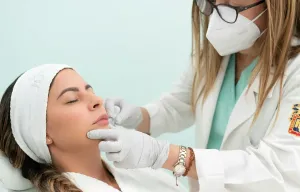
When a patient comes in after rapid weight loss, it's important for the doctor not to rush with an answer. First, it's necessary to understand what exactly has changed: whether the weight has stabilized, how quickly it was lost, which areas are most concerning, whether there is neck laxity, how the skin looks at rest and in motion, whether there is dryness, dullness, texture change, decreased density. Without this, it's easy to confuse the problem of skin quality with the problem of volume or vice versa.
In practice, this means that the consultation should include not only a frontal view of the face. The profile, semi-profile, neck, lower third, under-eye area, temples, surface quality of the skin, its reaction to facial expressions and light are important. Sometimes a patient talks about a "tired appearance," and the doctor sees that the cause is not one hollow, but a combination of dull skin, loss of density, and minor contour changes.
A professional approach in such cases is usually combined and step-by-step. If volume deficit dominates, methods of restoring support may be discussed. If the main problem is skin quality, attention shifts to procedures that work with texture, density, elasticity, and the overall appearance of the surface. If there is pronounced laxity, especially on the neck, energy-based device methods or other approaches aimed at tissue tone may be considered.
Separate publications on correcting laxity after weight loss consider device methods as a possible support tool but not as a replacement for surgery in cases of significant skin excess. For example, pilot data on subdermal radiofrequency technology for laxity after weight loss describe improvements in skin laxity and patient satisfaction, but at the same time emphasize that such an approach does not replace surgical intervention.
One typical mistake is trying to "add" volume where the main problem is skin quality. Another is working only with the surface when the face lacks deeper support. In the first case, the result may look heavy or unnatural. In the second, the patient may achieve better texture but still see a tired appearance in the mirror. That's why the doctor must combine skin assessment with facial architecture assessment, but not mix these problems into one.
Step-by-step approach is especially important if the weight has not yet stabilized. During the active phase of weight loss, too early aggressive correction may quickly become irrelevant. Sometimes it's more correct to support the skin, reduce irritation, improve the barrier, document changes with photos, and return to a fuller plan after weight stabilization. This is not postponing help but a more intelligent tactic.
There are also limits to aesthetic medicine that need to be honestly discussed. Not everything can be solved with injections or device procedures. If there is significant tissue laxity, pronounced neck changes, or skin excess, the patient sometimes needs not "one more procedure for skin quality," but a different level of consultation, including discussing surgical options. This does not diminish the value of non-surgical methods but helps avoid creating false expectations.
The final conclusion is simple: after rapid weight loss, the skin needs not only care but also proper assessment. The doctor must distinguish dryness from loss of density, laxity from volume deficit, texture problems from support changes. Such diagnostics allow for a plan that does not overload the face, does not promise the impossible, and helps the skin look healthier, more vibrant, and in harmony with the new body mass.