







Hair can indeed begin to shed noticeably during treatment with semaglutide or tirzepatide. This is not just patients’ complaints on social media: hair loss was recorded in clinical trials of these drugs, it is listed in the current prescribing information for Wegovy and Zepbound, and 2026 meta-analyses confirm a link between treatment and an increased risk of hair loss.
The most likely explanation is related, at least in part, to the weight-loss process itself. When body weight drops quickly, the body adapts to a sharp change in energy balance. If, due to appetite suppression, a person also starts eating very little, this may be compounded by insufficient protein intake or deficiencies of certain nutrients. Hair growth is not among the processes critically necessary for survival, so some follicles may shift earlier from the active growth phase to the resting phase, and a few months later that hair falls out. This is how telogen effluvium develops — one of the most likely causes of diffuse hair loss after significant or rapid weight loss. At the same time, studies do show an association between hair loss and the use of these drugs, but whether semaglutide and tirzepatide have a separate direct effect on the hair follicle has not yet been established.
What is known about hair loss on GLP-1 drugs
In clinical trials of Wegovy at a semaglutide dose of 2.4 mg, hair loss was reported in 3.3% of participants versus 1% in the placebo group. For Zepbound, the signal was especially noticeable among women: 7.1% versus 1.3% in the placebo group. The official information for both drugs links hair loss to weight reduction.
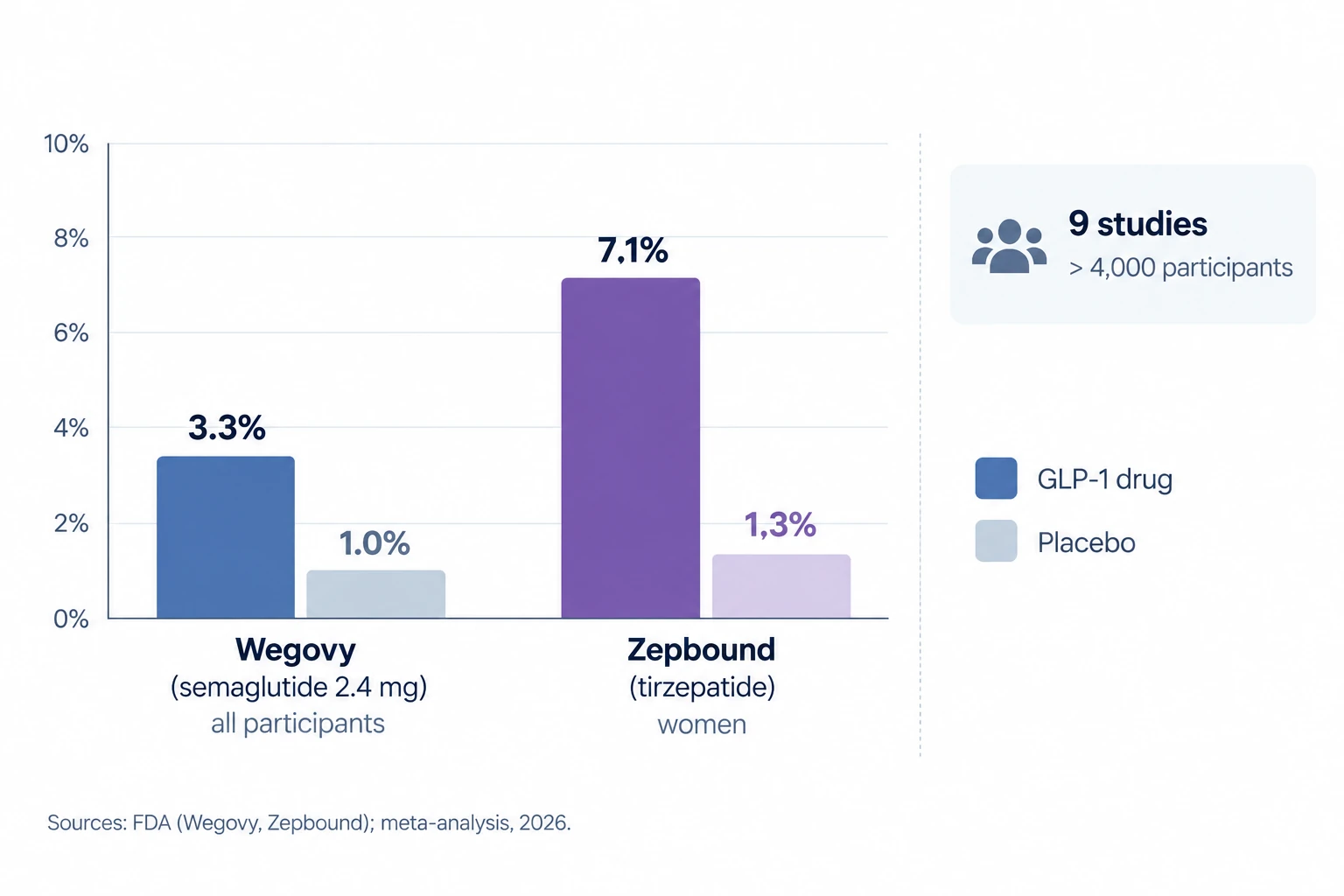
Fig. Hair loss on GLP-1 drugs: clinical trial results
In 2026, pooled data also became available: a meta-analysis of nine interventional studies involving more than four thousand users of GLP-1 drugs showed a statistically significant increase in the risk of hair loss compared with placebo. A large cohort study published the same year also found a higher incidence of non-scarring hair loss with semaglutide and tirzepatide use. Among patients with hair loss, a lower BMI was subsequently observed, which further supports the assumption that greater weight loss plays a role. The association between treatment and hair loss is already quite clear. What remains unresolved is the mechanism: no direct damage to the follicle by semaglutide or tirzepatide has been established, whereas rapid weight loss has long been known as a trigger for telogen effluvium.
Ozempic, Wegovy, and Mounjaro are not the same thing
In everyday speech, different weight-loss drugs are often called “Ozempic,” although this is incorrect. Ozempic and Wegovy contain semaglutide — a GLP-1 receptor agonist. Mounjaro and Zepbound contain tirzepatide — a dual GIP and GLP-1 receptor agonist. Therefore, data on semaglutide and tirzepatide should not be mechanically combined, although people taking these drugs for weight loss do share a common factor — the loss of body mass itself, sometimes quite rapid.
Who may have a higher risk of hair loss
In studies, hair loss has been particularly noticeable with semaglutide and tirzepatide use, and it is reported more often in women. Systematic reviews also discuss a possible association with drug dose and the magnitude of weight loss. However, these factors are closely interrelated: a higher dose may lead to stronger appetite suppression and greater weight loss, while rapid weight loss itself can trigger telogen effluvium.
In practice, this means that not only the name of the drug matters. It is also important to consider how quickly weight is dropping, whether the diet has become too restrictive, and what the person’s hair was like before treatment began. If thinning existed beforehand, telogen shedding may make an already existing problem much more noticeable.
Why hair starts falling out a few months later
A person may be actively losing weight in the spring, yet notice much more hair on the brush only in the summer. Such a delay is typical of telogen effluvium. Most scalp hair is in the active growth phase. After significant physiological stress, some follicles shift prematurely into the resting phase, but the hair shaft remains in place for several more months. Noticeable increased shedding usually begins about two to four months after the trigger. In other words, the hair falling out in large amounts today may be reacting to what was happening in the body two or three months ago.
Telogen effluvium is characterized by diffuse shedding: there is less hair across the entire scalp, without distinct bald patches. The follicles are not destroyed and can return to active growth.
What role nutrition and deficiencies play
GLP-1 drugs reduce appetite, and a person naturally begins to eat less. The problem arises when, along with calorie intake, the nutritional value of the diet also drops too sharply. During active weight loss, it is important to get enough protein and not turn medication-based treatment into an additional crash diet. If, because of appetite suppression, it has become difficult to eat полноценні meals, it is worth discussing with a doctor or dietitian how to get enough protein and other nutrients in a smaller volume of food.
Iron deficiency alone can cause diffuse hair loss and may coexist with telogen effluvium after weight loss. Based on the clinical picture, a doctor may check iron metabolism, thyroid function, or order other tests. A confirmed deficiency needs to be corrected, and inadequate nutrition needs to be improved. Biotin, zinc, iron, and “hair support” complexes are not automatically necessary for every person losing weight on GLP-1 drugs.
How long it lasts and when hair grows back
Acute telogen effluvium lasts less than six months. The period of active shedding often takes about three to six months, after which the amount of falling hair gradually decreases if the triggering factor is no longer present. Density returns more slowly: new hair is short at first, so even after the cycle normalizes, the hairstyle may still look less full for some time. Recovery should be evaluated over months, not weeks.
If intense shedding continues for more than six months, thinning progresses, or the hair shows no signs of recovery, it is worth checking whether there is another or an additional cause.
When the cause may not be GLP-1 drugs and weight loss
Diffuse shedding that begins two to four months after a period of especially rapid weight loss fits the picture of telogen effluvium well. But not every case of hair thinning during treatment has this mechanism.
If the central part gradually widens, the hair becomes finer at the crown, or thinning existed even before treatment began, androgenetic alopecia must be considered. Sudden telogen shedding sometimes simply makes a problem that has been developing for years much more noticeable.
Well-defined round hairless patches are characteristic of other forms of alopecia. Itching, pain, marked redness, inflammation, or significant scaling of the scalp also do not fit the usual picture of telogen effluvium. Other causes of diffuse hair loss include thyroid dysfunction, iron deficiency, recent acute illnesses, surgery, hormonal changes, and certain medications.
When to see a dermatologist
After rapid weight loss, it may be reasonable to observe the hair for a while if shedding is even and its timing matches telogen effluvium. A dermatologist consultation is especially appropriate if:
- distinct hairless patches appear;
- the central part widens or the hair at the crown becomes noticeably thinner;
- there is itching, pain, redness, inflammation, or marked scaling of the scalp;
- intense shedding lasts longer than six months or thinning continues to progress.
In such cases, it is important to determine the type of hair loss, even if the problem happened to coincide in time with the start of treatment with Ozempic, Wegovy, or Mounjaro.
What to do if hair has started falling out
It is worth starting with simple questions: when did the shedding begin, how quickly was weight dropping two to four months before that, has the diet become too restrictive, and is the hair falling out evenly across the whole head. A doctor may order tests if needed, but there is no universal panel designed specifically for “hair loss on Ozempic” — the choice depends on the specific situation.
If GLP-1 treatment is only just beginning, do not try to speed up weight loss further by severely restricting food. Against the background of reduced appetite, it is important to maintain sufficient protein intake and the nutritional value of the diet. If hair was already thinning before treatment began, it makes sense to discuss this with a dermatologist in advance: telogen shedding during rapid weight loss can make pre-existing alopecia more noticeable.
Should you stop Ozempic or Mounjaro
Hair loss by itself does not mean that prescribed treatment must be stopped immediately. If the problem is significant, it is worth evaluating together with a doctor the rate of weight loss, the dose, the drug’s tolerability, and nutrition. In Zepbound clinical trials, no participant in the tirzepatide group discontinued treatment because of hair loss.
If the cause is acute telogen effluvium, the main task is to eliminate or correct the trigger. Minoxidil is used for certain forms of alopecia, but typical acute telogen effluvium does not automatically mean that such treatment is needed. Shampoos, masks, and cosmetic serums can improve scalp condition, reduce breakage, and make hair look visually fuller, but they do not affect the cause of systemic telogen effluvium.
If hair is falling out because of acute telogen effluvium after rapid weight loss, the follicles do not disappear. When the body adapts, nutrition remains adequate, and weight stops dropping too quickly, the hair cycle gradually normalizes. Active shedding stops earlier than previous density returns, so recovery takes several months. If that does not happen, then another or an additional cause should be sought.
Sources
- Cheng P-L, Chang H-C. Glucagon-like peptide-1 receptor agonists and hair loss: A systematic review and meta-analysis. Diabetes Research and Clinical Practice. 2026.
- Viquez Burboa GU, Flores Guillén MAR, Duardo González VS. GLP-1 Receptor Agonists and Alopecia: A Systematic Review and Meta-Analysis of Incidence, Risk, Subtypes, and Mechanisms. Skin Appendage Disorders. 2026.
- Gupta AK, Teasell EM, Economopoulos V, Mirmirani P. GLP-1 therapies and hair loss: A systematic review of current evidence and implications for counseling. Science Progress. 2026.
- Branyiczky MK, Lowe MS, McMullen E, Donovan J, Khosravi-Hafshejani T. Effects of GLP-1 Receptor Agonists on Hair Loss and Regrowth: A Systematic Review. International Journal of Dermatology. 2026.
- U.S. Food and Drug Administration. Wegovy (semaglutide) prescribing information.
- U.S. Food and Drug Administration. Zepbound (tirzepatide) prescribing information.
- DermNet. Telogen effluvium.
- American Academy of Dermatology. Do you have hair loss or hair shedding?