






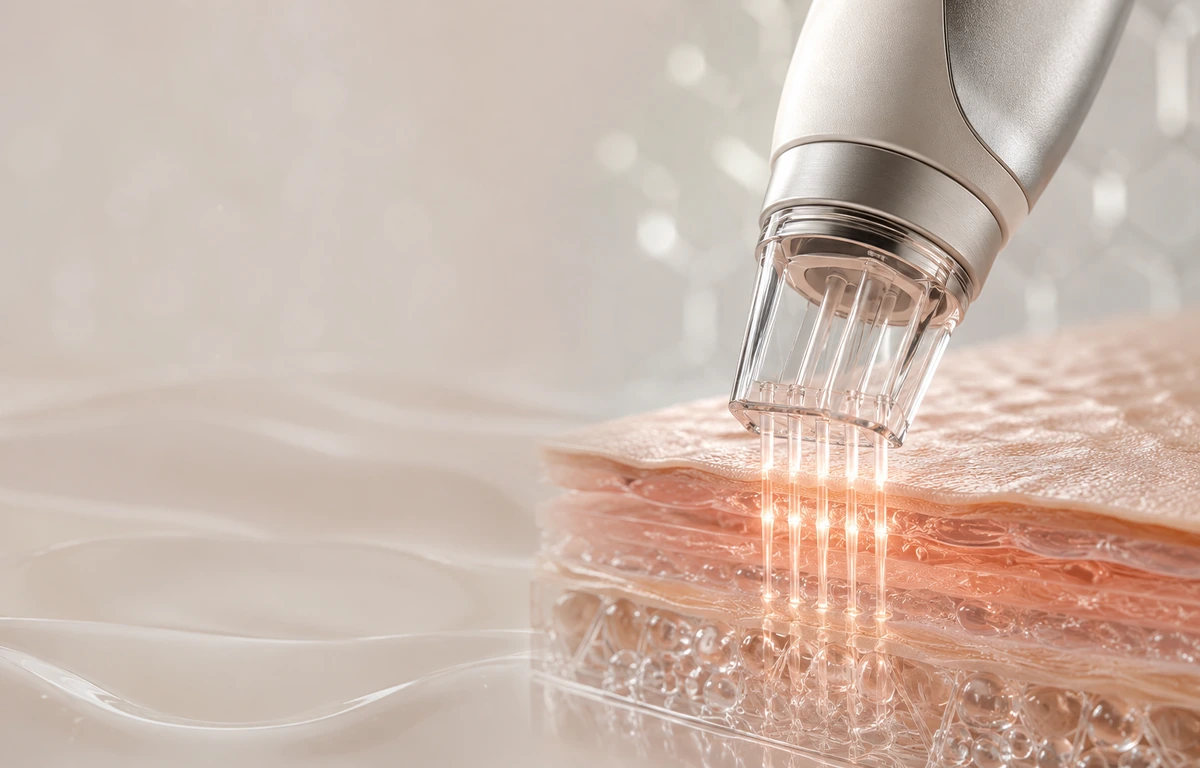
Fractional laser resurfacing is often described as if the device literally erases the old surface of the skin and creates a new one in its place. The word “resurfacing” itself supports this idea: uneven areas can supposedly be removed layer by layer, scars can be smoothed out, wrinkles eliminated, and signs of sun damage left in the past.
In reality, the procedure works in a more complex way. The laser does not polish the skin like an inanimate material and does not mechanically remove all changes. It creates controlled microscopic zones of injury, with areas of intact tissue preserved between them. The final result then depends on how the skin heals, remodels collagen, and restores its surface.
This is a medical procedure with real potential, but also with pain, downtime, and a risk of complications. That is why the choice should begin not with the name of the laser, but with diagnosis of the problem, assessment of phototype, barrier condition, and a realistic understanding of what can actually be changed. We discussed the general logic of this choice in the article “Aesthetic medicine: how to navigate methods, safety, and realistic expectations”.
How fractional laser resurfacing works
What “fractional” means
A fractional laser does not treat the entire surface as one continuous field. It creates a large number of microscopic columns of thermal impact in the skin. Between them remain areas of tissue that have not directly received the same level of exposure.
This principle differs from traditional full-field laser resurfacing, in which virtually the entire surface of the selected area was treated. The preserved gaps help the epithelium recover from the edges of the microzones and usually shorten the healing period compared with full-field ablation.
“We introduce and clinically investigate a new concept for cutaneous treatment — fractional photothermolysis.”
This first study formulated the basis of the method: creating an array of microscopic zones of thermal injury instead of uniformly traumatizing the entire surface.
Ablative and non-ablative effects are not the same
The term “fractional laser” may refer to fundamentally different procedures. An ablative laser vaporizes microscopic columns of tissue and leaves open channels surrounded by a zone of thermal impact. This is how fractional CO₂ and Er:YAG systems work.
A non-ablative fractional laser heats and coagulates tissue at depth but does not remove the surface layer at every treatment point. After such treatment, the skin also undergoes an inflammatory and repair response, but the surface injury is usually milder.
Ablative resurfacing can potentially produce a more pronounced improvement in skin texture, but at the cost of more noticeable recovery. Non-ablative systems often require a course of procedures and produce a more subtle result, but they may be more acceptable for someone who is not prepared for prolonged redness, swelling, and crusting.
What happens to the skin after a pulse
At the treatment site, part of the tissue is removed or coagulated, depending on the type of laser. Around this zone, a controlled inflammatory response is triggered. Keratinocytes restore the surface, while healing processes and remodeling of the extracellular matrix are activated in the dermis.
Collagen fibers may partially contract under the influence of heat, but the main result does not occur at the moment of the procedure. Over the following weeks and months, the collagen structure, fiber organization, and properties of scar tissue change. This is why objective improvement may continue to develop after the surface has already healed.
Schematically, this process can be shown as a sequence: the laser creates separated microzones of impact, the surface is restored from the surrounding tissue, and gradual remodeling occurs in the dermis.
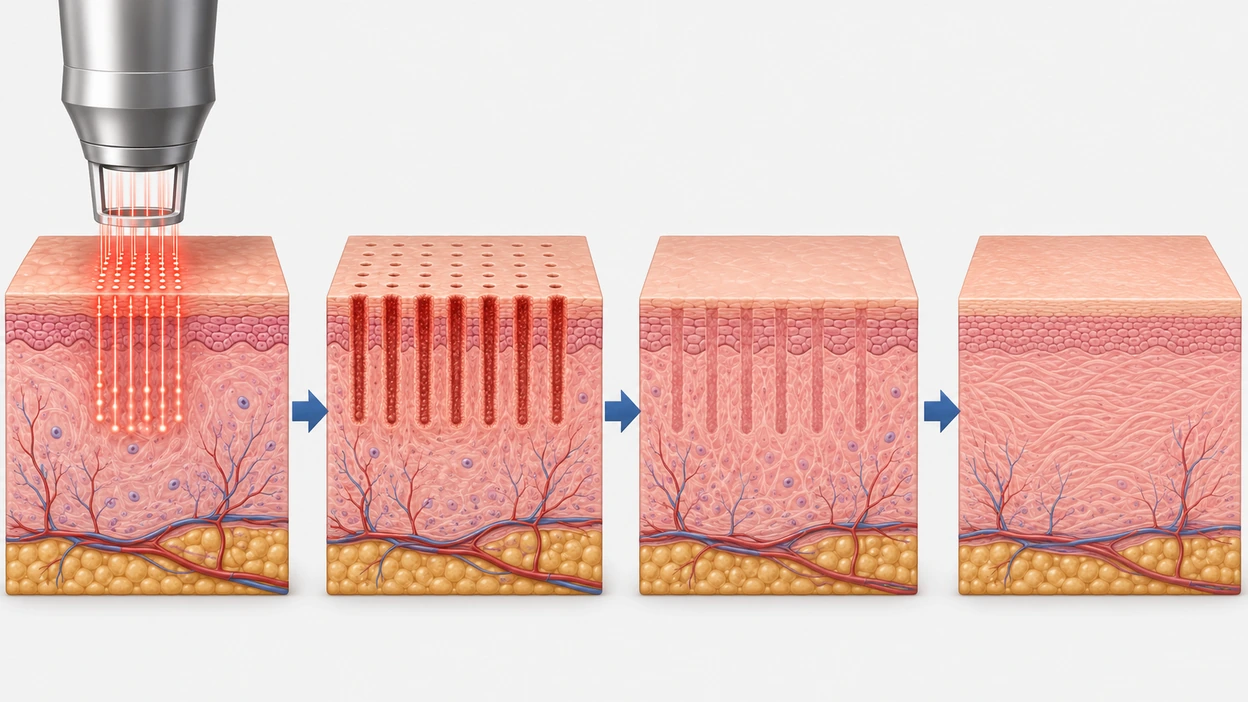
The diagram does not mean that every pulse always reaches the same depth or that recovery follows a universal scenario. The result is influenced by wavelength, energy, pulse duration, coverage density, number of passes, anatomical area, and the healing capacity of the individual skin.
What fractional laser treatment can genuinely improve
Atrophic acne scars
Fractional laser resurfacing has one of its most convincing applications in atrophic post-acne scars. It can soften the sharpness of the edges of individual defects, improve overall texture, and make the transitions between scarred and surrounding tissue less noticeable.
However, post-acne scarring is not one single type of scar. Rolling shallow scars, broad depressions with relatively defined edges, and narrow deep defects have different structures. If the surface is tethered by deep fibrous bands, laser remodeling alone may not be enough. If the defect is very narrow and deep, energy distributed over a large surface area may not always affect its base.
For this reason, laser treatment may be the main method, part of staged therapy, or not the first choice at all. In some cases, it is combined with subcision, focal chemical techniques, injectable correction, or other device-based procedures.
Radiofrequency microneedling may be an alternative or an adjunct. It has a different mechanism, a different recovery profile, and a different balance between effectiveness and pigmentation risk. This issue is discussed in more detail in the publication “RF microneedling: effectiveness, risks, and the limits of safe use”.
Photodamage, uneven texture, and fine wrinkles
Fractional lasers can improve roughness, fine wrinkles, surface irregularity, and some manifestations of chronic sun damage. Ablative resurfacing simultaneously renews part of the epidermis and triggers dermal remodeling, so the result may involve not just one parameter but the overall quality of the skin surface.
At the same time, a laser does not reposition descended fat pads, restore weakened ligaments, or remove significant excess skin. A person may see a more even, smoother, and denser surface, but this is not the same as a surgical lift.
This is where it is especially important to distinguish improvement in skin quality from a change in the anatomical position of tissues. We wrote about why even an effective procedure has limits in the article “The limits of cosmetic methods: where and why the effect ends”.
Traumatic, postoperative, and burn scars
Fractional lasers are used not only for aesthetic rejuvenation. They can help with some traumatic, postoperative, and burn scars by affecting their density, firmness, texture, and tissue mobility.
In this case, the goal is often not the complete disappearance of the mark. A realistic result may be softening of the scar, reduced tightness, improved elasticity, or a less noticeable transition between scarred and healthy skin.
The choice of parameters depends on whether the scar is atrophic, hypertrophic, retracted, dense, or functionally limiting. The same procedure name does not mean the same protocol for post-acne scars and a burn scar.
Can scars or wrinkles be removed completely?
Fractional laser resurfacing does not guarantee complete removal of scars, pores, wrinkles, or pigmentary changes. Its realistic goal is to reduce the severity of a specific problem within the limits allowed by its depth, structure, and the skin’s capacity for repair.
A course of treatments or a combination of methods is often needed. At the same time, more procedures do not always mean a proportionally better result. After each stage, it is important to assess not only improvement, but also the duration of redness, the pigmentary response, the condition of the barrier, and whether the next procedure remains clinically justified.
CO₂, Er:YAG, and non-ablative lasers: what is the difference?
Fractional CO₂ laser
The CO₂ laser operates at a wavelength of 10,600 nm, which is strongly absorbed by water in tissues. It creates microscopic ablation and a noticeable surrounding zone of thermal coagulation.
This residual thermal effect may contribute to pronounced dermal remodeling. But it also means a higher risk of prolonged redness, swelling, post-inflammatory hyperpigmentation, and unwanted scarring when parameters are excessive or when treatment is performed in sensitive areas.
CO₂ is not automatically the “best” laser simply because it can work more aggressively. Its advantage makes sense when a potentially stronger effect matches the clinical objective and the patient is prepared for the corresponding recovery.
Fractional Er:YAG laser
Er:YAG operates at a wavelength of 2940 nm and also interacts mainly with water. Its energy is absorbed very superficially, which allows small volumes of tissue to be removed more precisely and, in certain modes, leaves a smaller zone of residual heating.
This may mean a shorter or easier recovery compared with intensive CO₂ resurfacing. However, Er:YAG should not automatically be considered a weak procedure. Modern systems can vary the depth of ablation, the coagulation component, and the coverage density, so the actual effect depends not only on the name of the wavelength.
Non-ablative fractional systems
Non-ablative lasers leave the surface relatively intact and create microzones of coagulation within the tissue. Recovery after them is usually easier, but for pronounced atrophic scars or deeper changes, more sessions may be needed and the result may be more modest.
A non-ablative method may be a reasonable choice for someone who is not ready for open surface injury, has an increased risk of prolonged recovery, or needs a gradual approach. However, “without ablation” does not mean “without inflammation” or “without pigmentation risk.”
A real comparison: two halves of one face
In one randomized study, 24 participants with atrophic post-acne scars had one side of the face treated with fractional Er:YAG and the other with fractional CO₂. Each participant effectively served as their own control, so individual differences between different people had less influence on the outcome.
After six months, more than 50% improvement was recorded in 55% of the areas treated with Er:YAG and in 65% of the areas treated with CO₂. No statistically significant difference in clinical outcome was found between the systems, but CO₂ caused greater discomfort during the procedure.
This example clearly shows why the choice should not be reduced to the formula “a stronger laser means a better result.” In this particular study, effectiveness was comparable, while tolerability differed.
Recovery, pigmentation, and real complications
What normal recovery looks like
After ablative resurfacing, the skin may be red, swollen, moist, or covered with fine crusts. Burning, tightness, and increased sensitivity are possible. As the surface recovers, dryness and peeling appear, and a pink hue sometimes persists longer than the visible surface damage.
After non-ablative treatment, the reaction is usually milder, but redness, swelling, a sensation of heat, dryness, and temporary darkening of pigmented areas may also occur.
The recovery period cannot be accurately determined by the words “CO₂” or “Er:YAG” alone. It depends on the mode, energy, density, number of passes, treatment area, and individual response.
Why phototype changes the balance of benefit and risk
A darker phototype is not an automatic contraindication to fractional resurfacing. However, any controlled injury can trigger post-inflammatory hyperpigmentation, and this risk is higher in skin with a more active pigmentary response.
In one randomized study, 25 Asian patients had one side of the face treated with a fractional CO₂ laser and the other with a fractional picosecond laser. Both sides showed improvement in atrophic scars, but mild post-inflammatory pigmentation occurred in six participants — 24% — only on the CO₂-treated side.
This does not mean that CO₂ cannot be used in darker phototypes. The study shows something else: the same aesthetic goal can be addressed with methods that have different pigmentation-risk profiles, and this difference should be discussed before the procedure.
Tanning, active inflammation, unstable pigmentation, aggressive parameters, and insufficient ultraviolet protection can further worsen the prognosis.
A real case series: five patients with neck scarring
In 2009, a group of physicians described five patients who underwent ablative fractional CO₂ resurfacing of the neck for signs of photodamage. One to three months after the procedure, they were referred to the authors with hypertrophic scarring.
This is an important story precisely because fractional technology was already perceived at that time as safer than traditional full-field resurfacing. However, preserving intact areas did not eliminate the risk of excessive trauma.
The skin of the neck differs from facial skin in having fewer structures from which the epithelium can quickly regenerate, and it has a different healing potential. Parameters that are acceptably tolerated in one area cannot simply be transferred mechanically to another.
The authors emphasized caution when treating the neck, early recognition of problems, and careful wound care. In some patients, timely treatment helped improve the condition of the scars, but the very possibility of such a complication was entirely real.
A real case: lower eyelid injury and ectropion
Another publication from the same year analyzed four cases of scarring after fractional CO₂ resurfacing of the face or neck. In one case, the patient developed erosions and swelling of the lower eyelid just two days after the procedure. The injury healed with scarring and outward turning of the eyelid — ectropion.
The authors associated such complications with excessively aggressive treatment in sensitive areas, including excessive energy, density, or a combination of the two. This case does not prove that any laser treatment near the eyes will end in a problem. It shows how small the difference can be between controlled injury and trauma in areas where tissues are thin and scar contraction can alter the position of the eyelid.
Which signs should not be called normal healing
A normal reaction should gradually subside. Increasing pain, spreading redness, purulent discharge, an unpleasant odor, blisters, areas that do not close for a long time, sharply demarcated darkening or blanching, pronounced swelling around the eyes, and a change in eyelid position require medical assessment.
Likewise, one should not wait at home if vision worsens, severe eye pain develops, fever occurs, or the general condition deteriorates rapidly. Early medical attention does not guarantee that a complication will disappear without a trace, but it may reduce its severity.
The U.S. Food and Drug Administration lists pain, infection, scarring, changes in skin color, and incomplete resolution of the problem among the general risks of laser surgery. This is an important reminder: the absence of a scalpel incision does not make laser resurfacing an ordinary skincare service.
How to understand whether fractional resurfacing is right for you
A good consultation does not start with choosing a device
First, it is necessary to determine what exactly is creating the visible problem. A scar may be superficial or deep, have sharp edges, be tethered by a fibrous band, or be combined with active acne. A wrinkle may be a superficial textural change, the result of facial expression, volume loss, or excess skin.
Only after that does it make sense to discuss wavelength, ablative or non-ablative mode, coverage density, number of procedures, and alternatives.
The specialist should know about previous laser and injectable procedures, herpes outbreaks, a tendency to form keloids or hypertrophic scars, impaired healing, active dermatological diseases, and medications. Recent use of systemic isotretinoin also requires separate discussion, taking into account current data and the instructions for the specific device.
Which questions help assess a clinic
A patient should know the exact name of the device and the type of laser, but that is not enough. Much more important is whether the specialist can explain which tissue is the target, why a particular mode was chosen for this area, what result is realistic, and what plan is in place in case of slow healing, pigmentation, or infection.
Home care, sun protection, products permitted during recovery, and how to contact the clinic after the procedure should be discussed separately. An instruction sheet handed out after payment is no substitute for the ability to obtain a prompt medical assessment if a suspicious reaction occurs.
Laser or RF microneedling?
Both procedures create controlled injury and trigger remodeling, but they do so in different ways. Laser energy interacts with optical targets, while RF microneedling delivers heat through electrodes inserted into the tissue.
Fractional CO₂ can produce more pronounced texture improvement in some atrophic scars, but it is often accompanied by more noticeable downtime and depends on the skin’s pigmentary reactivity. RF microneedling is sometimes chosen because of a shorter recovery period or a different risk profile, but it is also not universally safe and does not affect all types of scars equally.
The right question is not “which procedure is better in general,” but “which mechanism predominates in my problem, and what balance of effectiveness, recovery, and risk is acceptable for me?”
What result can you expect?
Fractional laser resurfacing can make the skin more even, soften individual scars, reduce fine wrinkles, and improve signs of photodamage. It does not create completely new skin, erase all scars, or replace a lift in cases of significant tissue laxity.
The result depends not only on the device. It is shaped by the type of defect, procedure parameters, anatomical area, phototype, previous interventions, post-procedure care, and the biological response of the tissues. This is why the same protocol may produce different effects in different people — this professional issue is explored in more detail in the article “Why cosmetology resists simplification: a professional perspective”.
A good result does not necessarily have to be dramatic. Sometimes the right outcome is a less sharply defined texture, softer transitions, improved skin surface quality, and a scar that no longer draws attention first. A professional approach is not about making the impact as strong as possible, but about achieving sufficient improvement without unjustified risk.
This material is for informational purposes only and does not replace a medical consultation, individual assessment of indications, or review of the instructions for the specific laser equipment.