

Microneedling is used to improve post-acne scars, fine lines, and uneven skin texture. The method is based on controlled injury to the dermis, which triggers repair processes and remodeling of the collagen matrix. However, different aesthetic concerns do not respond to this type of stimulation in the same way.
The best-studied outcome of classic microneedling is improvement in the appearance of atrophic acne scars. Clinical data also support a reduction in fine lines and changes in skin elasticity. For pronounced skin laxity and enlarged pores, the evidence is much more limited.
Classic microneedling should also be distinguished from RF microneedling. Both procedures use needles, but radiofrequency technology additionally heats the tissue. This changes both the nature of the effect and the risk profile.
What is microneedling and how does it work?
Microneedling, or microneedle therapy, is a procedure in which a specialized device creates multiple microchannels in the skin using fine needles. Their depth and density depend on the treatment area, the condition of the skin, and the goal of treatment.
These microchannels trigger a wound-healing response. Signaling molecules are activated in the tissue, and the activity of fibroblasts — the cells that produce components of the extracellular matrix — changes. This is followed by the synthesis of new collagen fibers and gradual remodeling of the dermal structure.
For example, an atrophic scar forms where tissue has healed after inflammation with a deficit of structural components. Dermal remodeling can partially improve the architecture of this area and make the depression less noticeable. A similar mechanism underlies the correction of fine lines associated with age-related skin changes.
Dermapen, Dermaroller, and other devices: what is used for the procedure?
Microneedling can be performed with rollers, stamping devices, and motorized pen-like devices.
Dermaroller is a roller with needles that is moved across the skin. As it rolls, the needles enter the tissue at a changing angle. Such devices were used in many early clinical studies.
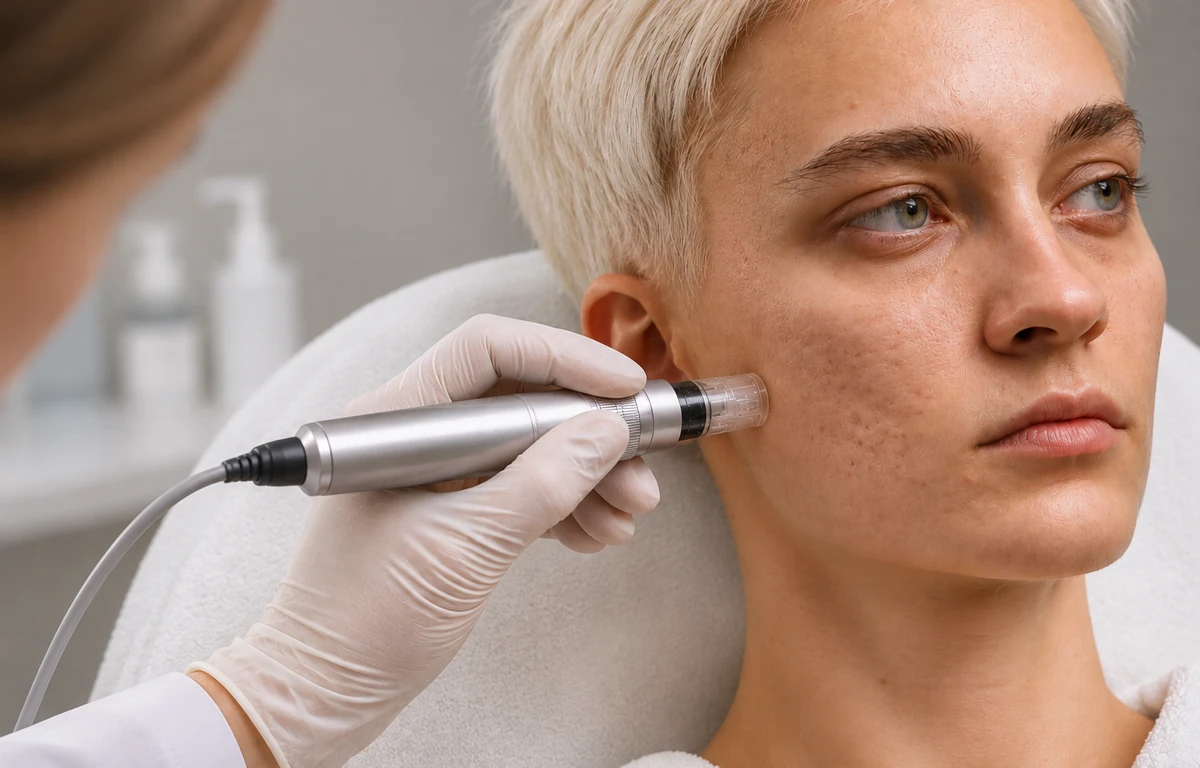
Dermapen is a common name for pen-like motorized devices in which the needles move rapidly back and forth. In many models, the penetration depth can be adjusted, allowing treatment to be adapted to different anatomical areas.
What does microneedling help with: effectiveness according to research
Post-acne scars: the most evidence-based use
Atrophic acne scars develop when inflammation damages tissue and healing is accompanied by collagen loss and the formation of depressions. Microneedling is used to stimulate dermal remodeling in these areas.
In 2014, JAMA Dermatology published a randomized study on the effectiveness of a standard microneedle roller for post-acne scars. Twenty participants with scars on both sides of the face were randomly assigned one side for treatment. The other side served as a control. Three procedures were performed at two-week intervals, and the results were assessed using standardized photographs at three and six months.
Fifteen participants completed the study. After six months, scar severity on the treated side had decreased to a statistically significant degree, while no meaningful changes were found on the control side. On average, the participants themselves rated the improvement in scar appearance at 41%. Independent assessment of the photographs confirmed clinical improvement after mechanical microneedling without radiofrequency heating or additional procedures.
In 2016, researchers compared conventional microneedling with a non-ablative fractional 1340 nm erbium laser. The randomized trial included 46 patients with atrophic post-acne scars. Each group received three procedures at monthly intervals.
Two and six months after treatment, scar severity decreased in both groups. No statistically significant difference was found between them. Redness after laser treatment lasted an average of three days, compared with about one day after microneedling. Post-inflammatory hyperpigmentation was recorded in 13.6% of participants in the laser group; no such cases occurred in the microneedling group.
The study confirmed the effectiveness of both methods under the protocols used, but it did not establish their equivalence. For patients, an important finding was that recovery after microneedling was shorter.
Which post-acne scars respond best to microneedling?
Atrophic scars differ in shape, depth, and the way they are attached to surrounding tissues. This affects the choice of treatment.
| Scar type | Features | Potential of microneedling |
| Shallow boxcar | Shallow depressions with well-defined edges | May improve texture through dermal remodeling |
| Deep boxcar | Deeper defects with pronounced edges | The effect is usually more limited; other methods may be needed |
| Rolling | Broad, wave-like depressions, sometimes with fibrous attachments | May improve texture, but does not always correct mechanical tethering |
| Ice-pick | Narrow, deep scars that taper downward | Conventional microneedling is often insufficient for noticeable correction |
In shallow boxcar scars, dermal remodeling can reduce the contrast between the depression and the surrounding skin.
Rolling scars are often held down by fibrous bands that connect the dermis to deeper tissues. Microneedling does not provide targeted release of these bands, so in cases of pronounced tethering, subcision — mechanical release of the scar — is used.
For narrow, deep ice-pick scars, localized methods such as TCA CROSS are more often considered. In patients with mixed scar types, different areas of the face may require different procedures.
Fine lines and photoaging: does microneedling have a rejuvenating effect?
Age-related changes in the dermis are associated with remodeling of collagen and elastic fibers. Ultraviolet radiation accelerates these processes, contributing to the appearance of fine lines, uneven texture, and reduced firmness.
In a study published in Aesthetic Surgery Journal in 2021, 35 participants underwent four monthly sessions of classic microneedling on the face and neck. Instrumental measurements and microbiopsies were used to assess skin condition.
Three months after completion of the course, facial skin elasticity had increased by 28.2% from baseline. Changes in tissue density parameters and increased expression of genes associated with type III collagen and elastin were also recorded.
A related publication from the same research program presented clinical wrinkle assessments after the same treatment course. The researchers found improvements on photographic scales. In total, 93.8% of participants reported an improvement in the appearance of wrinkles, and 87.5% were satisfied with the result.
It should be noted that these are results from a single research program without a control group, funded by the equipment manufacturer. Therefore, they demonstrate the potential of the method for correcting fine lines, but do not allow the exact size of the effect to be determined compared with no treatment.
Enlarged pores and uneven skin texture
The visibility of pores depends on the structure of pilosebaceous follicles, sebaceous gland activity, heredity, and the condition of the surrounding tissue. When uneven microrelief is combined with small atrophic defects or photoaging, dermal remodeling after microneedling may make the skin surface appear smoother.
However, there are few convincing studies demonstrating an objective reduction in pore size after classic microneedling. If pore visibility is mainly related to excess sebum production, comedones, or active acne, treatment of these conditions is the basis of correction.
Skin laxity and loss of firmness
Microneedling can affect the structure of the dermis and its mechanical properties, but an improvement in skin elasticity is not the same as a facial lifting effect.
Cheek descent, jowl formation, and changes in the facial contour are also related to the distribution of subcutaneous fat, the ligamentous support system, and deeper anatomical structures. Microneedling does not remove significant excess skin and does not reposition descended tissues. When these changes are present, other correction methods should be evaluated.
Microneedling or RF microneedling: what is the difference?
Classic microneedling and RF microneedling both use needles to affect the skin, but they work according to different physical principles.
Classic microneedling creates mechanical micro-injuries that trigger healing processes and dermal remodeling.
RF microneedling additionally delivers radiofrequency energy through needle electrodes. This produces localized heating in the tissue, the nature of which depends on the device design and selected settings.
| Criterion | Classic microneedling | RF microneedling |
|---|---|---|
| Mechanism of action | Mechanical microchannels | Microchannels and radiofrequency heating |
| Post-acne scars | Randomized studies of effectiveness are available | Individual studies of RF technologies are available |
| Fine lines | May improve their appearance | Combines mechanical remodeling with a thermal effect |
| Skin firmness | May improve certain dermal properties | Additional thermal effect is used to address changes in firmness |
| Recovery | Usually several days of redness and sensitivity | Depends on the settings and intensity of heating |
| Risks | Infection, pigmentary changes, skin injury, scarring | Burns and damage to deeper tissues are also possible |
When is classic microneedling chosen, and when is RF used?
For the correction of atrophic post-acne scars, classic microneedling has its own evidence base. If the goal of treatment is to improve skin texture, the use of radiofrequency energy is not mandatory.
RF microneedling is also used for scars and age-related changes, but its advantage should be assessed for the specific indication and device.
In October 2025, the FDA reported serious complications associated with certain uses of RF microneedling: burns, scarring, loss of subcutaneous fat, nerve damage, and tissue deformities. This warning applies to radiofrequency devices.
Read more about the technology in the article “RF microneedling: effectiveness, risks, and limits of safe use”. We have also explained who RF microneedling is suitable for and which complications require medical attention.
How is the microneedling procedure performed?
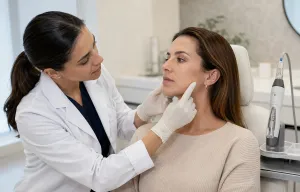
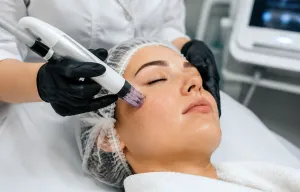
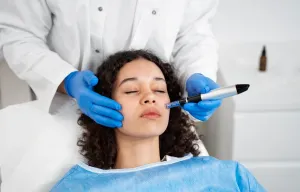
Before the procedure, the specialist assesses the condition of the skin, the type of scars or age-related changes, the presence of active inflammation, and contraindications. The skin is cleansed and treated with an antiseptic. If needed, local anesthesia is applied, after which microneedling is performed using a sterile single-use tip.
The depth and intensity of treatment are selected according to the anatomical area and treatment goal. For example, treating atrophic scars on the cheeks differs from working on the thin skin around the eyes.
During the procedure, patients may feel tingling, pressure, or burning. After treatment, the skin usually becomes red and sensitive, and pinpoint bleeding may sometimes occur.
A new sterile cartridge is used for each session. Reusing needle tips, even after cleaning, creates a risk of transmitting infections.
How many microneedling sessions are needed and when are results visible?
Microneedling is usually performed as a course of procedures because dermal remodeling occurs gradually.
Different protocols have been used in clinical studies. Alam and co-authors performed three procedures at two-week intervals, Cachafeiro and co-authors performed three procedures once a month, and the Wamsley research program used four monthly sessions.
The number of procedures depends on the indication and the initial condition of the skin. The first few days after a session are not suitable for evaluating effectiveness: temporary swelling may create the impression of a smoother surface, while structural changes develop over the following weeks and months.
Photographs taken with the same lighting and facial position are useful for comparing results. In post-acne scars, it is especially important that the lighting makes it possible to see the depth of the depressions.
Recovery after microneedling: how to care for the skin
The most common post-procedure reactions are redness, moderate swelling, dryness, tightness, and increased sensitivity. Small crusts or peeling may sometimes appear. These reactions usually subside within a few days.
During healing, gentle cleansing and products recommended by the specialist are used. Scrubs, acids, retinoids, and other irritating ingredients are temporarily avoided. The timing for returning to a regular skincare routine depends on the intensity of the procedure and the condition of the skin.
Active sun exposure must be avoided. The return to regular sunscreens should be discussed with the specialist, taking into account the recovery of the skin barrier.
Caution is needed when applying concentrated serums and topical products. After microchannels are created, the barrier properties of the skin change temporarily, so products that are well tolerated on intact skin may cause irritation or unwanted reactions.
The use of PRP and PRF during microneedling has separate protocols and its own evidence base. We discussed them in the article “Microneedling with PRP and PRF: what is known about effectiveness and limitations”.
Risks, complications, and contraindications
The most common adverse reactions after microneedling are temporary redness, swelling, tenderness, and peeling. Bruising and small crusts may also occur. Less commonly, infections, persistent pigmentary changes, herpes reactivation, or scarring may develop.
The procedure is postponed in the presence of active skin infections, herpetic eruptions, or damaged or inflamed areas. In active inflammatory acne, the condition must first be brought under control.
Individual assessment is required for patients prone to keloid scarring, those with blood clotting disorders, immunosuppression, uncontrolled diabetes, and conditions that impair healing. The specialist should also know about the use of anticoagulants, systemic isotretinoin, and other medications that may affect the course of the procedure.
For patients who are using or have recently used isotretinoin, the decision is made individually. Current research has called into question a universal six-month ban on all dermatologic procedures, but safety depends on the type of intervention and the condition of the skin.
In people with darker phototypes or a tendency toward post-inflammatory hyperpigmentation, proper parameter selection and photoprotection are especially important.
When should you see a doctor after the procedure?
Normal recovery is accompanied by a gradual decrease in redness, sensitivity, and swelling. If pain worsens, redness increases, or purulent discharge, blisters, pronounced weeping, or fever develops, medical evaluation is needed. These symptoms may indicate an infection or another complication.
Can microneedling be done at home?
Home dermarollers and pen-like devices may look similar to professional equipment, but their effect depends on their design and the actual depth of needle penetration. Superficial devices that act mainly on the stratum corneum of the epidermis do not produce the same effect on the dermis that has been studied in clinical trials for the treatment of scars and wrinkles.
Attempts to perform deeper microneedling on your own increase the risk of uneven injury, infection, pigmentary changes, and scarring. Reusing insufficiently sterile tips and applying products after puncturing the skin that are not intended for this use are especially dangerous.
The FDA has not authorized over-the-counter sale of medical devices for deep microneedling at home in the United States. For correction of scars and wrinkles that requires controlled action on the dermis, you should consult a qualified specialist.
Who is microneedling suitable for, and when should another method be chosen?
Classic microneedling has the most convincing clinical data for the correction of atrophic post-acne scars. It may also improve fine lines and skin texture, although the evidence base for rejuvenation is less well defined.
The nature of the defect is critical. A shallow atrophic scar can be improved through dermal remodeling. If the scar is held down by fibrous bands, these attachments need to be addressed. If the problem is related to tissue descent or volume loss, collagen stimulation alone is not enough.
Therefore, before choosing microneedling, RF, laser treatment, or subcision, it is more important to determine the nature of the skin changes than to compare device specifications. Correct diagnosis determines whether the chosen procedure can deliver the result the patient expects.