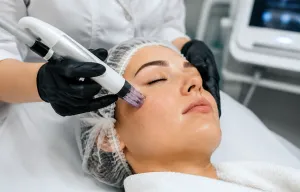







The morning after RF microneedling, the face may be red, swollen, and sensitive. For someone undergoing the procedure for the first time, this reaction can easily look like a complication. But a real problem does not always start dramatically either. Sometimes the first warning sign is pain that does not subside but intensifies, a grid-like imprint from the tip that does not fade, or a new hollow that becomes visible only after the swelling goes down.
That is why recovery is best assessed not by a single symptom, but by how it changes over time. A normal reaction may look unattractive, but it gradually subsides. If the condition worsens or new symptoms appear in addition to the initial ones, waiting is no longer a safe strategy.
Short answer: Common short-term side effects after RF microneedling may include even redness, moderate swelling, sensitivity, dryness, and small scabs during the first few days. Blisters, weeping, severe or increasing pain, pus, prolonged numbness, muscle weakness, a persistent imprint from the device tip, or new tissue hollows require medical assessment.
We discussed how the method works and how risk depends on depth, energy, and anatomical area in detail in the article “RF Microneedling: Effectiveness, Risks, and the Limits of Safe Use”. We also separately covered who RF microneedling is suitable for and how patients are selected.
The diagram below shows why the consequences of RF microneedling can vary. The needles pass through the epidermis and dermis, while heat spreads around the active part of the needle. If the actual depth or thermal dose exceeds what was planned, the effect may involve the skin surface, subcutaneous fat, blood vessels, or nerve structures.

This is a general illustration, not a tool for self-diagnosis. Changes that look similar on the surface may have different causes, so the depth and nature of the damage must be determined during a medical examination.
The first 24-48 hours: what can be considered a normal reaction?
RF microneedling deliberately creates mechanical micro-injuries and areas of controlled heating. Therefore, immediately after the procedure, the skin should not look the same as it did before. In clinical studies, redness, swelling, and sensitivity were among the most common early reactions.
In the first few hours or the next day, the following may appear:
- even redness of the treated area;
- moderate swelling, especially on the cheeks and around the eyes;
- a sensation of warmth, tightness, or mild burning;
- tenderness to touch;
- pinpoint bleeding;
- a grid-like imprint from the device tip that gradually fades;
- dryness and small scabs at the needle entry points.
Swelling can temporarily make the skin look smoother and firmer. This is not the final result, but an early tissue reaction. We explained why the effects of cosmetic procedures do not develop in a straight line in the article “Why Results in Cosmetology Are Not Linear”.
Normal: redness is distributed relatively evenly, swelling is not spreading, and pain remains moderate.
Not normal: severe burning pain, blisters, sharply white, dark, or weeping areas, rapidly increasing swelling, or worsening general well-being.
If it becomes difficult to breathe after the procedure, or the lips, tongue, or throat swell rapidly, this may be an acute allergic reaction to the anesthetic or a product applied to the skin. In this situation, emergency care is needed.
Days three to seven: when does the progression become concerning?
In most patients, the acute reaction has already begun to subside by this time. Redness fades, swelling decreases, and sensitivity becomes less pronounced. Small scabs dry out and fall off on their own.
There is no universal timeframe in which the skin must fully recover. Phototype, treatment area, number of passes, depth, and energy settings all matter. However, the direction of change should be clear: today’s condition should be the same as or better than yesterday’s.
Possible burn
Thermal injury can occur if the tissues receive an excessively high total heat dose. This may be caused by high energy, a long pulse duration, repeated overlap of the same area, strong pressure from the tip, or an inappropriate depth.
A burn does not always look like a large open wound. Warning signs include:
- pain that worsens after the first day;
- blisters or weeping;
- dark, gray, or sharply whitened areas;
- dense scabs extending beyond individual puncture points;
- localized damage that is much more pronounced than the surrounding reaction;
- a clear geometric imprint from the device tip that does not fade.
You should not wait for a blister or erosion to “dry out on its own.” Early assessment helps determine the depth of the injury, ensure proper wound care, and reduce the risk of infection and scarring.
Possible infection
In the first few days, redness and local warmth may still be part of a normal reaction. Infection becomes more suspicious when the condition worsens again after initial improvement.
Normal: redness gradually fades, pain decreases, and scabs remain dry.
Not normal: redness expands, the skin becomes hotter and more painful, and pus, an unpleasant odor, weeping, or fever appears.
A cluster of painful blisters may be a sign of a herpes infection, especially if herpes has occurred before. You should not choose an antibiotic, antiviral medication, or steroid cream on your own. In the early stages, different complications may look similar, and incorrect treatment can alter the clinical picture.
After one to two weeks: which complications appear later?
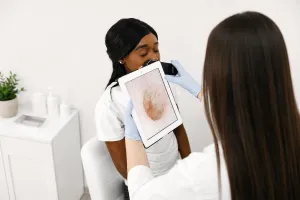
Once the acute redness and swelling have passed, changes that were not visible in the first few days may become noticeable. This is when pigmentation, persistent device-tip marks, and texture changes are more often detected.
Post-inflammatory hyperpigmentation
Pigmentation may appear as brown, gray, or unevenly dark areas. Sometimes it follows the borders of the treated zone or the shape of the device tip. The risk is higher in darker phototypes, recent tanning, active inflammation, excessive energy settings, and insufficient sun protection.
The fact that radiofrequency energy is less dependent on melanin than many lasers does not mean that pigment-related complications cannot occur. They may be triggered by the inflammatory reaction itself.
Pigmentation usually does not require emergency care, but it should be shown to a dermatologist, especially if the spots darken, spread, or are accompanied by scarring. Applying acids and retinoids to still-irritated skin on your own can make the condition worse.
Persistent device-tip imprint and tram-track scarring
A mild grid-like imprint immediately after the session is not yet a scar. It becomes concerning when it does not disappear along with the rest of the reaction and turns into rows of papules, depressions, or pigmented lines.
A real clinical case. Dermatologists Dedianto Hidajat and Sinta Murlistyarini described a 27-year-old patient with Fitzpatrick skin type IV who underwent RF microneedling to correct atrophic acne scars. One month later, papules that followed the needle pattern remained on her forehead, and pigmented streaks were present near the zygomatic arch.
The patient required separate treatment under dermatological supervision. After three months, her condition had improved noticeably, and after six months, the authors recorded complete resolution of the lesions. The source of the case is the Journal of Cosmetic and Laser Therapy.
This case does not show how common this complication is. It demonstrates that a persistent geometric mark should not be covered up with a new peel, laser treatment, or repeat microneedling without proper diagnosis.
After several weeks or months: fat loss and neurological symptoms
Unwanted change in subcutaneous volume
In the first few days, it is difficult to assess facial contours because of swelling. A new hollow or asymmetry may become noticeable later, once the acute reaction has fully resolved.
A patient may notice:
- a new hollow on the cheek or in the temple area;
- a more pronounced bony contour;
- asymmetry that was not present before the procedure;
- the impression that the face has become thinner or more gaunt.
Such changes do not always mean that fat tissue has been destroyed. They may be related to differences in lighting, pre-existing asymmetry, resolution of swelling, or weight changes. This is why pre-procedure photographs and an in-person assessment are needed.
However, the FDA has received reports of subcutaneous fat loss and tissue deformation after certain uses of RF microneedling. The risk is especially important in thin areas, on lean faces, and when working at greater depths.
A new hollow should not be intensively massaged, heated, or immediately corrected with filler. First, the changes should be documented with photographs and independently assessed by a medical professional.
Nerve injury
Short-term reduction in sensitivity may be related to local anesthesia or swelling. A different situation is numbness that does not subside, spreads, or is accompanied by burning pain, tingling, or muscle weakness.
Changes in facial expression, asymmetry of the smile, difficulty closing the eye, loss of sensation over a large area, or progressive pain require prompt assessment. These symptoms cannot be explained away as “active collagen production.”
When and how quickly should you seek help?
Immediately or the same day
- vision changes or eye pain;
- difficulty breathing, swelling of the lips, tongue, or throat;
- facial asymmetry or muscle weakness;
- rapidly increasing swelling;
- severe or worsening pain;
- blisters, dark areas, or sharply white areas;
- a large open or weeping wound;
- high fever together with local inflammation.
Within the next few days
- purulent discharge or an unpleasant odor;
- redness that is spreading;
- numbness that does not subside;
- a persistent geometric imprint from the device tip;
- papules or scabs that are not decreasing;
- pain that worsens again after initial improvement.
Planned but necessary assessment
- pigment spots that do not lighten;
- new asymmetry after swelling has resolved;
- hollows or changes in contour;
- persistent texture irregularity;
- slow healing without obvious worsening.
A planned assessment does not mean the problem can be ignored for months. It means there are no signs of an immediate threat, but the changes still require diagnosis and documentation.
What should you do before seeing a doctor?
The first step is not to try to treat all possible complications at once. Acids, retinoids, peels, scrubs, alcohol-based solutions, heat exposure, and at-home device procedures can worsen the damage.
Contact the clinic and clearly describe what has changed: when the symptom appeared, whether it is worsening, and whether there is pain, blisters, discharge, numbness, or a change in facial contours. Take photographs in daylight, without filters or makeup.
For further assessment, it is useful to keep a record of:
- the date of the procedure;
- the name and model of the device;
- the treated areas;
- the depth, energy settings, and number of passes, if known;
- the names of the anesthetic and products applied after the session;
- photographs taken before the procedure, immediately after it, and in the following days.
If the clinic simply keeps saying that “everything is normal” while the symptoms are objectively worsening, it is worth seeking an independent consultation with a dermatologist or plastic surgeon who works with complications from energy-based procedures.
“RF microneedling is a medical procedure, not a cosmetic treatment, and these devices should not be used at home.”
U.S. Food and Drug Administration, 2025
The FDA emphasizes that RF microneedling is a medical procedure, not a routine cosmetic service, and that such devices are not intended for home use.
Brief answers to the main questions
How long does redness last after RF microneedling?
Most often, it gradually subsides over several days. The exact number of days is less important than the trend: redness should not become more intense or spread.
Is it normal to see needle marks?
Yes, pinpoint marks and small scabs are possible in the first few days. A persistent grid-like pattern, papules, or depressions that do not improve require assessment.
When can fat loss become visible?
Possible contour changes become more noticeable after swelling resolves, sometimes after several weeks. It is impossible to determine their exact cause from a photograph, so an in-person assessment is needed.
Can Morpheus8 cause fat loss?
Morpheus8 is an RF microneedling system. The U.S. Food and Drug Administration (FDA) has received reports of serious complications, including loss of subcutaneous fat, after certain uses of RF microneedling devices. Its safety communication does not provide a Morpheus8-specific rate or show that this outcome occurs after every treatment. Risk depends on the device, settings, treatment depth, and area; discuss these factors with a qualified medical professional.
Can I apply acids or retinoids on my own?
No, not unless they have been prescribed by a doctor after an examination. Irritating products can worsen a burn, inflammation, or pigmentation.
Does a complication always mean the practitioner made a mistake?
Not always. Individual tissue response, phototype, previous procedures, and device characteristics all matter. However, excessive energy, inappropriate depth, repeated passes, and insufficient anatomical knowledge increase the risk.
Normal recovery does not necessarily look attractive, but it should gradually improve. If the condition worsens or new symptoms appear, waiting is no longer a safe strategy.