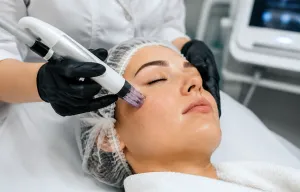






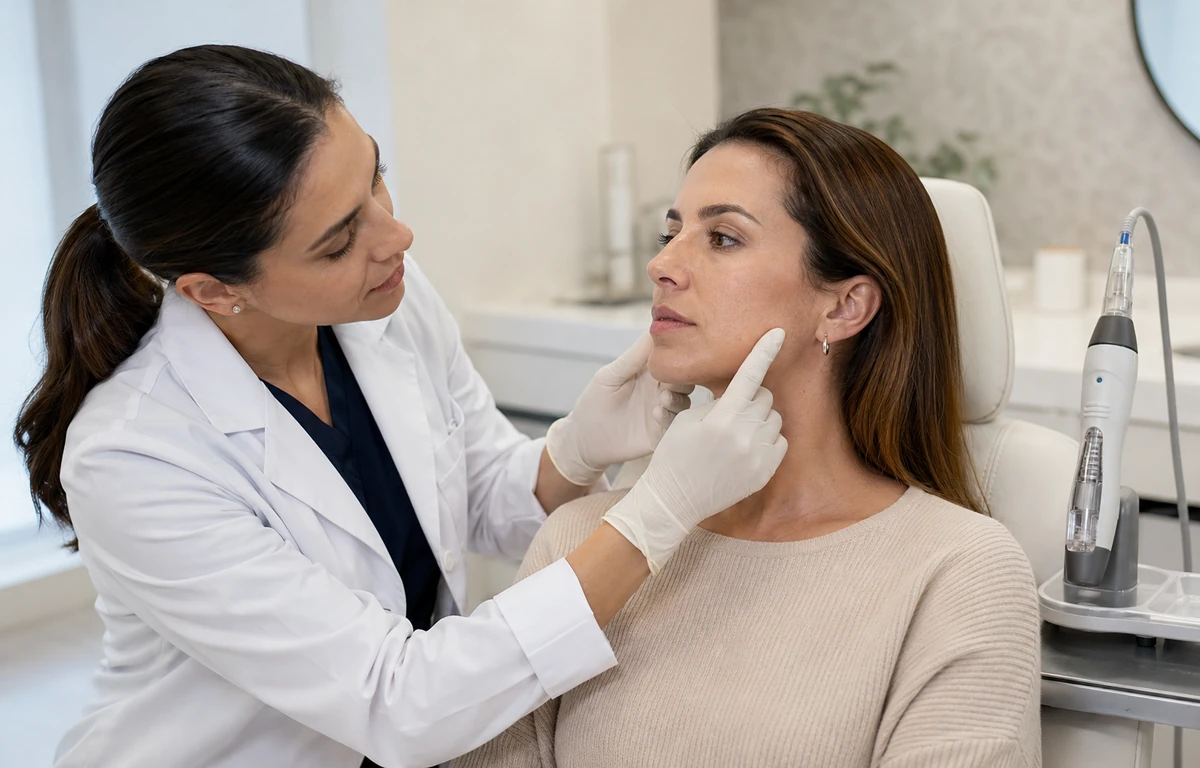
A typical consultation scenario: a patient asks to “tighten the facial oval” and assumes that a deeper, more powerful procedure will produce a better result. But an indistinct contour can have different causes: reduced skin density, loss of subcutaneous volume, swelling, excess tissue, or displacement of deeper structures.
RF microneedling can affect only some of these changes. It creates microchannels and delivers radiofrequency energy to a preset depth, triggering controlled tissue remodeling. The method can improve texture, dermal density, and the appearance of certain types of scars. However, it does not restore lost volume, reposition sagging tissues, or remove excess skin.
Short answer: the best candidates for RF microneedling are patients with stable atrophic acne scars, uneven texture, fine lines, or a moderate loss of firmness. The method is far less likely to meet expectations when there is significant volume loss, pronounced tissue descent, active inflammation, or a desire to achieve the result of a surgical facelift.
We discussed the mechanism of action, evidence base, and possible complications of the procedure in detail in the article “RF Microneedling: Effectiveness, Risks, and the Limits of Safe Use”. Here, the main question is different: how to understand whether the method matches a patient’s specific concern.
Who is RF microneedling best suited for?
The most well-supported indication remains atrophic acne scarring. In a 2026 systematic review that included 41 studies, RF microneedling consistently reduced scar severity and, in some studies, showed effectiveness comparable to fractional lasers.
However, it is not only the term “post-acne” that matters, but also the structure of the scars. Broad, shallow defects and some rolling scars may respond well to dermal remodeling. Narrow, deep scars, significant tissue loss, or dense fibrous bands often require a different approach.
Imagine a patient whose active acne is already under control, who rarely develops new inflammatory lesions, and whose main problem is broad atrophic scars and an uneven skin surface. For this patient, RF microneedling may be a logical choice—either on its own or as part of combined treatment.
Another situation is a patient with fine lines, photodamage, visible pores, and a moderate decrease in firmness, but without significant volume loss or excess skin. Here, the goal of the procedure is clear: not to change facial anatomy, but to gradually improve tissue quality.
With proper patient selection, one can expect:
- a reduction in the severity of some atrophic scars;
- a more even skin texture;
- moderate improvement in density and firmness;
- a reduction in fine lines;
- pores that look less noticeable, if their appearance is related to reduced firmness and uneven texture.
The procedure cannot make pores disappear completely. Their appearance depends not only on the condition of the dermis, but also on genetics, sebaceous gland activity, photodamage, and skin structure.
A darker phototype does not in itself rule out RF microneedling. Radiofrequency energy is not directed specifically at melanin, so the method is often considered an alternative to some laser procedures. At the same time, the risk of post-inflammatory hyperpigmentation does not disappear. It increases after tanning, in the presence of active inflammation, with overly aggressive settings, and with insufficient sun protection.
A good candidate understands that the result will be gradual. Collagen remodeling takes weeks and months, while early swelling can create the misleading impression of immediate skin tightening. It is too early to assess the outcome a few days after a session.
When is RF microneedling only one part of treatment?
This most often applies to acne scars. A single patient may have rolling, boxcar, and narrow deep scars at the same time. It is unrealistic to expect one device to affect all of them equally.
If the skin surface is tethered by dense fibrous bands, these may first need to be mechanically released. Deep, narrow scars may require focal chemical reconstruction, while significant tissue loss may need separate injectable or surgical correction. In such a treatment plan, RF microneedling helps improve the overall surface, but it does not replace all other stages.
Active acne also changes the priorities. If painful nodules, cysts, and multiple pustular lesions predominate on the skin, inflammation must be controlled first. Otherwise, the patient will continue to develop new scars while the physician is trying to correct the old ones.
Melasma and rosacea require a cautious approach. There are individual positive studies for these conditions, but the evidence base is weaker than it is for atrophic scars. In addition, heat and the inflammatory response can not only improve the skin condition, but also worsen it.
In active melasma after a sunny holiday, or during a rosacea flare with burning and bright redness, an energy-based procedure should not be the first step. The process should be stabilized first, and the skin barrier restored.
RF microneedling also should not automatically be replaced with classic microneedling, or vice versa. In the classic procedure, the main stimulus is mechanical micro-injury, whereas an RF system adds controlled heating of the tissues. We wrote about conventional microneedling and its combination with platelet-based preparations in the article “Microneedling with PRP and PRF: What Is Known About Effectiveness and Limitations”.
Who is RF microneedling unlikely to help?
The least predictable results occur when the procedure targets the wrong tissue. If the main problem lies deeper than the dermis, even a technically correct session may produce almost no visible change.
A telling example is a thin face with hollow temples, prominent cheekbones, and age-related loss of subcutaneous fat. The patient may describe this as “laxity” and ask for stronger skin tightening. In reality, additional dermal tightening will not restore lost volume.
Moreover, working too deeply or aggressively in thin areas may be undesirable. The FDA has reported cases of subcutaneous fat loss, tissue deformity, and nerve damage after certain uses of RF microneedling. This is precisely why greater depth is not automatically an advantage.
The method also does not replace a surgical facelift in cases of pronounced tissue descent and significant excess skin. It may improve the surface, but it will not reposition fat compartments, restore ligamentous support, or remove excess tissue.
A questionable candidate is also someone who expects scars, pores, or wrinkles to disappear completely after one session. With such expectations, even a noticeable clinical improvement may be perceived as a failure.
RF microneedling is unlikely to solve the main problem if:
- an indistinct contour is caused mainly by volume loss or descent of deep tissues;
- there is significant excess skin;
- scars are tethered by deep fibrous bands;
- the patient expects the result of a surgical facelift;
- the goal is complete removal of pores, scars, or pigmentation;
- the specialist cannot explain exactly which tissue is the target of the procedure.
When should the procedure be postponed?
RF microneedling is not performed over active infection, open wounds, herpetic eruptions, severe irritation, or a flare of a dermatologic disease in the treatment area. The skin should first return to a stable state.
Additional medical assessment is needed in cases of blood-clotting disorders, anticoagulant use, uncontrolled diabetes mellitus, immunodeficiency states, active anticancer treatment, and diseases that impair healing.
A tendency to form keloid scars is assessed not only by asking, “Do you have keloids?” It is important to find out how previous surgeries, ear piercings, injuries, and deep inflammatory lesions healed.
Pregnancy and breastfeeding are usually reasons to postpone an elective aesthetic procedure. This is a cautious approach, because there are insufficient data on the safety of such an intervention.
The physician must be informed before protocol selection about systemic isotretinoin use, the presence of a pacemaker, electronic medical devices, metal implants, fillers, biostimulators, and threads. The decision depends on the specific device, treatment area, time since the previous procedure, and the manufacturer’s instructions.
“RF microneedling is a medical procedure, not a cosmetic treatment, and these devices should not be used at home.”
U.S. Food and Drug Administration, 2025
This is not a formal warning. Radiofrequency microneedles deliver heat into and beneath the skin, so an error in depth, energy, or anatomical area can affect more than just the superficial layer.
How can you tell that patient selection has been done correctly?
A proper consultation does not begin with a package of three procedures or a demonstration of the device. First, the physician determines what exactly is creating the problem.
- Identifying the target tissue. For scars, their shape, depth, and mobility are assessed. For age-related changes, skin quality, subcutaneous volume, the position of soft tissues, and excess skin are analyzed separately.
- Assessing the anatomy. The forehead, temples, zygomatic arch, cheeks, lower third of the face, and neck all have different tissue thicknesses. Using identical settings across the entire face is not a sign of high-quality standardization.
- Taking the medical history. The physician asks about previous injections, surgeries, laser and energy-based procedures, medications, herpes, reactions to traumatic interventions, and a tendency toward pigmentation and scarring.
- Agreeing on a realistic goal. Reducing scar severity or improving texture are realistic goals. Completely eliminating pores or replacing a facelift is not.
The specialist should name the device, explain the choice of tip and settings, describe the normal recovery process, and have an action plan in case of complications. A new sterile disposable cartridge is opened for every patient and every session.
Red flags include a promise of a radical result after one session, presenting maximum depth as an advantage, using the same settings for all areas, not asking about medications and previous procedures, and reluctance to name the device model.
Short answers to the key questions
Who is RF microneedling best suited for?
Patients with stable atrophic acne scars, uneven texture, fine lines, and a moderate decrease in firmness, without significant volume loss or excess skin.
Is the procedure suitable for a thin face?
Sometimes yes, but thin tissues and a lack of subcutaneous fat require especially careful selection of depth and energy. The procedure does not restore lost volume.
Can RF microneedling be performed on darker phototypes?
A darker phototype is not an automatic contraindication. However, the risk of post-inflammatory hyperpigmentation remains, and both the settings and aftercare must take the skin’s individual reactivity into account.
Does RF microneedling replace a facelift?
No. It can moderately improve skin density and texture, but it does not reposition sagging deep tissues or remove significant excess skin.
The main question before the procedure is not “how powerful is the device?” but “which exact problem is it supposed to solve?” If the physician can clearly identify the target tissue, explain the alternatives, the limits of the result, and the logic behind the settings, RF microneedling may be a justified part of treatment. If the method is offered as universal rejuvenation without an individual assessment, it is better to seek another consultation.
If you develop a new hollow, persistent numbness, worsening pain, or another unexpected change after treatment, read our guide to RF microneedling complications and when to seek medical care for a symptom-by-symptom overview.