





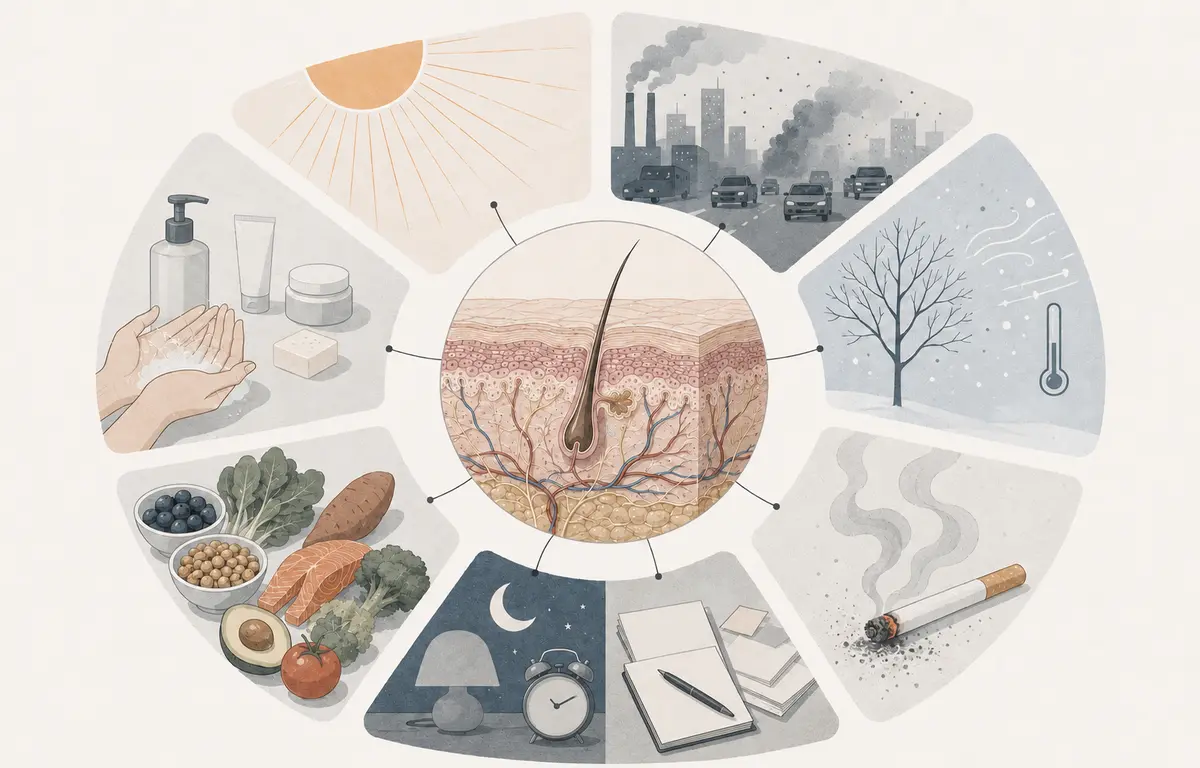
Two people of the same age can have very different skin conditions. This is influenced by genes, cumulative sun exposure, air quality, smoking, sleep, diet, daily skincare, and other circumstances. Over time, these influences accumulate, overlap, and interact with the skin’s own protective capacities.
The concept of the exposome helps us see this system as a whole. In science, it describes the totality of external and internal influences a person experiences throughout life. The exposome cannot be used to calculate the “biological age” of the face or to explain every wrinkle by lifestyle alone. This concept makes it possible to view skin changes comprehensively and take into account the cumulative effects of different factors.
What the skin exposome is and why this concept matters
The term “exposome” was proposed by epidemiologist Christopher Wild in 2005 as a complement to the genome. If the genome describes the inherited biological foundation, the exposome encompasses the totality of life-long exposures and the body’s related responses. In the first publication on the exposome concept, the focus was primarily on the difficulty of measuring environmental influences in research on chronic diseases. Later, this approach began to be applied to individual organs and conditions, including the skin.
In 2017, researchers formulated a model of the skin aging exposome. This foundational review has an important industry context: three of the five authors were employees of L’Oréal, including Vichy Laboratories. This does not invalidate the proposed model, but the industry connection should be taken into account when a broad scientific concept is used to justify cosmetic products. They included solar radiation, air pollution, tobacco smoke, diet, stress, sleep deprivation, and cosmetic exposures among the main groups of influencing factors. Broader models of the skin exposome also consider climate, occupational factors, the hormonal environment, the microbiome, and everyday skincare habits.
What matters is the intensity and duration of exposure, how often it is repeated, and how it combines with other factors. A short walk through the city creates a different burden than working for years next to a busy road. A few nights of insufficient sleep are likewise not equivalent to chronic sleep disruption.
The individual response depends on phototype, age, genetic characteristics, barrier status, hormonal background, diseases, and medications. The exposome complements the genetic picture by describing the conditions in which a particular person’s biology is expressed.
Which factors are part of the skin exposome and how convincing the evidence is
The scientific evidence in this area is uneven. Some conclusions come from laboratory models, some from observations in humans, and randomized studies exist only for certain preventive measures. A clinical-biological review of the exposome’s impact on the skin confirms that sun exposure, pollution, hormonal, dietary, and psychological factors have been studied to different degrees.
The table below does not reproduce a formal GRADE scale. It is an editorial comparison of study types, reproducibility of results, and the ability to establish causality.
| Factor | What studies show | What changes it is associated with |
|---|---|---|
| Solar radiation | The effects of UVA and UVB are supported by laboratory, epidemiological, and clinical data. There is a randomized study for regular photoprotection. | Uneven pigmentation, wrinkles, reduced elasticity, texture changes, photodamage, and an increased risk of skin cancer. |
| Tobacco smoke | Numerous observational studies show a consistent association, and laboratory work explains possible mechanisms. Most of the data concern active smoking. | Premature wrinkles, dullness, impaired microcirculation, and slower tissue recovery. |
| Air pollution | The evidence is based mainly on observational studies and laboratory models. They show repeatable associations, although the effect of a specific pollutant is difficult to separate from other living conditions. | Pigment spots, oxidative stress, inflammatory reactivity, barrier disruption, and signs of premature aging. |
| Climate and microclimate | A review of studies on temperature and humidity links cold, dry air with impaired barrier function and greater reactivity. There is much less evidence on the independent contribution of climate to long-term aging. | Dryness, dehydration, redness, increased sensitivity, and flare-ups of certain dermatoses. |
| Sleep and psychological stress | A small study of 60 healthy women linked chronically poor sleep quality with greater water loss and slower barrier recovery. The long-term contribution of sleep and stress to skin aging is studied much less thoroughly than the effects of sun exposure or smoking. | Temporary worsening of hydration and appearance, higher reactivity, and possible exacerbation of inflammatory conditions. |
| Diet | The data are heterogeneous and depend on the specific question. Nutrient deficiencies, metabolic disturbances, and overall dietary patterns matter, but no universal “diet for youthful skin” has been proven. | Barrier and recovery changes in deficiency states, effects on inflammatory processes, and a possible contribution of glycation to the loss of tissue elasticity. |
| Cosmetics and procedures | The result depends on the finished formula, the mode of use, and the condition of the skin. Data on a single ingredient cannot automatically be transferred to any product containing it. | Support or damage to the barrier, contact reactions, dryness, sensitivity, photosensitization, or correction of certain signs of photoaging. |
Solar radiation includes several ranges with different effects. UVB is more strongly associated with burns and direct DNA damage, while UVA penetrates deeper and is involved in oxidative stress and changes in the dermal matrix. Visible light within solar radiation is of particular importance for pigmentation disorders in people with darker phototypes and a tendency to melasma. The infrared range is being studied in the context of thermal and oxidative burden, but its clinical consequences are less well understood than those of ultraviolet radiation.
Air pollution is a mixture of particulate matter, ozone, nitrogen oxides, polycyclic aromatic hydrocarbons, and other compounds. Epidemiological studies link traffic-related pollution with lentigines and signs of extrinsic aging, while laboratory work points to the involvement of oxidative stress, inflammation, and the aryl hydrocarbon receptor. At the same time, such studies reveal associations but do not make it possible to precisely separate the effect of air quality from other living conditions in a large city.
Stress, sleep, and diet act in more complex ways than a direct “factor = wrinkle” scheme. Chronic stress may affect neuroimmune interactions, inflammatory responses, sebum production, and barrier recovery. We discussed the connection between the nervous system and the skin in more detail in the article “Neurocosmetics and the ‘skin-brain’ axis: where science ends and marketing begins”. Diet exerts its influence through the body’s supply of energy and nutrients, metabolic health, and inflammatory processes. A single product usually does not determine the condition of the skin.
Data on sleep require particularly cautious reading. The study mentioned included only 60 women of Caucasian origin, and some of the authors worked for Estée Lauder. The work showed an association but did not prove that poor sleep quality by itself accelerates skin aging.
Cosmetic skincare is both part of daily exposure and a way to reduce some of its consequences. Sunscreen, gentle cleansing, and appropriate moisturization support the skin’s protective functions. Excessive exfoliation, constant switching of actives, and irritating formulas, on the contrary, add to the burden. The shift from layering products to a contextual approach is discussed in the article “K-beauty after the 10-step era: the new logic of Korean skincare”.
How different exposures lead to similar skin changes
Dryness, uneven tone, or loss of firmness rarely point to a single specific exposure. Different factors trigger partly shared biological processes, and one process can have several outward manifestations.
- Oxidative stress. Reactive oxygen species are necessary for normal cell function, but their excess damages lipids, proteins, and DNA. Sunlight, tobacco smoke, and some pollutants can shift this balance.
- Inflammatory response. A short-term inflammatory response is necessary for protection and recovery. Prolonged low-intensity stimulation can sustain reactivity, affect pigmentation, and interfere with normal tissue repair.
- Barrier disruption. A damaged lipid structure of the stratum corneum retains water less effectively and protects less well against irritants. Dry air, harsh cleansing, excessive exfoliation, and inflammatory diseases can reinforce one another. We explain in more detail how to recognize a damaged skin barrier and help it recover in a separate article.
- Changes in the extracellular matrix. Ultraviolet radiation and oxidative-inflammatory signals affect enzymes involved in the breakdown of collagen and other structural components of the dermis. If damage recurs faster than repair takes place, the skin’s firmness, texture, and mechanical properties gradually change.
- Pigmentation disturbances. Solar radiation, inflammation, and some pollutants can affect melanocytes through different pathways. The result depends on phototype, hormonal background, previous inflammatory processes, and a predisposition to certain pigmentary conditions.
- Changes in the microbial environment. The barrier, sebum, humidity, temperature, and skincare shape the conditions for microorganisms on the skin surface. This link is being actively studied, but microbiome analysis still does not explain every case of irritation and does not prove the effectiveness of a cosmetic product.
Individual factors can also amplify one another. The interaction between solar radiation and air pollution is called photopollution. Under UVA exposure, some polycyclic aromatic hydrocarbons become more phototoxic, and oxidative burden from different sources can overlap. A review of the synergy between sun exposure and pollution combines laboratory and epidemiological data. The author reported working for a cosmetics company, which is important to consider when moving from describing a mechanism to recommending “anti-pollution” products. The interaction of factors itself does not yet prove the need for a separate category of cosmetics for every city resident.
What is often overstated in discussions of the exposome
- “Most skin aging is caused by the exposome.” The popular 80% figure refers mainly to estimates of the contribution of ultraviolet radiation to visible signs of facial skin aging. It does not show the share of the entire exposome, which includes not only sun exposure but also air pollution, smoking, climatic factors, and other life-long influences. In an observational study of 298 women of Caucasian origin aged 30-78 years, the authors compared groups with different sun-exposure habits and used clinical scales to assess the contribution of UV radiation to visible signs of facial aging. The population, assessment area, and study design do not allow the 80% figure to be applied to all phototypes, body areas, and manifestations of aging.
- “Screens age the skin the same way the sun does.” Blue light at high experimental doses can provoke biological reactions, but the actual intensity from phones and monitors is much lower than that of sunlight. A systematic review of clinical data does not provide grounds to equate ordinary device use with being outdoors.
- “The skin needs to be detoxed.” Cleansing removes sebum, particles, cosmetic residues, and other contaminants from the surface, but it does not draw abstract “toxins” out of tissues. Metabolism and elimination of substances are handled by specific biological systems, not by a cosmetic ritual labeled detox.
- “An antioxidant or anti-pollution product neutralizes the exposome.” The presence of a promising ingredient in the formula does not in itself prove the protective effect of the finished product. Concentration, stability, method of use, study design, and the measured outcome all matter. The difference between a mechanism, early data, and the properties of a commercial product is also clearly visible in the example of exosomes in cosmetology.
What we can actually influence
The practical value of the exposome concept lies in setting the right priorities. It is impossible to control every contact with the environment, and not all factors carry the same weight of evidence.
- Reduce excessive sun exposure. Shade, clothing, a hat, and sunscreen work more reliably in combination. In a randomized study involving 903 adults under 55 years of age, daily use of a broad-spectrum sunscreen for 4.5 years slowed the progression of photoaging by 24% compared with discretionary use. The result was assessed by changes in the skin microrelief on the back of the hand.
- Avoid tobacco smoke. Quitting smoking matters far beyond appearance. For the skin, it means reducing chemical, oxidative, and vascular burden that no serum can compensate for.
- Support the barrier according to conditions. In dry or cold air, the skin may need gentler cleansing and a richer moisturizer; in heat and high humidity, a lighter texture may be preferable. The routine should be adjusted according to the skin’s response, avoiding additional irritation.
- Cleanse the skin without aggression. In the evening, it makes sense to remove sunscreen, makeup, sebum, and particles from the surface. Tightness, burning, or flaking after cleansing indicate that the chosen routine may be excessive.
- Treat sleep, movement, diet, and stress management as the foundation of health. A полноценный раціон helps prevent deficiencies and supports tissue repair, but there is no universal supplement that “blocks the exposome.” Poor sleep or stress also do not explain every breakout or wrinkle.
- Check the promises of a specific product. Labels such as “anti-pollution,” “exposome defense,” or “cellular protection” describe positioning. Evidence of efficacy may come from studies of the finished formula under real conditions using clinically meaningful endpoints. The activity of a single molecule in cell culture is not enough for that.
Persistent or rapidly progressing changes, itching, pain, pronounced inflammation, or new growths require medical evaluation. Such manifestations may reflect dermatological diseases, hormonal changes, medication effects, or other conditions that the exposome concept does not diagnose.
Chronological aging continues regardless of lifestyle, and skin condition is not a measure of how “correctly” a person lives. The exposome concept adds important context: throughout life, the skin encounters many influences, and their contributions are not equal. The best-supported priorities remain photoprotection, avoiding smoking, maintaining the barrier, and timely medical care. Cosmetic technologies can complement this foundation if their claims are supported for a specific formula.
Sources
- Wild C. P. Complementing the Genome with an “Exposome”. 2005. Krutmann J. et al. The Skin Aging Exposome. 2017.
- Passeron T. et al. The Impact of the Exposome on Skin Aging and Skin Health. 2020.
- Engebretsen K. A. et al. The Effect of Environmental Humidity and Temperature on Skin Barrier Function and Dermatitis. 2016.
- Oyetakin-White P. et al. Does Poor Sleep Quality Affect Skin Ageing? 2015.
- Marrot L. Photo-pollution: How Sunlight and Airborne Pollutants Cooperate to Damage the Skin. 2018.
- Flament F. et al. Effect of the Sun on Visible Clinical Signs of Ageing in Caucasian Skin. 2013.
- Suitthimeathegorn O. et al. The Impact of Blue Light and Digital Screens on the Skin. 2022. Hughes M. C. B. et al. Sunscreen and Prevention of Skin Aging: A Randomized Trial. 2013.