






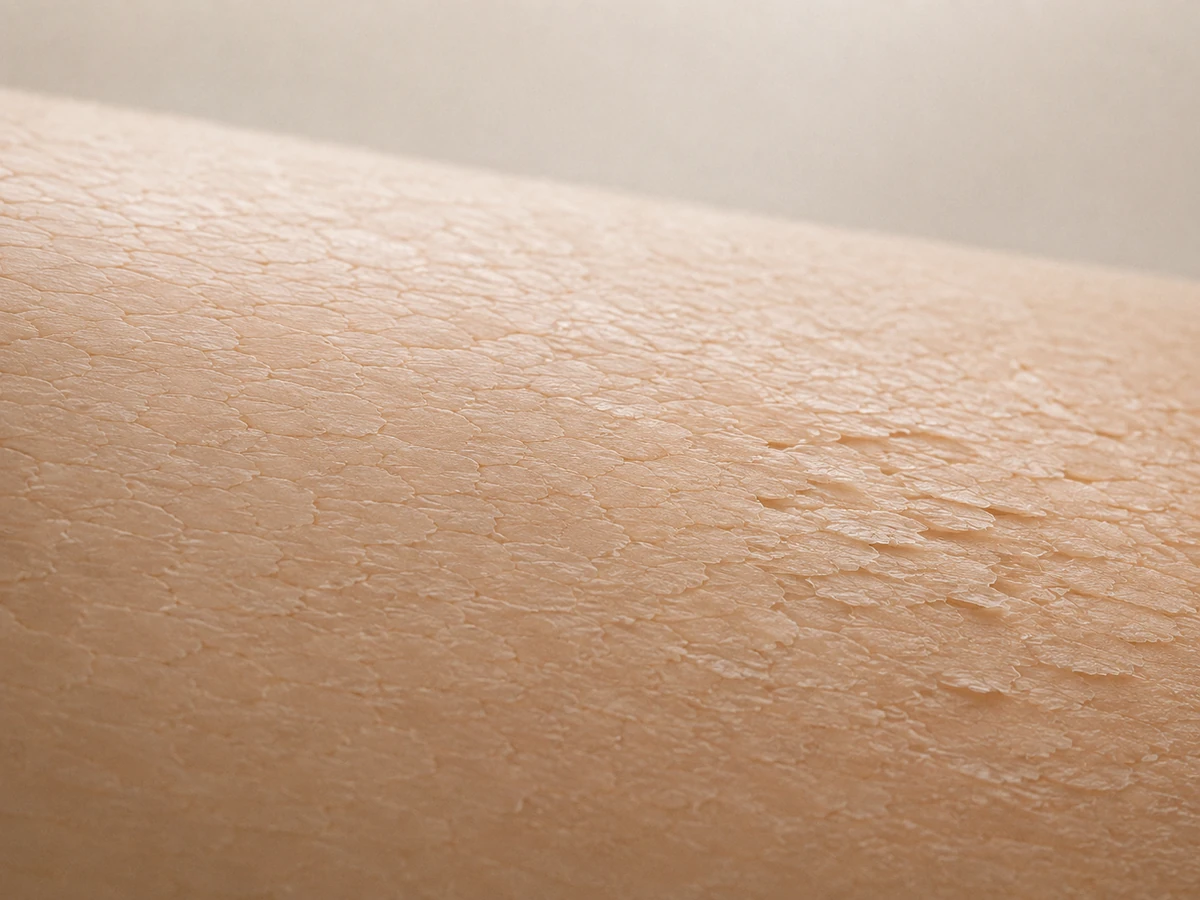
Has your skin suddenly started feeling tight after cleansing, your usual cream begun to sting, and dryness, flaking, or the sense that almost any product irritates it appeared? In the beauty world, this condition is often called a “damaged skin barrier.” Behind this popular phrase is a real physiological process: the stratum corneum retains water less effectively and protects the skin from external irritants less efficiently.
Similar symptoms can also occur with contact dermatitis, rosacea, atopic dermatitis, and other conditions. That is why context matters: when the changes appeared, what preceded them, and how the skin behaves after a possible irritant is removed. If the problem started after overloading your routine, aggressive cleansing, retinoids, acids, or a procedure, impaired barrier function may indeed be part of the picture.
What the skin barrier is and what “damage” to it means
When people talk about the skin barrier in the context of cosmetic care, they primarily mean the stratum corneum of the epidermis. It is often compared to a brick wall: corneocytes act as the “bricks,” while intercellular lipids fill the space between them. Among these lipids, ceramides, cholesterol, and free fatty acids are especially important. Together, they form an ordered structure that helps retain water in the skin and limit the penetration of external substances.
When this system functions less effectively, transepidermal water loss increases — TEWL, transepidermal water loss. Water evaporates more quickly through the stratum corneum, the skin becomes drier, and contact with substances that were previously well tolerated may cause burning or tingling. This is why barrier disruption often shows up not only as dryness, but as a combination of tightness, flaking, and increased reactivity.
The skin barrier is not only the mechanical protection provided by the stratum corneum. Its function is closely linked to the acidity of the skin surface, the microbiome, and immune mechanisms. At the same time, it is important to distinguish these concepts: the skin barrier, acid mantle, and microbiome are not the same thing, but separate interconnected systems. Disruption of one of them can affect the condition of the others.
A “damaged barrier” is a convenient way to describe a state of reduced barrier function, not a separate diagnosis. That is why it should be assessed based on a combination of symptoms and circumstances, rather than a single sign.
How to tell if the skin barrier is impaired
The most typical scenario looks like this: until recently, your skin tolerated its usual routine well, but after a change in routine, an intensive course of retinoids or acids, frequent exfoliation, a new cleanser, or unfavorable weather, it became tight, dry, and reactive. A cream or serum that previously caused no discomfort begins to sting; after washing, you feel the need to apply cream immediately; fine flaking, roughness, and areas of redness appear.
Possible signs include:
- tightness, especially after cleansing;
- dryness and flaking;
- burning or tingling from familiar products;
- a sudden increase in reactivity;
- roughness and uneven texture;
- redness together with other signs of irritation.
The most telling factor is not one isolated sign, but a change in the skin’s usual behavior after a specific trigger. For example, if after several weeks of using a daily retinoid together with an acid toner, the face began to flake and both water and cream cause burning, a connection with an overloaded routine is quite likely. An itchy rash without an obvious trigger, one that spreads or keeps coming back, requires a different assessment.
Damaged barrier or dehydrated skin
Dehydration and impaired barrier function are closely related, but they are not the same thing. Dehydrated skin has insufficient water content in the stratum corneum, while with barrier disruption the problem is broader: the skin has more difficulty controlling water loss and becomes more vulnerable to irritants. Dehydration therefore more often presents as tightness and a feeling of dryness, whereas pronounced impairment of barrier function is often accompanied by burning and a sharp increase in reactivity.
| Sign | Dehydrated skin | Impaired barrier |
| Tightness | Common | Common |
| Flaking | Possible | Common with pronounced irritation |
| Usual cream suddenly stings | Not a typical key sign | More characteristic |
| Increased reactivity | May occur | Common |
| Insufficient water content in the stratum corneum | Yes, often accompanies the issue | Present, usually as part of a broader problem |
Table. Comparison of dehydrated skin and skin with an impaired barrier by main signs
In practice, these states often overlap. Excessive cleansing, for example, can simultaneously increase water loss, cause dehydration, and worsen barrier function. In this situation, the first step is to remove the irritant and return to a simple basic routine.
When the cause may not be only the barrier
Eczema, irritant or allergic contact dermatitis, rosacea, and other dermatological conditions can also be accompanied by dryness, burning, redness, and changes in barrier function. A barrier-repair cream may reduce discomfort, but it does not replace treatment of the underlying condition.
You should see a doctor if there is pronounced swelling, oozing, blisters, cracks with bleeding, severe itching or pain, signs of infection, a rash that spreads quickly, or no improvement after obvious irritants are removed. If the problem keeps coming back, it is important to identify the cause rather than spend months switching between “barrier repair” products.
Can a damaged barrier cause acne?
There is a connection between acne and barrier function, but it cannot be reduced to a simple formula of “the barrier was damaged — pimples appeared.” Studies show changes in the stratum corneum and transepidermal water loss in people with acne, meaning that acne-prone skin itself often has a less stable barrier. It can also be further worsened by products used to treat breakouts: retinoids, benzoyl peroxide, and some acids often cause dryness, flaking, and irritation, especially at the start of therapy.
As a result, oiliness, breakouts, and flaking can exist at the same time. In such a situation, flaking does not necessarily mean the skin needs to be “dried out” even more or that more actives should be added. On the contrary, the problem may sometimes be that, against the background of acne, the barrier is already overloaded by treatment.
So it is more logical not to abandon necessary acne therapy, but to reduce unnecessary irritation: simplify cleansing, add a well-tolerated moisturizer, and adjust the frequency of active ingredients if needed. Barrier support can improve treatment tolerability and reduce irritation, but it does not treat acne on its own.
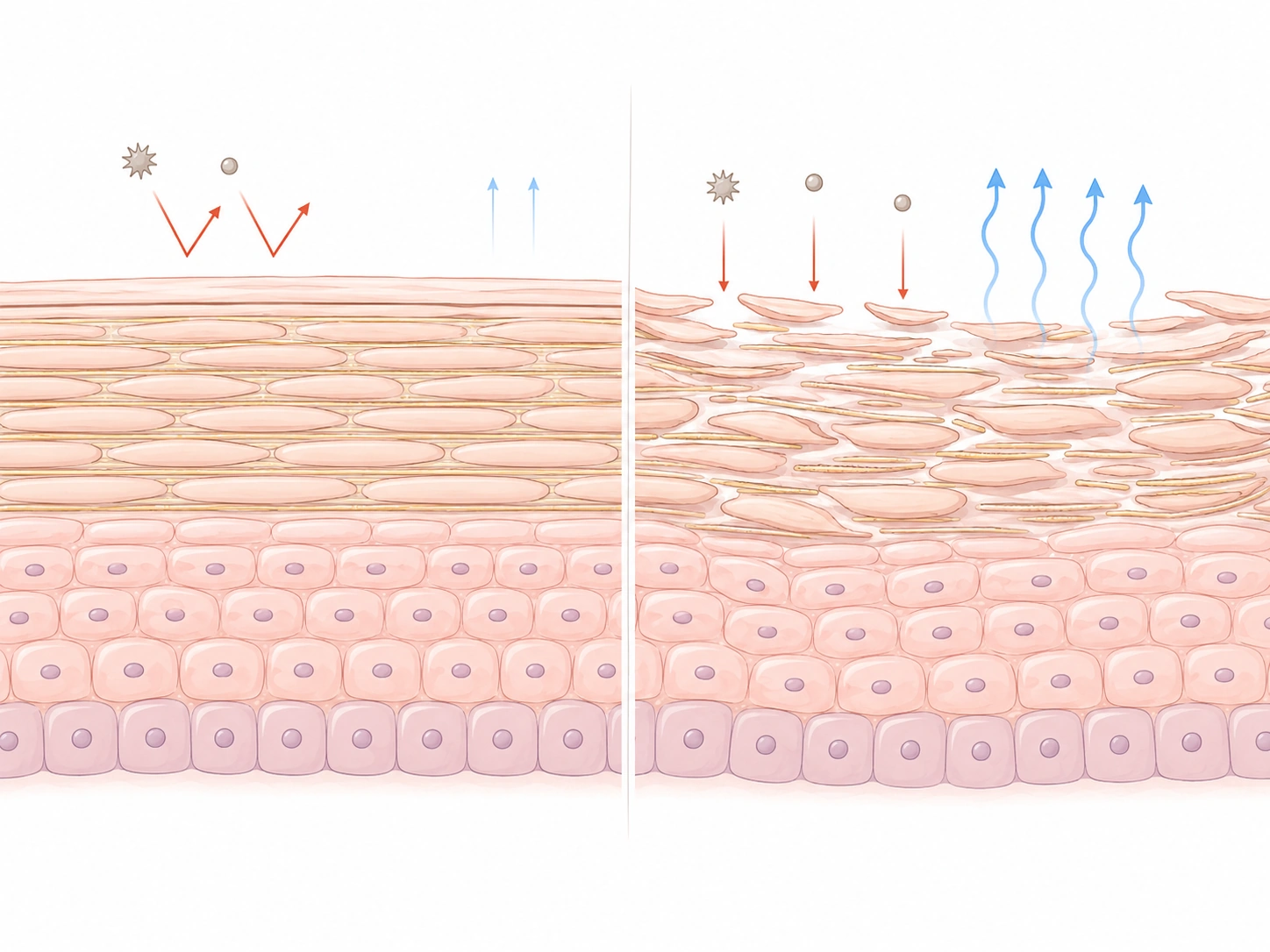
Fig. Diagram of a healthy and damaged skin barrier: moisture loss and impaired protective function
What damages the skin barrier
One of the most common scenarios today is an overloaded routine. The skin is cleansed twice with active products, exfoliated regularly, and exposed to a retinoid, an acid serum, a spot-treatment product, while several new products are being tested at the same time. Each individual step may be appropriate, but their combination and frequency create irritation that the skin can no longer compensate for. When the problem is caused by such an overloaded routine, reducing the number of products is often more helpful than adding another “repairing” serum. We discussed this shift in approach separately in the article K-beauty after the era of 10 steps: the new logic of Korean skincare.
Typical factors include overly aggressive cleansing, frequent use of scrubs or acids, hot water, mechanical friction, and introducing several potentially irritating actives at the same time. The environment also matters: cold, low humidity, wind, and ultraviolet radiation change the conditions in which the stratum corneum functions. These factors act together with everyday habits and skincare — we examined the broader context of their impact in the article on the skin exposome and the effects of environment and lifestyle on the skin.
Can retinol damage the skin barrier?
Retinoids can cause dryness, redness, flaking, and irritation, especially at the beginning of use or when frequency is increased too quickly. The risk is higher if a retinoid is combined with several other irritating products, or if use continues despite already pronounced burning and flaking. Under these conditions, retinoid irritation may be accompanied by worsening barrier function.
A similar situation is possible with AHA and BHA acids, benzoyl peroxide, and other actives. Concentration, frequency, product combinations, and the skin’s initial condition all matter. If, after irritation appears, active exfoliation continues or cleansing is intensified, the problem may persist much longer.
What happens after peels and laser procedures
Professional procedures are a separate situation because some of them deliberately alter the barrier. Chemical peels, ablative laser resurfacing, and some other methods intentionally create damage of a specific depth, after which recovery is part of the expected tissue response. Skincare during this period depends on the method, intensity of exposure, and the doctor’s recommendations, and should not simply copy a routine intended for irritation after at-home actives.
We wrote separately about the basic logic of hydration after such procedures in the article Hyaluronic acid after peels and laser: when to use it and how to restore the barrier.
How to repair a damaged skin barrier
The first step is to remove what is continuing to irritate the skin. If the problem began after increasing the frequency of a retinoid, introducing a new acid product, or doing a series of at-home peels, that factor should be temporarily removed. If the skin feels tight after cleansing, the cleanser, water temperature, and cleansing frequency should be reconsidered. In most everyday situations, a shorter routine with gentle cleansing, moisturizing, and sun protection works better than adding several “repairing” products at once.
During this period, cleansing should remove SPF, makeup, sebum, and impurities without leaving pronounced tightness after washing. A “squeaky clean” feeling is not a sign of better cleansing. Brushes, rough towels, and vigorous rubbing are also unnecessary. If morning cleansing with a product only worsens dryness, water alone is enough for some people, while evening cleansing remains necessary to remove what has accumulated on the skin during the day.
What should a barrier-repair cream be like?
When barrier function is impaired, the skin not only loses water more quickly — the organization of the intercellular lipids of the stratum corneum also changes. A good cream should therefore perform two related tasks: help restore and maintain water content in the stratum corneum and support the recovery of its lipid structure. This combination of mechanisms matters more than the word barrier on the packaging or one standalone “hero” ingredient.
For hydration, hygroscopic moisturizing ingredients (humectants) are important — for example, glycerin or hyaluronic acid. They help increase water content in the stratum corneum. Softening ingredients (emollients) make the skin surface smoother and softer, while occlusive ingredients (occlusives), including petrolatum or dimethicone, reduce water evaporation. Moisturizing ingredients alone may therefore be insufficient if water continues to be lost quickly through a compromised barrier.
For restoring the lipid part of the barrier, ceramides, cholesterol, and free fatty acids — the main classes of intercellular lipids in the stratum corneum — are especially important. They form lamellar structures between corneocytes and help maintain barrier integrity and limit water loss. Products with these lipids can support the restoration of barrier function, but their effectiveness depends on the full formula, the ratio of components, and how they are incorporated. The word ceramides in an ingredient list does not automatically mean that a specific cream will be better than another well-formulated product.
Hyaluronic acid works well as a hydrating ingredient, but on its own it does not replace a complete cream. If the skin remains tight after an HA serum, it may lack emollient or occlusive support. We explained a practical approach in the article “How to apply hyaluronic acid correctly — without tightness or pilling under SPF”.
What to temporarily remove from your routine
If the skin is actively burning, flaking, and poorly tolerates even basic products, it is worth pausing whatever is sustaining irritation: at-home peels, scrubs, overly frequent use of acids, retinoids, or other actives after which the condition clearly worsens. Products that the skin tolerates well do not need to be removed automatically. The goal is to find and eliminate the factor that is maintaining irritation, not to turn skincare into a list of prohibitions.
During recovery, it is better not to test several new products at once. If the skin gradually calms down on a simple routine, it is easier to understand what truly suits it and what can be reintroduced later. Constantly adding new “soothing” serums, masks, and toners only makes it harder to identify the cause if irritation recurs.
Sun protection remains an important part of the morning routine, especially when using retinoids or acids, or after professional procedures. If a particular SPF formula stings strongly on irritated skin, it is better to choose a product that is more comfortable to tolerate.
How long does the skin barrier take to recover, and when can actives be reintroduced?
There is no universal timeline such as “the barrier fully recovers in 14 or 28 days.” The speed depends on the cause, the severity of the disruption, whether the irritant has been removed, and whether there is an accompanying dermatological condition. Experimental models of stratum corneum damage also show that different barrier parameters normalize at different rates. A single calendar timeframe therefore cannot be applied to all cases of dryness, irritation, or reactions to actives.
Mild irritation after a few unsuccessful uses of a new product may begin to noticeably decrease quite quickly after stopping it. If the skin has been overloaded with actives for a long time, is severely flaking, or barrier dysfunction is associated with a dermatological disease, recovery takes longer and may require treatment. After ablative procedures, timelines are determined by the depth of controlled injury; we separately discussed day-by-day recovery after laser resurfacing.
How to tell that the skin barrier has recovered
A practical sign of recovery is the return of predictability. Ordinary cleansing no longer leaves a long-lasting feeling of tightness, a basic cream does not sting, pronounced flaking has decreased, and the skin no longer reacts sharply to every step of the routine. At the same time, it does not have to become perfectly smooth, poreless, free of breakouts, or without redness: barrier function does not determine every aspect of the skin’s appearance.
When basic care is comfortable again, actives can be reintroduced gradually. The simplest principle is one product at a time and less frequently than before the irritation. A retinoid, for example, can first be used once or twice a week, the skin’s response assessed, and only then the frequency increased. If a retinoid, an acid, and another new serum are all reintroduced at once, it will be difficult to understand which product triggered irritation if it returns.
The skin barrier does not need a complicated ritual. In most everyday cases, a simple approach works: remove excessive irritation, cleanse the skin gently, support water and lipid content in the stratum corneum, reduce moisture loss, and gradually reintroduce actives after tolerance has normalized. If the skin does not calm down or the symptoms do not resemble ordinary irritation from skincare, it is worth looking for the cause together with a dermatologist.
Sources
- Rajkumar J, et al. The skin barrier and moisturization: function, disruption, and mechanisms of repair. Skin Pharmacol Physiol. 2023. https://pubmed.ncbi.nlm.nih.gov/37717558/
- Spada F, et al. The role of ceramides in skin barrier function and the importance of their correct formulation for skincare applications. 2024. https://pubmed.ncbi.nlm.nih.gov/39113291/
- Wohlrab J, et al. Restoring skin hydration and barrier function: mechanistic insights into basic emollients for xerosis cutis. 2025. https://pubmed.ncbi.nlm.nih.gov/40231699/
- Narsa AC, et al. A comprehensive review of the strategies to reduce retinoid-induced skin irritation in topical formulation. 2024. https://pubmed.ncbi.nlm.nih.gov/39184919/
- American Academy of Dermatology. Contact dermatitis. https://www.aad.org/public/everyday-care/itchy-skin/rash/itchy-rash-contact-dermatitis