






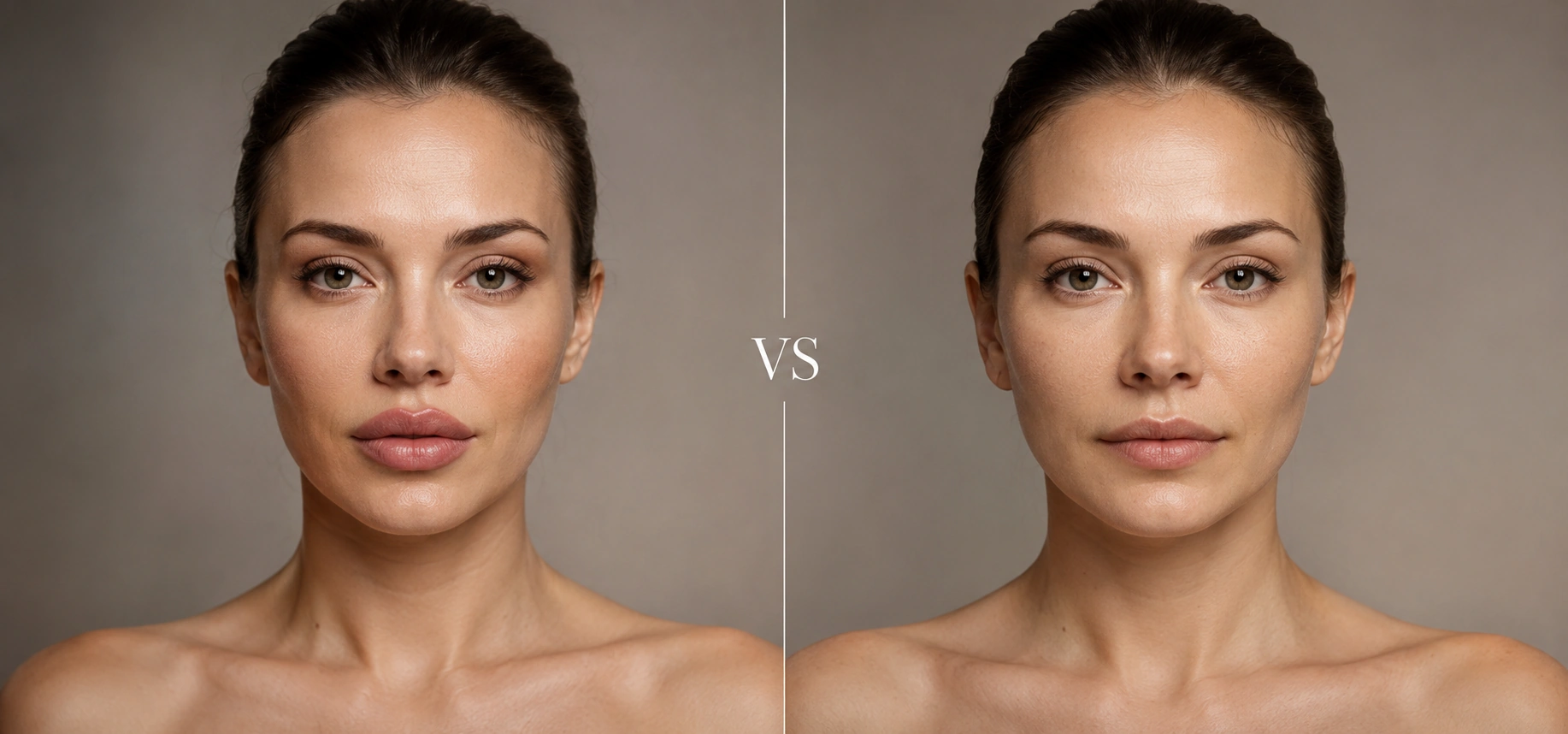
Until quite recently, the result of aesthetic correction was often demonstrated through a single area: the lips became fuller, the cheekbones more defined, the chin sharper, the wrinkle less noticeable. Today, such a comparison is no longer enough. The face may change noticeably without becoming more harmonious. And conversely, after complex, well-planned work, people around you will not notice “done” lips or cheekbones, but a fresher and calmer appearance.
What is changing is not people’s desire to look better, but the criterion for a good result. It is no longer important only how noticeably a single area has been corrected. What matters are the proportions of the entire face, facial expressions, age appropriateness, tissue condition, and the person’s recognizability. In this frame of reference, naturalness is not a rejection of procedures and not a competition to use the smallest amount of product. It is a result after which the face remains itself.
From an isolated area to the whole face
A zone-based approach is easy to explain and show. There is a specific request, a selected area, and a clear “before” and “after” comparison. The format of advertising, social media, and short videos is especially convenient for demonstrating such changes: the lips became larger, the cheekbones lifted, the jawline became sharper. Gradually, this creates the impression that the face consists of separate elements that can be improved one by one.
In reality, any noticeable intervention changes the perception of adjacent areas. Lip volume affects the relationship between the nose, the mouth area, and the chin. Cheekbone projection is connected with how the temples, eyes, cheeks, and lower third look. Chin correction can significantly alter the profile even without intervention in the nose area. A technically neat procedure does not always produce a convincing aesthetic result if it was planned only within the limits of one area.
For example, the desire to enlarge the lips sometimes arises not because they lack volume, but because of the relationship of the lips, nose, and chin in profile. If the lips are simply made more noticeable, the sense of imbalance may remain or even intensify. Another plan does not necessarily mean more interventions. It may be enough to assess the proportions more precisely, redistribute volume differently, or honestly conclude that additional lip correction will not solve the original concern.
Holistic planning begins with assessing the face in the frontal view, profile, and three-quarter view, at rest and in motion. The doctor takes into account the bony support, soft tissues, volume distribution, muscle activity, asymmetries, and previous interventions. It is important to determine whether the area indicated by the patient is truly the source of the imbalance. Sometimes it only makes noticeable a change that is developing in another part of the face.
This approach often helps do less. It makes it possible to find a solution that affects overall perception without triggering an endless sequence of local corrections. In the article on the limitations of cosmetology methods and realistic expectations, we already explained that a procedure should be evaluated by how well it fits a specific task, not by the intensity of its impact or the number of treated areas.
Naturalness is not a minimum, but appropriateness
The phrase “I want it to look natural” sounds clear, but it means different things to different people. For some, it is important that others not guess they had a procedure. Someone else is afraid of losing their familiar smile or facial expressions. Another person wants to look fresher while preserving the characteristic shape of their lips, a distinctive nose, eyebrow asymmetry, or other features associated with their sense of their own appearance.
In 2024, a study was published in which the FACE-Q Aesthetics Natural module was developed and validated to assess naturalness from the patient’s own perspective. It covers expectations before the procedure, the naturalness of appearance, and the perception of the result obtained. Psychometric validation was carried out using data from 1,358 participants. Higher ratings of the naturalness of appearance and of the result were associated with greater satisfaction with facial appearance, and among the parameters important to patients was the naturalness of movement.
This work did not compare the effectiveness of products or procedures. Its significance lies elsewhere: naturalness is no longer viewed as a vague wish that each specialist interprets at their own discretion. Separate assessment tools are being created for it, taking into account the patient’s experience, expectations, and feelings after the intervention. You can learn more about the study design and results in the publication on FACE-Q Aesthetics Natural.
A natural look is not guaranteed by using a small amount of product. A small volume can create an inappropriate accent if anatomy, proportions, or tissue movement are not taken into account. At the same time, a comprehensive correction is sometimes perceived as organic because each of its parts has a clear function. What matters is not minimalism at any cost, but the justification for every step.
Likewise, naturalness cannot be reduced to reproducing a universal lip, cheekbone, or jawline shape. Measurements and proportion analysis help reveal imbalance and predict the consequences of intervention, but they do not provide a ready-made formula for a beautiful face. What looks harmonious on one person may seem alien on another because of differences in skull structure, soft tissues, facial expressions, age, and the overall character of appearance.
Asymmetry is also not always a flaw that needs to be corrected. A slight difference between the two halves of the face, a characteristic curve of the lips, a particular nose shape, or uneven facial expression often contributes to forming a recognizable image. Professional correction can soften imbalance, restore lost tissue support, or make the transition between areas calmer without turning an individual feature into an indication for a procedure.
The face in motion: facial expressions, age, and recognizability
The results of procedures are usually documented under standardized conditions: the same lighting, a neutral expression, and a fixed angle. This is necessary for comparison, but in life the face almost never remains motionless. It changes during conversation, smiling, laughing, squinting, and turning the head. It is precisely in motion that it becomes clear whether the familiar interaction between the skin, muscles, ligaments, and added volume has been preserved.
A statically neat contour may look heavy during a smile. Excessive projection of the midface sometimes becomes more noticeable when the muscles contract. After lip correction, their dynamics during speech may change. Excessive weakening of muscle activity can reduce wrinkles but at the same time affect eyebrow position, eye expression, or the smile. A person may look smoother in a still frame, yet less like themselves in communication.
In clinical studies, movement is already being used as a separate assessment parameter. In one paper, more than 3,000 independent observers watched videos of an open smile before and after correction of wrinkles in the lower third of the face with hyaluronic acid fillers. The authors analyzed whether the result was perceived as natural during movement, not only in a static photograph. The study concerned specific products and was funded by Galderma, their manufacturer. Therefore, it should not be taken as evidence for all fillers and techniques. At the same time, the very principle of evaluation is illustrative: a good result is assessed not only at rest. The paper is available in the PubMed database.
Movement is directly related to recognizability. We recognize loved ones not by a set of precise measurements, but by a combination of shape, gaze, expression, and the way they smile and speak. When correction changes these familiar patterns, even a formally attractive face may be perceived as чужим. That is why, during planning, it is important to see how features behave during active facial expression, rather than relying only on a full-face photograph.
No less important is the age appropriateness of the result. Natural correction of a mature face is not obliged to return it to the proportions of a twenty-year-old person. With age, bony support, fat pads, ligaments, muscle activity, skin, and volume distribution all change. Trying to compensate for all of this restructuring solely by adding filler can make the face larger, but not necessarily younger. Heavy contours, excessive roundness, and a gradual loss of natural definition may appear.
This is not an argument against injectable methods. Fillers can restore lost volume, soften shadows, support individual contours, and address asymmetries. The problem arises when one tool is used for all levels of age-related change. In the article “Is There a Limit to Injectable Cosmetology?” we analyzed in detail where injections truly work and in which situations another or a combined strategy is needed.
Why a natural result requires a more complex solution
Talk about naturalness sometimes creates the misleading impression that aesthetic correction has become simpler: it is enough to inject less product and avoid drastic changes. In reality, preserving the face is more difficult than creating a noticeable effect. It requires precise diagnostics, knowledge of anatomy, assessment of facial expressions, understanding of tissue condition, and a forecast of how today’s procedure will affect future decisions.
A professional consultation does not begin with the name of the product. First, it is necessary to understand what exactly is forming the complaint. A tired appearance may be associated with volume deficiency, pigmentation, vascular manifestations, puffiness, the structure of the orbital area, or a combination of several factors. An indistinct oval may arise due to loss of support, tissue displacement, excess skin, bite features, chin position, or age-related changes in the neck. An outwardly similar request does not mean the same cause or the same plan.
The history of previous procedures requires special attention. The idea that hyaluronic acid filler completely disappears after a certain short period is increasingly being refined with the help of imaging. In a retrospective series of MRI studies of the midface, filler remnants were found in all 33 patients at least two years after injection, and in one case after 15 years. This is a small sample in which different products and protocols were used, so its results do not mean that every filler persists equally long or necessarily affects appearance throughout that entire time. They confirm something else: during repeat correction, one cannot always proceed from the assumption that the previously injected product is already gone. The study was published in Plastic and Reconstructive Surgery.
Before a new injection, a pause, ultrasound diagnostics, or a revision of the previous plan may sometimes be needed. Ultrasound helps determine the location of previously injected product, distinguish filler from swelling or other changes, and plan correction more precisely. We wrote in more detail about the possibilities and limitations of the method in the article on ultrasound before fillers.
If there is excess volume, migration, hardening, or contour deformation, a professional step may be partial or complete dissolution of the hyaluronic acid filler. This is not an automatic “rejection of the result,” but a way to remove a factor that prevents seeing the real anatomy and building a more accurate plan. In the article on hyaluronidase in aesthetic medicine, we explained when dissolution is needed, what its limitations are, and why it should neither be feared nor used without sufficient indications.
A natural result is also not limited to injections. If the main problem is related to texture, photodamage, pigmentation, vascular manifestations, inflammation, or impairment of the skin barrier, added volume will not eliminate its cause. If there is significant excess tissue or pronounced changes at the surgical level, intensifying device-based and injectable protocols may increase the burden without proportional benefit.
Depending on the baseline condition, the plan may include home care, treatment of a dermatological disease, work with muscle activity, a device-based technique, injectable correction, consultation with a plastic surgeon, or another specialist. Sometimes the best decision is to refuse a procedure that is technically possible but does not correspond to the real task. It is precisely this logic that underlies our extensive article on how to navigate aesthetic medicine methods, safety, and realistic expectations.
Modern aesthetics is gradually moving away from evaluating results by the number of corrected areas and the strength of visible transformation. Far more important is whether the person’s proportions, movement, character, and recognizability have been preserved. This does not forbid noticeable changes when they are the conscious goal. But every intervention must have a clear task, a limit, and a place in the overall architecture of the face.
Making a single feature more expressive is technically easier than keeping a face recognizable. That is why a natural result requires not less work, but more precise work.
Sources
- Klassen A. F. et al. “I Want It to Look Natural”: Development and Validation of the FACE-Q Aesthetics Natural Module. Aesthetic Surgery Journal. 2024;44(7):733-743. DOI: 10.1093/asj/sjad374. PubMed.
- Dayan S., Fabi S., Nogueira A. Lay Rater Evaluation of Naturalness and First Impression Following Treatment of Lower Face Wrinkles With Hyaluronic Acid Fillers. Journal of Cosmetic Dermatology. 2021;20(4):1091-1097. DOI: 10.1111/jocd.13927. PubMed.
- Master M., Azizeddin A., Master V. Hyaluronic Acid Filler Longevity in the Mid-face: A Review of 33 Magnetic Resonance Imaging Studies. Plastic and Reconstructive Surgery - Global Open. 2024;12(7):e5934. DOI: 10.1097/GOX.0000000000005934. PubMed.