





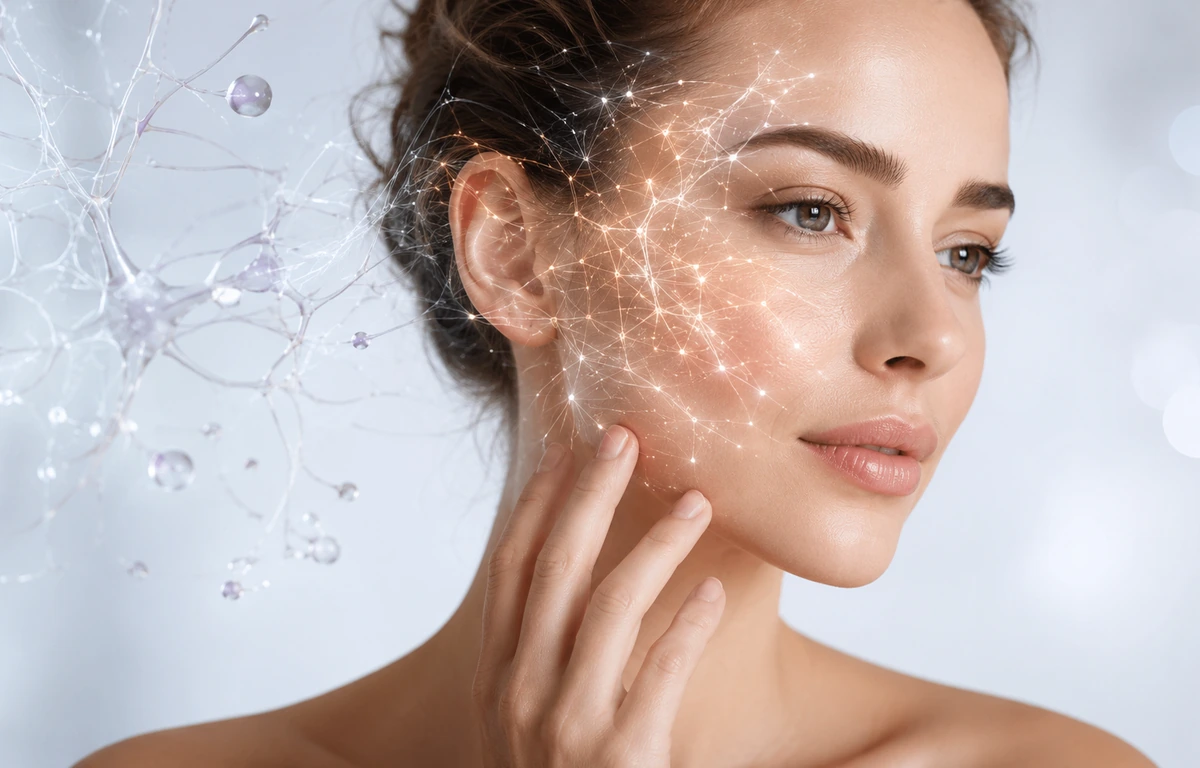
Creams no longer promise only hydration, firmness, or an even tone. Now they “control skin stress,” reduce cortisol production, influence neuropeptides, improve emotional state, and even restore younger tactile perception to the skin.
These are not invented claims. The developer of the active ingredient Neurophroline® claims it reduces cortisol production by skin cells and releases a natural soothing neuropeptide. Sensityl™ is positioned as an “indirect mood enhancer through skin soothing.” And the PrimalHyal™ NeuroYouth complex, introduced in 2026, opens up yet another category: fighting so-called neuro-ageing of the skin.
The cosmetics industry is gradually adopting a language that, until recently, belonged mainly to neuroscience, endocrinology, and psychodermatology. Ingredient presentations now feature cortisol, beta-endorphins, substance P, sensory receptors, nerve fibres, and the connection between the skin and the brain.
But a scientific term does not always mean a scientifically proven promise. If a cosmetic product affects a particular receptor in the skin, can it change mood? If a person feels better after applying a cream, what exactly worked: the active ingredient, reduced irritation, fragrance, touch, or the expectation of results?
Neurocosmetics are cosmetic products aimed at the nervous, sensory, and neuroimmune mechanisms of the skin. They may affect receptors, neuropeptide signals, neurogenic inflammation, itching, burning, and other manifestations of reactivity. This does not mean that an ordinary cream acts directly on the brain or can treat stress and psychological disorders.
What neurocosmetics are and how they work
Neurocosmetics act primarily at the level of the skin, not the central nervous system. Their potential targets include sensory nerve endings, sensory receptors, keratinocytes, immune cells, neuropeptides, and local response mechanisms to irritation.
The term itself is not as new as it may seem. Neurocosmetics have been discussed at least since the 1990s. Initially, the category included products intended to influence the skin’s neuroimmune system and reduce redness, itching, sensitivity, or neurogenic inflammation.
So-called Botox-like peptides became a separate early direction. They were developed to influence processes associated with the formation of expression lines. The best-known example is acetyl hexapeptide-8, known under the trade name Argireline®. Its mechanism was described through interaction with proteins involved in the transmission of nerve signals.
However, the word “Botox-like” did not mean that a peptide applied to the skin works in the same way as a botulinum toxin injection. In the first case, we are talking about a cosmetic ingredient with limited penetration and a much milder effect. In the second, it is a medicinal product injected directly into a muscle. Marketing combined these approaches under one easily understood comparison, although in terms of mode of action and strength of effect, they are fundamentally different.
Today, the boundaries of neurocosmetics have become even broader. The category now includes products for sensitive skin, formulas against “skin stress,” cooling and warming components, fragrance compositions for improving well-being, products for maintaining sensory comfort, and new anti-ageing ingredients targeting the nervous structures of the skin.
This expansion is exactly what has prompted professional debate. In 2025, dermatologist Laurent Misery and his co-authors published a critical commentary with the telling title “Neurocosmetics are cosmetics and therefore can only affect the skin”.
“Cosmetics with pleasant properties are not neurocosmetics.”
This phrase separates a specific effect on the skin’s neurosensory mechanisms from the ordinary pleasure of using a product. A pleasant scent, silky texture, or cooling sensation may matter to the user, but on their own they do not prove neurocosmetic action.
The “skin–brain” axis: not a metaphor, but a signalling system
The “skin–brain” axis is a two-way connection between the skin, the peripheral nervous system, immune mechanisms, hormonal response, and brain structures. Emotional state can affect skin reactivity, while prolonged skin discomfort can affect sleep, self-esteem, and quality of life.
This connection is easy to notice in everyday reactions. A person blushes from excitement, sweats under stress, gets goosebumps from fear or intense emotion. Itching can become more intense when attention is focused on it. Touch, by contrast, can sometimes reduce tension and create a sense of safety.
Behind these reactions is a complex biological network. The skin is permeated by nerve fibres that perceive temperature, pressure, pain, itching, and chemical irritants. But nerves are not the only participants in signal transmission. Keratinocytes, melanocytes, immune cells, blood vessels, and hair follicles also produce and recognise signalling molecules.
One of the most frequently mentioned examples is the TRPV1 receptor. It responds to high temperature, acidity, and certain irritating substances. Its activation partly explains the burning sensation caused by capsaicin, the compound that gives peppers their heat. In the skin, altered TRPV1 activity may be associated with burning, redness, and increased reactivity.
Other receptors in this group respond to cold, warmth, mechanical impact, and various chemical signals. That is why menthol creates a feeling of coolness without actually lowering skin temperature, while some warming components create a sensation of heat without an external heat source.
Neuropeptides are important participants in this communication: small molecules that can be released by nerve endings and other cells. Among those most often mentioned are substance P and calcitonin gene-related peptide, or CGRP. They can affect blood vessels, immune cells, and the inflammatory response.
This is how neurogenic inflammation develops: the nervous system not only reports irritation but also participates in the development of the local response. Blood vessels dilate, redness appears, immune-cell activity changes, and itching or burning intensifies.
Stress adds a hormonal layer to this system. The body changes its production of cortisol, catecholamines, cytokines, and other mediators. At the same time, the skin is not merely a passive recipient of signals from the brain. It has its own local stress-response system, in which cells can produce corticotropin-releasing hormone, proopiomelanocortin, cortisol, and related substances.
This does not mean that every rash is caused by nerves. However, stress can impair skin-barrier recovery, alter the perception of itching, sustain the inflammatory response, and affect sebum production. Against this background, some people experience flare-ups of atopic dermatitis, psoriasis, acne, rosacea, and chronic itching.
The reverse direction is no less important. A person who experiences burning, pain, or severe itching every day is unlikely to perceive it merely as a cosmetic inconvenience. Long-term discomfort disrupts sleep, makes people avoid social contact, and sustains anxiety. Visible skin changes can affect body image and a person’s attitude toward themselves.
In a 2026 scientific review, neurocosmetics are considered precisely at the intersection of dermatology, neuroscience, and psychology. The authors acknowledge the potential of products that reduce skin discomfort or improve self-perception, but emphasise that such effects are mostly indirect, context-dependent, and should not be conflated with the treatment of mental disorders.
Sensory experience matters, but it is not proof
A cosmetic product is never perceived as a set of active molecules. A person simultaneously feels its temperature, density, slip, scent, stickiness, absorption rate, and what the skin surface feels like after application.
In a laboratory description, a cream may contain an active ingredient that affects a receptor. In real life, that same cream may be too sticky, leave a heavy film, or have a scent that becomes irritating after a few minutes. Conversely, a formula without a complex neurocosmetic concept may become a favourite because of its comfort, predictability, and pleasant ritual.
We examined this difference in detail in the Union Beauty article on how skin feels cosmetics.
“A formula does not work on abstract skin, but on a specific face.”
This matters both for daily skincare and for neurocosmetics research. A finished product creates a combination of chemical, tactile, thermal, olfactory, and emotional signals. If, after application, a person reports feeling calmer, it is necessary to understand exactly which component of the experience produced the result.
Perhaps the active ingredient reduced skin reactivity. Perhaps the burning sensation that constantly distracted the person disappeared. Perhaps the fragrance worked. Or perhaps the slow application of the cream became a brief pause at the end of a stressful day.
All these effects can be real. The problem arises when they are grouped under the single word “neurocosmetics” and attributed exclusively to the active component.
Fragrance, for example, can indeed influence emotions and memory through the olfactory system. But this is a different pathway from the local interaction of a cosmetic ingredient with a skin receptor. If a scented cream improved results in a well-being questionnaire, the effect of the scent must be separated from the effect of the claimed active ingredient.
The same applies to massage. Touch and slow repetitive movements can have a calming effect regardless of the product’s composition. If one group of participants applies a product with massage while another simply spreads a control formula, the study is effectively comparing not only ingredients but also different rituals.
Even a cooling sensation can influence product evaluation. It quickly creates an impression of relief, especially on irritated skin. However, subjective cooling does not always mean a reduction in the inflammatory process.
This is why creating a high-quality control product is especially difficult for neurocosmetics. It must be as similar as possible in scent, texture, temperature, finish, and after-feel. Otherwise, a participant can easily guess which product is the active one, and expectations will begin to influence their responses.
Three examples that reveal the boundary
The market already offers several different models of neurocosmetic action. They show how quickly a local biological mechanism can turn into a broad emotional promise.
Neurophroline®: cortisol in the skin
Neurophroline® is obtained from the seeds of Tephrosia purpurea, a plant used in the Ayurvedic tradition. The developer claims that the active reduces cortisol production by skin cells, stimulates the release of a natural soothing neuropeptide, and improves visible complexion.
In laboratory studies described in a scientific review of neurocosmetic ingredients, Neurophroline® reduced cortisol production in skin cells and increased the release of beta-endorphins. This is an interesting mechanistic result, but it needs to be interpreted correctly.
Cortisol produced by skin cells is not identical to all systemic cortisol in the body. A change in a local cellular marker does not prove that a cosmetic product has reduced a person’s psychological stress. Likewise, an increase in a certain neuropeptide in a laboratory model does not automatically mean an improvement in mood.
To move from a cellular result to such a claim, the finished formula must be studied in humans, assessing not only skin parameters but also psycho-emotional state using appropriate methods.
Sensityl™: mood through soothing the skin
Sensityl™ is a microalgae-derived ingredient intended primarily for sensitive skin. The developer reports reduced expression of TRPV1 receptors, a decrease in pain sensations, an effect on inflammatory processes, and a positive change in the emotions of study participants.
When the ingredient was launched in 2019, Givaudan stated that after one month of use, participants described their feelings about their facial skin more positively compared with placebo. In marketing communication, this turned into wording about an effect on mood.
However, what was actually assessed is important. A more positive attitude toward the condition of one’s own skin and an overall improvement in mood are not the same outcomes. If the skin burns less, reddens less intensely, and causes less concern, a person may indeed feel better.
The current ingredient page uses a more precise definition: “indirect mood enhancer through skin soothing.” The word “indirect” is crucial here. It describes a plausible causal chain: first skin discomfort decreases, and only then does subjective well-being change.
PrimalHyal™ NeuroYouth: neuro-ageing of the skin
In 2026, the neurocosmetic concept moved beyond sensitivity and stress. Givaudan introduced the PrimalHyal™ NeuroYouth complex, made from low-molecular-weight hyaluronic acid and selected amino acids, targeting a process the company called Neuro Skin Ageing: neuro-ageing of the skin.
The idea is that with age, not only collagen, elastin, pigmentation, and barrier properties change. According to the developer, cutaneous nerve fibres become fewer in number, shorter, and functionally weaker. This may affect tactile perception and communication between cells.
The company reports that more than 120 volunteers took part in clinical studies. Among the claimed results are a reduction in visible skin age, fewer wrinkles, improved firmness, and restoration of tactile perception to a level characteristic of people 30 years younger.
The phrase “tactile perception 30 years younger” sounds impressive and is easy to remember. But it requires a detailed explanation. What method was used to measure sensitivity? Which age group was the result compared with? Is this the average value for all participants, the best result obtained, or a marketing transformation of technical data?
The very emergence of such an ingredient shows where the market is heading. Neurocosmetics now claim not only to reduce burning or redness, but also to occupy a place in the concept of skin longevity. The broader the promise becomes, the more important it is to see the full methodology, not just the most impressive figure.
Can neurocosmetics affect mood?
Neurocosmetics may indirectly improve well-being if they reduce itching, burning, tightness, or other discomfort. There is still insufficient convincing evidence that an ordinary cosmetic product directly controls mood through the central nervous system.
This does not diminish the value of a cosmetic result. For a person with reactive skin, being able to wash their face without burning or apply a cream without red patches appearing can significantly change everyday life. The constant anticipation of a new reaction disappears, attention to unpleasant sensations decreases, and skincare stops being a source of anxiety.
Here, it is possible to speak of a real connection between the skin and emotional comfort. However, the causal chain must be described honestly: the product improved the condition of the skin, reduced discomfort, and because of this, the person began to feel better.
A different situation arises when a brand claims that a product regulates emotions, reduces anxiety, activates “happiness hormones,” or directly affects the brain. Such claims go beyond the usual substantiation of cosmetic efficacy.
To assess changes in mood, it is not enough to ask participants whether they liked the cream. Validated psychological scales are needed, along with control of expectations, comparison with placebo, a sufficient number of participants, and a clear separation of the effects of the active component, fragrance, texture, and the ritual itself.
It is also worth distinguishing between mood, perception of one’s own skin, and satisfaction with a product. A person may evaluate their face more positively because redness has decreased. They may love a cream because of its scent. They may feel relaxed during massage. But none of these outcomes alone proves a direct neurochemical effect of the formula on the brain.
Scientific reviews acknowledge that texture, temperature, touch, and olfactory signals can influence perceived stress, comfort, and self-perception. At the same time, authors point to the heterogeneity of the studies: different methods are used, participant groups are small, questionnaires are subjective, and endpoints vary.
Particular caution is needed when transferring results from laboratory models. Detecting activity in cell culture answers the question of whether a certain mechanism is possible. It does not answer the question of whether a person will feel calmer after applying the finished cream.
Between these two conclusions stand the ingredient concentration, its stability, penetration into the skin, the composition of the full formula, duration of use, individual reactivity, and the design of the clinical study.
How to distinguish a scientific approach from a marketing promise
A scientifically grounded neurocosmetic claim should name a specific target, describe a measurable result, and rely on research of the finished product or a formula as close as possible to the one the consumer will use.
The problem with many presentations is not that the data provided are necessarily wrong. Often, the marketing wording simply becomes broader than the research result.
For example, cells showed a decrease in the production of a certain mediator. In a finished formula, reduced redness was observed. In a survey, participants reported greater comfort. All three results may be true, but they do not automatically allow a claim that the cream reduces psychological stress.
Each level of research answers its own question:
- in vitro shows a possible cellular or molecular mechanism;
- ex vivo helps assess the response of tissue or a skin model;
- instrumental measurements record hydration, barrier function, redness, temperature, firmness, or other parameters;
- clinical assessment shows visible changes according to a defined protocol;
- self-assessment conveys participants’ sensations and impressions;
- psychological methods are needed for claims about mood, anxiety, stress, or emotional well-being.
Self-assessment is not an unnecessary or secondary method. Itching, burning, tightness, and comfort are, by their nature, largely subjective. However, participants’ answers must be interpreted within the limits of what they were asked.
The phrase “90% of participants felt better” may conceal very different outcomes. Perhaps the skin became softer. Perhaps tightness decreased. Perhaps participants liked the scent. Without the questionnaire, methodology, and description of the control group, this percentage explains almost nothing.
When evaluating a neurocosmetic product, it is worth asking several practical questions:
- What exactly does the product promise: an effect on the condition of the skin or on a person’s emotions?
- Was the finished formula studied, or only a separate ingredient?
- Was the effect shown in cells, on a skin model, or with human participants?
- Did the control product contain the same fragrance and have a similar texture?
- Which parameters were measured, and do they correspond to the advertising claim?
- How many participants were in the study, and how long did they use the product?
- Has the full methodology been published, not just the most attractive result?
- Have the data been confirmed by independent researchers?
The last question is especially important. Initial trials of a new cosmetic ingredient are usually funded or conducted by its developer. This is normal practice: the company is the one investing in the technology and has access to the formula. However, a manufacturer’s internal data and an independently reproduced result carry different evidentiary weight.
In the European Union, cosmetic product claims are regulated by EU Regulation No. 655/2013. It requires promises to be truthful, honest, understandable, and supported by adequate evidence.
“The transfer of the properties of an ingredient to the finished product must be supported by adequate and verifiable evidence.”
Therefore, it is not enough to add to a formula a component that has shown a certain activity in the laboratory. It must be confirmed that the component is present at an effective concentration, remains stable, works in the specific composition, and delivers exactly the result promised to the consumer.
A separate boundary appears where a cosmetic promise begins to resemble a medical one. A product may support skin comfort and positive self-perception. But it should not be positioned as a treatment for depression, anxiety disorder, chronic stress, or sleep disorders.
A cosmetic ritual can be calming. Self-care can provide a sense of control, predictability, and care. But this does not make cosmetics a substitute for psychotherapy, medical diagnosis, or treatment.
Neurocosmetics without magic
Neurocosmetics are not an empty marketing invention. The skin truly has a complex neurosensory system, interacts with immune and endocrine mechanisms, responds to stress, and transmits signals capable of affecting a person’s well-being.
Products aimed at reducing neurogenic inflammation, reactivity, itching, burning, and sensory discomfort may become a meaningful direction in cosmetic science. This is especially important for sensitive skin, where subjective sensations are often no less significant than visible manifestations.
Research into age-related changes in the skin’s nervous structures is also promising. If further independent studies confirm the connection between the condition of nerve fibres, cellular communication, sensory perception, and ageing, neurocosmetics will gain new well-founded targets.
At the same time, the existence of the “skin–brain” axis does not turn every pleasant cream into a tool for managing emotions. The words “cortisol,” “neuropeptide,” or “endorphin” in a presentation are not yet proof of an effect on mood. And a positive impression from texture or scent does not confirm a specific neurobiological action of the active component.
The most accurate definition of neurocosmetics sounds more modest than advertising slogans. It is not “cosmetics for the brain,” but skincare that takes into account the nervous and sensory component of how the skin functions and attempts to influence it within the limits of local cosmetic action.
The word “neurocosmetics” itself makes a product neither scientific nor pseudoscientific. What matters is what stands behind it: a plausible mechanism, research on the finished formula, correctly chosen parameters, and a promise that does not go beyond the results obtained.
If these conditions are met, neurocosmetics can be a useful tool for working with sensitive, reactive, and ageing skin. If not, the “skin–brain” axis becomes nothing more than a new beautiful story printed on the packaging of an ordinary cream.

-lazy-placeholder.webp)
-medium.webp)