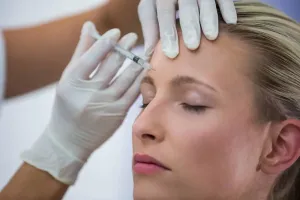






Botulinum toxin and fillers are often mentioned together because both procedures are performed using injections and are used to correct age-related changes. That is where the similarities nearly end. Botulinum toxin temporarily weakens the activity of certain muscles. Fillers are injected into the tissues to add or restore volume, change contour, or correct specific folds. The choice depends on what exactly is causing the change: muscle movement, volume deficiency, anatomical features, changes in the skin itself, or a combination of several factors. That is why equally noticeable wrinkles in two different people may require different correction.
Botox and fillers: what is the main difference
In everyday speech, the word “Botox” is often used to refer to botulinum toxin treatment in general, although Botox is the brand name of one of the botulinum toxin type A products.
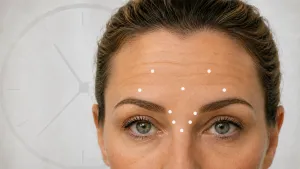
After injection, botulinum toxin reduces the transmission of the nerve signal to the target muscle. The muscle contracts less strongly, and the skin above it folds less. The most typical examples are vertical lines between the eyebrows, horizontal forehead wrinkles, and crow’s feet, which become more pronounced during facial expression.
Fillers work differently. They can restore lost volume, fill hollows, change the projection of the chin or cheekbones, add volume to the lips, or soften certain folds. The most common fillers contain hyaluronic acid, but products based on calcium hydroxyapatite, poly-L-lactic acid, and other materials are also used. Their properties and indications differ.
The division into “dynamic wrinkles for Botox” and “static wrinkles for fillers” is useful only as an initial guide. A wrinkle that is already visible at rest may be the result of many years of facial expression and structural changes in the skin. Filling such a line with filler is by no means always necessary.
| What needs to be corrected | Botulinum toxin | Filler |
|---|---|---|
| Wrinkles that form mainly during facial expression | Often the main method | Usually does not affect the cause |
| Volume loss, hollows | Does not restore volume | Can restore volume |
| Projection of the lips, chin, cheekbones | Does not add volume | Can change shape and projection |
| A deep line visible at rest | Can reduce the facial-expression component | Sometimes used depending on the cause and area |
| Uneven texture, photodamage, fine superficial wrinkles | Limited role | Not always the optimal method |
| Marked ptosis or excess skin | Does not eliminate it | Does not replace surgical lifting |
If after botulinum toxin treatment the muscle has relaxed well but a deep line remains, this may already reflect a change in the skin itself. In such cases, the doctor evaluates whether additional injectable correction is needed or whether it is more appropriate to work on skin quality—for example, using laser, peel, or other techniques.
What is chosen for different areas of the face
Forehead, glabella, and crow’s feet
When wrinkles appear or become much more pronounced during eyebrow raising, frowning, or squinting, the main cause is active muscle movement. In such cases, botulinum toxin reduces the very mechanism that creates the fold.
If a wrinkle has already become deep and is visible at rest, after the muscle relaxes it may lessen but not disappear completely. Increasing the dose of botulinum toxin does not solve the problem here: the muscle can be weakened more, but this will not restore the already altered skin structure.
The next step does not necessarily have to be filler. This is especially true for the glabella and forehead: these areas have vascular connections with the arteries that supply the eye, so filler injections here are associated with an increased risk of severe vascular complications. In the United States, the FDA does not approve the injection of dermal fillers into the glabella, forehead, nose, and periorbital area. If a static line remains after botulinum toxin treatment, the doctor evaluates its depth and the condition of the skin and decides whether additional correction is needed and by which method.
Under-eye area and the midface
Crow’s feet and hollows under the eyes are located close to each other, but they have different causes. Expression lines near the outer corner of the eye may respond to botulinum toxin. A tear trough or volume deficiency cannot be filled by it.
There are fillers with appropriate indications for infraorbital hollows, but this area requires especially careful patient selection. A tendency to swelling, lymphatic drainage features, fat pads, excess skin, or the anatomy of the lower eyelid can make the result worse rather than better.
A similar logic applies in the cheek and cheekbone area: when the problem is related to volume deficiency or insufficient projection, botulinum toxin will not compensate for it.
Nasolabial folds
The nasolabial fold is not a facial-expression wrinkle in the same sense as the lines between the eyebrows. Its prominence is influenced by facial structure, changes in the soft tissues, volume loss, and the anatomy of the fold itself. Fillers may be used to correct it, including directly in the area of the fold. But the plan is determined by the face as a whole, not only by the depth of a single line.
Trying to significantly weaken with botulinum toxin the muscles involved in smiling is not an alternative to filler: normal facial expression and mouth function may be altered without achieving the desired effect on the fold.
Lips and the area around the mouth
Filler can add volume to the lips, change the contour, proportions, or correct asymmetry. Botulinum toxin does not create volume. In the so-called lip flip, a small change in the activity of the orbicularis oris muscle can slightly change the position of the upper lip. This is a different effect and not a substitute for lip augmentation with filler.
In the lower third of the face, botulinum toxin is also used to correct certain muscle patterns—for example, excessive activity of the chin muscle, the muscles that pull down the corners of the mouth, or the chewing muscles. For a specific product, such aesthetic uses may be off-label in some countries, so the indications depend on the product and local registration.
Chin, jaw, and lower third of the face
Here, botulinum toxin and filler can sometimes produce a visually similar result by different means. If the chin lacks projection, filler can change its contour and proportions. If the surface of the chin becomes uneven because of active contraction of the m. mentalis, the treatment targets the muscle. With prominent chewing muscles, botulinum toxin can gradually reduce their activity and volume. Filler, by contrast, is used to add structural volume in certain areas of the lower third.
It is the cause of the change that determines which of these methods makes sense.
When both methods are needed—or neither
Botulinum toxin and fillers can be used in the same correction plan because they solve different tasks. For example, botulinum toxin addresses active facial expression in the upper third, while filler addresses volume deficiency in the midface or chin projection.
Sometimes several mechanisms are combined in one area. A deep wrinkle may form because of many years of muscle contraction, but over time structural changes also appear in the skin. Reducing muscle activity decreases repeated creasing, but the residual line may require separate evaluation.
Another situation is age-related changes in which skin texture, photodamage, or loss of elasticity play a major role. Adding volume does not correct all of these processes. Laser resurfacing, chemical peels, microneedling, and other skin-remodeling methods target something different and may be more appropriate.
With marked tissue sagging and excess skin, the possibilities of injections are also limited. Filler can change contour or compensate for certain volume deficiencies, but it does not perform the function of a surgical lift.
Therefore, the goal of the consultation is not to decide “which is better: Botox or filler,” but to determine which structures are creating the change and whether an injectable procedure is needed at all.
Risks and how to understand which method is suitable
The risk profiles of botulinum toxin treatment and fillers differ.
After botulinum toxin, pain, redness, or bruising at the injection site may occur. An unwanted muscular effect may appear as asymmetry, a change in eyebrow position, upper eyelid ptosis, or impaired function of neighboring muscles. There is no quick way to return the muscle to its original activity once the effect of botulinum toxin has developed. Function gradually recovers as the effect of the product weakens.
For fillers, common early reactions include swelling, redness, tenderness, and bruising. Nodules, inflammatory reactions, infections, and delayed complications are also possible. The most serious specific risk is inadvertent injection of filler into a blood vessel. Vascular occlusion can cause ischemia and tissue necrosis. If the material enters vessels connected with the blood supply to the eye or brain, visual disturbances, blindness, or stroke may occur. Such complications are rare but potentially irreversible. Unusual severe pain during or after filler injection, sudden blanching of the skin, gray or bluish discoloration, a net-like skin pattern, visual disturbances, or neurological symptoms require urgent medical evaluation.
The reversibility of the result depends on the material. Hyaluronic acid-based fillers can in many cases be partially or completely dissolved with hyaluronidase. The amount of enzyme and its effectiveness depend on the specific product, the quantity, and the location of the filler. For calcium hydroxyapatite, poly-L-lactic acid, and permanent fillers, there is no similarly rapid way to dissolve them.
For an initial orientation, you can ask yourself a few simple questions:
- Does the line appear mainly during facial expression? Muscle activity is likely playing a major role.
- Is there hollowing, volume loss, or a need to change projection? Filler may be considered.
- Does the wrinkle remain at rest even with weak facial expression? It is necessary to assess not only the muscle, but also the condition of the skin and tissue volume.
- Is the main problem laxity, texture, or marked tissue sagging? Botox and filler may not be the primary methods.
During the consultation, the doctor assesses the face at rest and in motion, baseline asymmetry, muscle activity, volume distribution, and skin quality. Only then does the same “wrinkle” turn into a specific task: reduce excessive muscle activity, restore volume, work on the skin, or combine several approaches.
Sources
- U.S. Food and Drug Administration. Dermal Fillers (Soft Tissue Fillers).
- U.S. Food and Drug Administration. FDA Executive Summary: General Issues Panel Meeting on Dermal Fillers. 2026.
- BOTOX Cosmetic (onabotulinumtoxinA). Full Prescribing Information. AbbVie / U.S. FDA.
- American Academy of Dermatology. Botulinum toxin therapy: Overview.
- American Academy of Dermatology. Fillers: Overview.
- Sundaram H, Liew S, Signorini M, et al. Global Aesthetics Consensus: Hyaluronic Acid Fillers and Botulinum Toxin Type A - Recommendations for Combined Treatment and Optimizing Outcomes in Diverse Patient Populations. Plastic and Reconstructive Surgery. 2016;137(5):1410-1423.
- Signorini M, Liew S, Sundaram H, et al. Global Aesthetics Consensus: Avoidance and Management of Complications from Hyaluronic Acid Fillers. Plastic and Reconstructive Surgery. 2016;137(6):961-971.