







Two weeks have passed since the injections, but your forehead still moves almost the same as before. Or the result was noticeable at first, but after just a few weeks, facial movement started to return actively. In both cases, it is easy to conclude: “Botox didn’t work.” In reality, these are different situations, and their causes are different too.
A weak effect may be related to the dose, the choice of injection points, and the way specific muscles work. Sometimes the product has done its job, but the wrinkle already has a pronounced static component and does not disappear simply because facial movement has been reduced. Much less often, the issue is reduced sensitivity to botulinum toxin.
That is why, after a result that seems unsuccessful at first glance, it is important to understand not only whether the wrinkle remains, but how the muscle’s activity changed after the procedure.
We discussed the normal timing of onset and duration of the effect separately in the article “When Botox starts working and how long the results last”.
Did Botox really not work — or does the result simply look insufficient?
Botulinum toxin reduces the transmission of nerve signals to the muscle. That is why the main indicator of its action is a change in the strength of contraction. If the muscle has become noticeably weaker after the procedure, the product is working, even if the line on the skin is still clearly visible.
| What is happening | What it may mean |
|---|---|
| Only a few days have passed since the procedure, and facial movement is still active | The result is being assessed too early |
| The muscle has become weaker, but the wrinkle remains at rest | Botulinum toxin has worked, but the crease already has a static component |
| After 10–14 days, the muscle moves almost as strongly as before | The effect is genuinely insufficient; the dose, injection points, and product should be reviewed |
| Part of the area has relaxed, while a separate segment remains active | There may have been insufficient correction of a specific part of the muscle |
| The result was good at first, but facial movement returned much earlier than usual | This is no longer about the strength of the initial effect, but about its duration |
| Several procedures in a row work increasingly weakly or for a shorter time | This is one scenario in which secondary reduced response should be considered |
The return of the first movements also does not mean that the action of botulinum toxin has ended. Facial movement recovers gradually: first, slight mobility appears, and only later does the muscle approach its original activity.
That is why the phrase “my Botox wore off after two months” can mean very different things. For one person, this may be the moment when an eyebrow has only just started to move; for another, strong facial movement may already have fully returned.
Why the effect may be weak or short-lived
The dose is insufficient for the specific muscle. The same standard amount of product does not produce the same result in everyone. Muscle strength, thickness, and habitual activity vary, so if the dose is insufficient, the muscles may weaken only partially.
Dose also affects how long the result lasts. In studies of the glabellar area, higher doses of onabotulinumtoxinA were associated with a longer-lasting result. But on the face, this does not mean “the more, the better”: excessive weakening of one muscle can change brow position, facial expression, and the balance of neighboring muscle groups.
Sometimes a very subtle result is the consequence of an intentionally conservative approach. If the goal was to preserve natural movement as much as possible, some facial activity will remain. Such an effect will be less pronounced and may wear off earlier than after more complete muscle relaxation.
The injection points do not fully match how the muscle works. A standard pattern is only a guide. The shape and height of the forehead, brow position, baseline asymmetry, and the strength of individual areas of the frontalis, corrugator, procerus, or orbicularis oculi all matter.
If the most active part of the muscle did not receive enough effect, one area may barely move anymore while visible facial movement remains nearby. This is why working with botulinum toxin requires not a mechanical repetition of a set of points, but an assessment of each person’s specific facial movement.
The wrinkle is no longer caused only by facial movement. A deep line that is clearly visible even at rest gradually becomes a structural change in the skin itself. After botulinum toxin, the muscle may relax very well, but the crease will not disappear completely.
In this situation, additional units will not necessarily make the skin smooth. They will weaken the muscle more strongly, but they will not remove an already formed change in skin texture. We explained the limits of what this method can achieve in more detail in the article on how botulinum toxin works on the face.
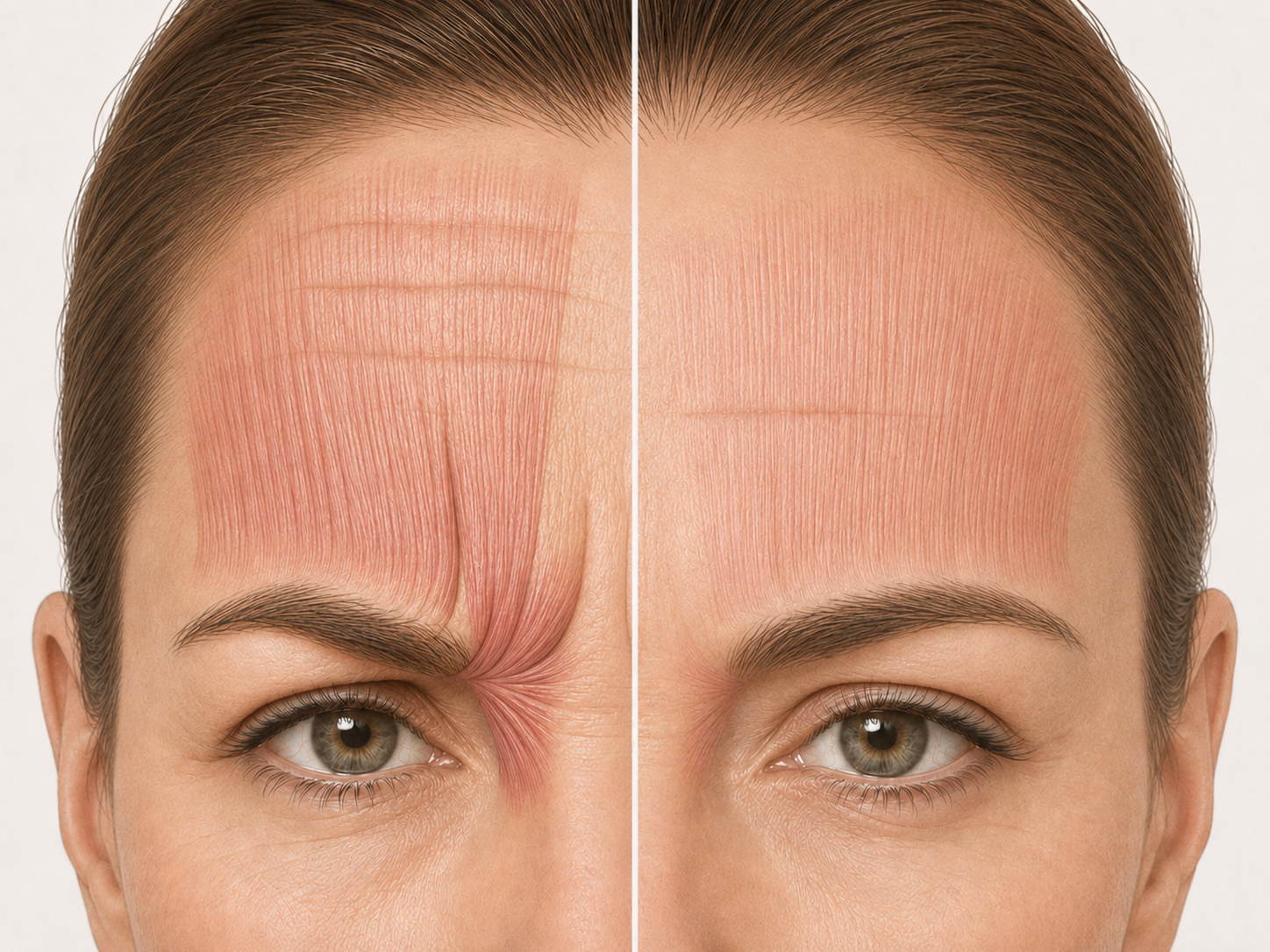
Fig. Schematic representation of the effect of botulinum toxin on expression wrinkles. Left — active muscle contraction forms dynamic wrinkles; right — after the muscle relaxes, expression lines decrease, but an already formed static line may remain.
After switching products, the wrong numbers are being compared. Units of different botulinum toxin products are not interchangeable. 20 units of one product cannot automatically be considered equal to 20 units of another. Therefore, after switching, for example, from Botox to Dysport or Xeomin, comparing only the number of units says nothing about dose equivalence.
How the product was stored, reconstituted, and injected matters. Violations of storage conditions, incorrect preparation of the product, or technical errors during injection are also described among the reasons for an insufficient response to botulinum toxin.
“Fast metabolism” does not explain everything. This is one of the most common answers to the question of why Botox did not last long, but its mechanism of action is more complex.
After injection, the product does not simply remain in the body for several months until “metabolism clears it.” It acts locally on neuromuscular transmission, and movement returns as this system recovers.
Individual differences in duration of effect do exist. They can vary between different people and even between different areas of the same face. However, if Botox used to work consistently for three to four months and now the full effect disappears within a few weeks, the explanation “you have a fast metabolism” is not enough on its own.
Physical activity, sauna use, or other habits should also not automatically be blamed for every short-lived result. It is much more useful to compare the dose, product, treatment area, technique, and response to previous procedures.
Can resistance to Botox develop?
Yes, resistance to botulinum toxin exists, but after one weak or short-lived result, it is far from the first explanation. In medicine, the term secondary nonresponse is used more often: the product previously worked normally, but over time the effect begins to weaken.
First, simpler causes should be ruled out: an insufficient dose, anatomical and facial movement patterns, suboptimal injection points, incorrect interpretation of the result, or problems with how the product was used.
In the scientific literature, secondary nonresponse is described as follows:
“Secondary nonresponse (SNR) occurs when BoNT-A is initially effective before failure commences at a later point.”
In other words, botulinum toxin works normally at first, and later the effect begins to weaken. This definition is given by George Kroumpouzos and Fernando Silikovich in a 2025 review in JMIR Dermatology.
One mechanism of true Botox resistance may be the formation of neutralizing antibodies to botulinum toxin. With aesthetic doses, this is a rare scenario.
Botox resistance should be suspected not after a single unsuccessful session, but when a consistent pattern can be traced: the product used to work well, then the effect became progressively weaker or shorter, and technical causes have already been excluded.
One short-lived effect after many normal procedures does not yet create such a pattern.
Very frequent repeat injections and high cumulative doses are considered among the factors that may increase the risk of an immune response. Therefore, constantly “adding just a little more” at short intervals is not the best strategy if the cause of the weak result is unclear.
When correction makes sense
If the result seems weak in the first few days, there is no need to rush into a touch-up: the main effect is still developing. It is much more informative to assess facial movement at around two weeks.
If the area has responded well overall but a small active area remains, targeted correction may be entirely reasonable. For example, one part of the forehead has already relaxed, while a separate active muscle segment nearby remains.
Another scenario is when, after two weeks, the entire target area moves almost the same as before the procedure. In this case, simply adding more units is not enough: it is necessary to understand how many units were injected, which product was used, and whether the treatment pattern matched the work of the specific muscles.
If the result was good at first and then disappeared unusually quickly, the doctor will be interested not only in the most recent procedure, but in the full history of botulinum toxin treatments.
After a weak or short-lived effect, it is useful to bring the following to the consultation:
- the name of the product;
- the number of units injected, if known;
- the date of the procedure;
- information about previous injections and how long they lasted;
- photos or short videos of facial movement before and after the procedure.
These details often say more than the phrase “Botox doesn’t work on me.”
A weak initial effect, a rapid return of facial movement, and a wrinkle that remains despite a well-relaxed muscle are three different situations. They are corrected in different ways as well. The purpose of a follow-up consultation is not simply to add a few more units, but to understand exactly which scenario the result belongs to.
Sources
- Kroumpouzos G, Silikovich F. Exploring Nonresponse to Botulinum Toxin in Aesthetics: Narrative Review of Key Trigger Factors and Effective Management Strategies. JMIR Dermatology. 2025;8:e69960.
- Shtefan V, Fletcher J, Duclos OA. Causes of Botulinum Toxin Treatment Failure. Clinical, Cosmetic and Investigational Dermatology. 2022;15:1045-1049.
- Kaufman-Janette J, Cox SE, Dayan S, et al. Botulinum Toxin Type A for Glabellar Frown Lines: What Impact of Higher Doses on Outcomes? Toxins. 2021;13(7):494.
- Lee KWA, et al. Immunogenicity of Botulinum Toxin Type A in Different Clinical Applications. Life. 2024;14(10):1217.
- BOTOX Cosmetic (onabotulinumtoxinA). Full Prescribing Information. AbbVie.