





The first changes after botulinum therapy do not appear immediately, and the effect does not disappear in one day. Let's figure out when Botox starts to work, how many days it takes to evaluate the result, how long it usually lasts, and whether the timing differs for different type A botulinum toxin preparations.
In everyday language, the word "Botox" is often used to refer to various type A botulinum toxin preparations. In this material, we explain the basic timeline primarily using the example of BOTOX Cosmetic (onabotulinumtoxinA), as detailed current instructions and a large array of registration randomized studies with consistent result evaluation on the 7th, 30th, 60th, 90th, and 120th day are available for it. The timing may differ for other preparations. Full instructions for BOTOX Cosmetic.
The mechanism of botulinum therapy, indications, correction zones, and situations where the method does not solve the problem are discussed in more detail in our material Botox for the face: how botulinum therapy works.
When Botox starts to work
Botulinum toxin reduces muscle activity not mechanically. It blocks the release of acetylcholine at the neuromuscular junction, thereby weakening the signal transmission from the nerve to the muscle. The BOTOX Cosmetic instructions state that the initial chemical denervation of muscles occurs approximately 1-2 days after administration and intensifies during the first week. The visible cosmetic result may appear later.
The approximate dynamics after the procedure look like this:
| Time after injection | What to expect |
|---|---|
| 1-2 days | A pronounced cosmetic result may not yet be visible, although the drug's action is already beginning |
| 3-5 days | Many people notice a reduction in facial expression activity |
| 7 days | The effect is usually already well noticeable |
| 10-14 days | The result can be more specifically evaluated by muscle contraction strength, symmetry, and wrinkle severity |
| Following weeks | The effect may still change somewhat |
In registration studies of BOTOX Cosmetic, by the 7th day, 74% of participants had absent or mild glabellar lines according to the doctor's assessment, and by the 30th day - 80%. The participants themselves assessed the improvement even more frequently. Therefore, the practical guideline of 10-14 days is needed not because the drug "is not yet working" by this time, but to evaluate a more formed result.
The speed of changes after cosmetic procedures can generally differ. We wrote more about this in the material about the non-linearity of results in cosmetology.
It is also important to distinguish between the reduction of muscle activity and the disappearance of a wrinkle. If a fold is already well visible at rest, it may remain even with a significant weakening of facial expressions. Botulinum toxin works with the muscle component and cannot instantly restructure the skin's structure. This is one example of the physiological limits of cosmetology methods.
How long Botox lasts and whether different preparations act the same
For BOTOX Cosmetic, the official instructions indicate the duration of the effect in correcting glabellar lines is approximately 3-4 months. In registration studies, the reduction in wrinkle severity compared to placebo was traced up to the 120th day. At the same time, the effect weakens gradually, not disappearing on a specific date.
In 2025, JAMA Dermatology published a direct double-blind randomized study of four type A botulinum toxin preparations for the glabellar area. Botox, Dysport, Jeuveau, and Xeomin were administered in the recommended doses for each preparation and evaluated by one method on the 3rd, 30th, 90th, and 180th day. This allows comparing the time dynamics of the preparations under the same conditions. Randomized study in JAMA Dermatology.
| Preparation | Action on the 3rd day in the direct study | When the maximum effect was observed | What is known about the duration |
|---|---|---|---|
| Botox / onabotulinumtoxinA | About 70% of the maximum effect | Mainly the 30th day | Official guideline for the glabellar area - about 3-4 months |
| Dysport / abobotulinumtoxinA | About 85%; the fastest dynamics along with Jeuveau | In this study, a pronounced effect was already on the 3rd day | In FDA registration data, the median onset of response is 3 days, the effect was traced up to 4 months |
| Jeuveau / prabotulinumtoxinA | About 82% of the maximum effect | Mainly the 30th day | In the study, residual muscle deformation reduction was determined even on the 180th day |
| Xeomin / incobotulinumtoxinA | About 64% of the maximum effect | Mainly the 30th day | The current FDA instructions indicate the onset of action within 2-7 days and a typical duration of 12-16 weeks |
For Dysport, these timings are confirmed by FDA materials. For Xeomin, the current American instructions indicate the onset of action within 2-7 days and a typical duration of 12-16 weeks: XEOMIN instructions.
The figures in the table show dynamics, not the exact duration of the full cosmetic effect for each person. For example, residual action measurable on the 180th day does not mean that a pronounced result is maintained for six months in all patients.
The study was single-center and funded by Evolus - the manufacturer of Jeuveau. Therefore, its results are primarily useful for comparing the time dynamics of the preparations, not for compiling a "best-worst" rating.
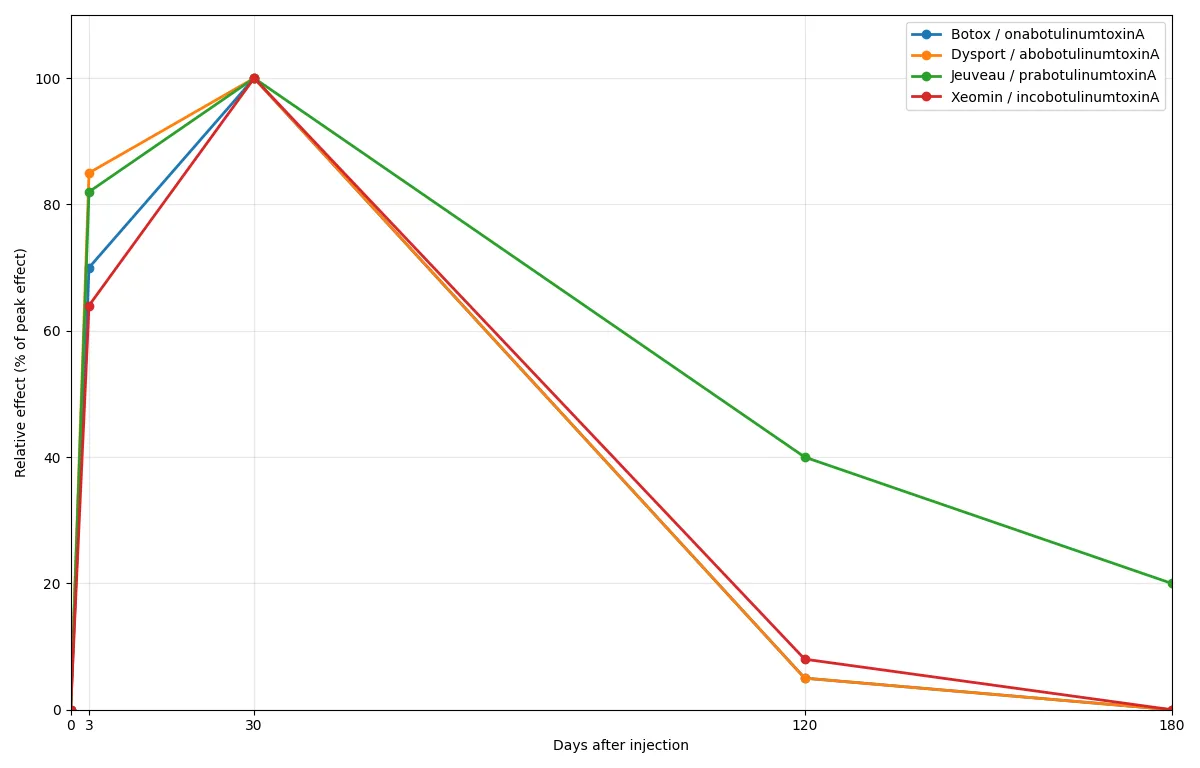
Fig. Dynamics of action of type A botulinum toxin preparations
Individual preparations may have a longer action profile. For example, in studies of daxibotulinumtoxinA (Daxxify), the median retention of glabellar lines at the "absent or mild" level was about 24 weeks. This indicator cannot be directly compared with the data in the table above due to different study protocols. SAKURA 1 and SAKURA 2.
Another important detail: units of different botulinum toxins are not interchangeable. For example, 20 units of Botox cannot be automatically equated to 20 units of Dysport. These are separate preparations with their own methods of determining biological activity.
What determines the duration of the result
The duration of action is determined by more than one factor.
Preparation and dose. Different formulas have different activity units and are studied in their own recommended doses. The dose can also affect the duration of the response, but increasing the amount of the drug itself does not guarantee a better result. Excessive muscle weakening can change the natural expression and balance of neighboring muscle groups.
Zone and muscle strength. The glabellar area, forehead, and area around the eyes have different anatomy and functional load. Therefore, the same person may notice the return of facial expressions in different zones at different times.
Individual response. Even in controlled studies, the effect weakens not simultaneously in all participants. Therefore, three or four months is a guideline, not an exact duration for each person.
The duration of the effect is not reduced to the speed of "elimination" of the drug from the body. Botulinum toxin initiates a block of neuromuscular transmission, and the return of facial expressions is primarily associated with the gradual restoration of this function and reinnervation. Therefore, the first muscle movements may appear earlier than the effect of botulinum therapy completely disappears.
Neutralizing antibodies can also affect the response, but in aesthetic applications, this is not the most typical explanation for a weak effect. In three studies of BOTOX Cosmetic for lateral wrinkles around the eyes, among 916 studied patients, neutralizing antibodies were not detected.
What to do if the effect is weak or quickly disappears
If only a few days have passed since the procedure, it is too early to conclude unsuccessful botulinum therapy. It is important to evaluate not only the wrinkle itself but also the muscle function: how much the contraction strength has changed, whether symmetry is maintained, and whether the right and left sides work equally.
If the muscle has noticeably relaxed, but a deep fold remains, this does not necessarily mean that the drug did not work. A static wrinkle already exists in the skin's structure and may not completely disappear just after reducing muscle activity.
If approximately 10-14 days later the activity of the target muscle has almost not changed or the result significantly differs from the expected, the situation should be evaluated together with the doctor who performed the procedure. The preparation, dose, injection points, anatomy, muscle strength, and previous history of botulinum therapy may all be significant.
It is not worth immediately repeating the full procedure without evaluating the result. For BOTOX Cosmetic, the safety and efficacy of administration more often than once every three months have not been clinically established.
Thus, the question "how long does Botox last" does not have one correct number. Using the example of BOTOX Cosmetic, one can orient approximately 3-4 months, but the visible effect forms gradually and weakens just as gradually. Other type A botulinum toxin preparations may differ in the speed of onset and duration of response, and individual dynamics do not always coincide with the average study indicators.
Sources
- BOTOX Cosmetic (onabotulinumtoxinA). Full Prescribing Information. AbbVie.
- Lemdani MS, Honig SE, Habarth-Morales TE et al. Comparison of Botulinum Toxin A Formulations for Glabellar Strain Treatment in Women: A Double-Blind Randomized Clinical Trial. JAMA Dermatology. 2025;161(7):723-730.
- U.S. Food and Drug Administration. Clinical review and approval materials for Dysport (abobotulinumtoxinA), glabellar lines.
- XEOMIN (incobotulinumtoxinA). Full Prescribing Information. U.S. Food and Drug Administration. 2026.
- Fabi SG, Cohen JL, Green LJ et al. DaxibotulinumtoxinA for Injection for the Treatment of Glabellar Lines: Results From SAKURA 1 and SAKURA 2. Plastic and Reconstructive Surgery. 2020.