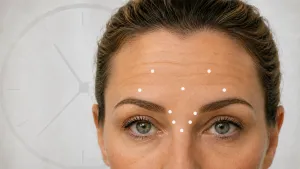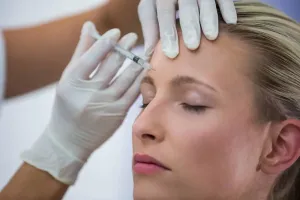







Botox, Dysport, Xeomin, as well as newer products such as Jeuveau, Daxxify, Letybo and others, all belong to one broad category. Their action is based on botulinum toxin type A: after injection, it temporarily reduces signal transmission from the nerve to the muscle, so the selected muscle contracts less strongly. Their similarities do not end there, but these products are not identical either.
They differ in manufacturing technology, purification and stabilization, the composition of the finished product, the method used to determine biological activity, recommended doses, and approved indications. Because of this, even the word “unit” does not mean exactly the same thing for different toxins.
That is why the question “which is stronger — Botox or Dysport?” does not have a simple answer. First, it is necessary to understand what exactly we are comparing: dose, speed of onset, area of muscle weakening, degree of facial movement restriction, or duration of the result.
One area, but different units
The name Botox has become so firmly established in everyday language that it is often used to refer to any botulinum toxin treatment. In reality, BOTOX Cosmetic is a specific product: onabotulinumtoxinA. Dysport contains abobotulinumtoxinA, and Xeomin contains incobotulinumtoxinA. There are also other botulinum toxin type A products: Jeuveau, Letybo, and Daxxify. All of them work in a similar way, but each has its own dosing system. And this is where confusion most often arises.
A botulinum toxin unit is not a milliliter and not a certain weight-based amount of substance. It reflects the biological activity of the product. Milliliters show only the volume of solution that is injected.
For example, a syringe may contain 0.1 ml of Botox solution, but those 0.1 ml will contain a certain number of units — depending on the concentration at which the product was prepared. Therefore, the phrases “20 units were injected” and “0.5 ml was injected” describe different things: the first refers to the dose of the product, while the second refers to the volume of liquid.
Another important point: one unit of Botox is not equal to one unit of Dysport or any other botulinum toxin. Each manufacturer determines the biological activity of its product using its own standardized method. Therefore, units of different products are not officially considered interchangeable.
This is clearly seen in the doses for the same area — glabellar lines between the eyebrows.
| Product | Active ingredient | FDA-approved dose for glabellar lines in the U.S. |
|---|---|---|
| BOTOX Cosmetic | onabotulinumtoxinA | 20 U |
| Dysport | abobotulinumtoxinA | 50 U |
| Xeomin | incobotulinumtoxinA | 20 U |
| Jeuveau | prabotulinumtoxinA | 20 U |
| Letybo | letibotulinumtoxinA | 20 U |
| Daxxify | daxibotulinumtoxinA | 40 U |
These numbers do not mean that 50 U of Dysport is two and a half times “stronger” than 20 U of Botox, or that 40 U of Daxxify means twice as much product. They are simply different systems for measuring activity. You can think of it roughly like different temperature scales: 20 degrees Celsius and 68 degrees Fahrenheit are different numbers, but they describe the same temperature. With botulinum toxins, the analogy is not perfect because there is no single precise universal conversion factor between products, but the principle is the same: the number itself says almost nothing without the name of the product. Therefore, a situation such as “I used to get 50 units, and now only 20” does not mean the dose was lower this time. If Dysport was used before and Botox or Xeomin is being used now, the numbers simply cannot be compared directly.
In clinical practice, doctors rely on the recommended doses of the specific product and their own experience with it. There are practical ratios that can help when switching from one toxin to another, but for patients they should not turn into a do-it-yourself “unit calculator.” It is far more useful to remember which product was used, in which area, what dose of that specific product was injected, what the result was, and how long it lasted.
In other words, what should be compared is not simply 20 U versus 50 U, but the result of one procedure versus the result of another.
Onset, duration, and “spread”: where the differences really exist
No botulinum toxin product relaxes the muscle at the moment of injection. Time is needed for the neurotoxin to bind to the nerve ending and interfere with the release of acetylcholine. Package inserts describe this process in different ways. For BOTOX Cosmetic, it is stated that initial chemical denervation occurs within approximately 1-2 days, with intensity increasing during the first week. For Xeomin, the median onset of the actual clinical effect is listed as 2-7 days. These are different assessment criteria, so using these figures to create a speed ranking of Botox and Xeomin would be incorrect.
The situation with Dysport is similar. It is often said to have a faster onset, and some individual studies have indeed found differences between products in the first few days. In other comparisons, however, a different toxin began working faster. In practice, there is no consistent order of “Dysport first, Botox second, Xeomin third.” The treatment area, dose, muscle activity, and injection pattern for a particular person matter more than a difference of a few days between study averages.
Duration also cannot be reduced to a simple “long — medium — short” table. For classic type A products, the aesthetic effect often lasts about three to four months. The BOTOX Cosmetic prescribing information lists approximately 3-4 months for the glabellar area, while Xeomin describes the typical duration of effect as 12-16 weeks. This is not an expiration date: muscle movement returns gradually. Daxxify stands somewhat apart. In large phase 3 studies for glabellar lines, after injection of 40 U, the median time during which results were maintained at the level of “none or mild wrinkles” was about 24 weeks. So it can indeed be discussed if one of the priorities is a longer-lasting effect in this particular area. These 24 weeks should not be automatically applied to the forehead, “crow’s feet,” or any other area: the studied and FDA-approved aesthetic indication for Daxxify in the U.S. is glabellar lines.
And here again it becomes clear why units should not be read literally: 40 U of Daxxify does not make it “twice as strong” as 20 U of Botox.
Read more about when Botox starts working and how long the effect lasts in another Cosmet.info article.
Even more myths have arisen around the “spread” of the product. Online, you can often find what looks almost like a ready-made map: Dysport supposedly spreads more widely, Botox acts more locally, and Xeomin is the most “precise.” This has led to advice to choose one toxin for a large forehead and another for the area around the eyes. Such a scheme oversimplifies what happens after injection. The local area of muscle weakening does have a certain size. But it is affected by dose, concentration, the volume of solution injected, the number of injection points, their location, and the anatomy of the muscle.
A small study showed that when the same amount of onabotulinumtoxinA was diluted more and injected in a larger volume, the product could spread over a larger area of the muscle. In nine out of ten participants, the zone of effect was approximately 50% larger. Sometimes a wider area of weakening is needed. In another anatomical region, even a small unwanted effect on a neighboring muscle can change the position of the eyebrow or eyelid. The doctor’s task is not to find a toxin that “doesn’t spread anywhere,” but to achieve the desired effect precisely in the planned area.
Therefore, the risk of ptosis or asymmetry cannot be solved by brand choice alone. The anatomy of the individual face, injection points, dose, volume, and injection technique are far more important.
Xeomin without complexing proteins: does this mean a lower risk of “resistance”?
Xeomin does indeed differ from Botox and Dysport in composition. During the production of incobotulinumtoxinA, the active neurotoxin is separated from other proteins of the botulinum complex, so the product contains the 150 kDa neurotoxin without so-called complexing, or accessory, proteins. This is why Xeomin is often called a “pure botulinum toxin.” This does not mean that other products contain unwanted impurities: it refers to a different protein composition of the finished products.
Does this difference have practical significance? It is mainly discussed in connection with immunogenicity — the ability of a product to trigger antibody formation.
Botulinum neurotoxin is a protein, and under certain conditions the immune system can produce neutralizing antibodies against it. If enough of them are formed, the toxin binds less effectively to its target, so the result of injections becomes weaker or disappears. In everyday language, this is sometimes called “getting used to Botox,” although it is more accurate to speak of secondary immune non-response or resistance.
The absence of complexing proteins reduces the overall protein load of the product, so incobotulinumtoxinA is considered to have very low immunogenic potential. This is one of its real pharmaceutical characteristics. However, in aesthetic medicine, the difference is less significant than advertising may suggest: modern botulinum toxin type A products are used here in relatively small doses, and neutralizing antibodies after cosmetic procedures form rarely.
In other words, Xeomin cannot be described as a product to which resistance is impossible to develop, just as it is incorrect to assume that Botox or Dysport will inevitably “stop working” after several years of use.
The risk of neutralizing antibody formation increases primarily with a higher cumulative amount of toxin, frequent repeat injections, and large doses. This is why immune resistance is far more relevant in neurology and other therapeutic fields, where botulinum toxin may be administered for years at doses much higher than aesthetic doses.
For a cosmetic patient, the more important takeaway is this: if botulinum toxin suddenly seemed to work less effectively after a procedure, antibodies are far from the most likely explanation. Much more often, the reason lies in the dose, choice of muscles and injection points, technique, individual facial muscle activity, or simply in assessing the result too early. We discuss possible reasons in more detail in the article “Why Botox did not work or wore off quickly”.
For the same reason, there is no need to regularly alternate Botox, Dysport, and Xeomin “so the body doesn’t get used to them.” Such rotation is not, by itself, a method of preventing resistance. If true neutralizing antibodies to botulinum toxin type A have already formed, simply changing the brand name will not solve the problem. The immune system reacts to the neurotoxin itself, not to the product name on the vial.
Therefore, the situation “Botox stopped working — let’s try Dysport or Xeomin” does not yet prove resistance. First, it is necessary to determine whether the body has truly become insensitive to the toxin or whether the weak result has a much simpler explanation.
Which botulinum toxin is better to choose?
If a certain product has already been used several times and the result has been consistently satisfactory, there is usually no reason to change it just for the sake of a different trade name. At the same time, there are situations where the properties of a particular product can genuinely influence the choice.
If the main priority is duration of effect, Daxxify can be discussed for correction of the frown lines between the eyebrows, provided it is approved and available in your country. For daxibotulinumtoxinA, clinical data show a longer duration of effect after a single procedure than is usually expected from classic botulinum toxin type A products.
If there is a well-founded suspicion of secondary immune resistance, or if a person has been receiving large repeat doses of botulinum toxin for medical indications for years, the composition and immunogenicity of the product become more important. In such a situation, Xeomin’s specific feature may matter: incobotulinumtoxinA does not contain complexing proteins. For routine aesthetic injections, this criterion rarely becomes decisive.
It is also important to consider approved indications. For example, in the U.S., Xeomin is approved for the correction of glabellar lines, horizontal forehead lines, and lateral canthal lines, while for Dysport, Jeuveau, Letybo, and Daxxify, the aesthetic indication remains glabellar lines. This matters for official protocols, but it does not create a universal ranking of products.
The legal origin of the product, its registration in your country, and compliance with storage conditions are no less important. And when comparing cost, it is better to look not at the price of one unit, but at the total cost of correcting the desired area: units of different products are not interchangeable.
The final choice also depends on what exactly needs to be corrected: frown lines between the eyebrows, horizontal forehead lines, “crow’s feet,” eyebrow position, or another area. We explain in detail how botulinum toxin acts on facial muscles, what it can correct, and where the method’s limitations begin in the article “Botox for the face: how botulinum toxin works, possibilities and limitations of botulinum toxin treatment”.
So during a consultation, it is more useful to ask not “which Botox is the strongest?” but which product is being recommended for your specific concern, why it was chosen, and how much the full correction will cost.
Sources
- U.S. Food and Drug Administration / DailyMed. BOTOX Cosmetic (onabotulinumtoxinA): Prescribing Information.
- U.S. Food and Drug Administration / DailyMed. DYSPORT (abobotulinumtoxinA): Prescribing Information.
- U.S. Food and Drug Administration / DailyMed. XEOMIN (incobotulinumtoxinA): Prescribing Information.
- U.S. Food and Drug Administration / DailyMed. JEUVEAU (prabotulinumtoxinA): Prescribing Information.
- U.S. Food and Drug Administration / DailyMed. LETYBO (letibotulinumtoxinA-wlbg): Prescribing Information.
- U.S. Food and Drug Administration / DailyMed. DAXXIFY (daxibotulinumtoxinA-lanm): Prescribing Information.
- Sattler G, Callander MJ, Grablowitz D, et al. Noninferiority of IncobotulinumtoxinA, Free from Complexing Proteins, Compared with Another Botulinum Toxin Type A in the Treatment of Glabellar Frown Lines. Dermatol Surg. 2010.
- Hsu TSJ, Dover JS, Arndt KA. Effect of Volume and Concentration on the Diffusion of Botulinum Exotoxin A. Arch Dermatol. 2004.
- Carruthers JD, Fagien S, Joseph JH, et al. DaxibotulinumtoxinA for Injection for the Treatment of Glabellar Lines: Results from Each of Two Multicenter, Randomized, Double-Blind, Placebo-Controlled, Phase 3 Studies. Plast Reconstr Surg. 2020.
- Bertucci V, Solish N, Kaufman-Janette J, et al. DaxibotulinumtoxinA for Injection Has a Prolonged Duration of Response in the Treatment of Glabellar Lines. J Am Acad Dermatol. 2020.
- Rahman E, Alhitmi HK, Mosahebi A. Botulinum Toxin Type A Immunogenicity across Multiple Indications: An Overview Systematic Review. Plast Reconstr Surg Glob Open. 2022.