

Post-acne marks may include spots, depressions, or raised areas. This article focuses mainly on atrophic scars and methods of correcting them: laser treatment, microneedling, subcision, and TCA CROSS. The choice depends on the scar’s shape, depth, and whether it is tethered to deeper tissues.
Before choosing a procedure, it is important to distinguish between a change in skin color and a change in skin texture. Flat red or brown marks are post-inflammatory erythema or hyperpigmentation, not depressions. Raised hypertrophic scars and keloids also have a different structure and require a different approach.
What is an atrophic scar?
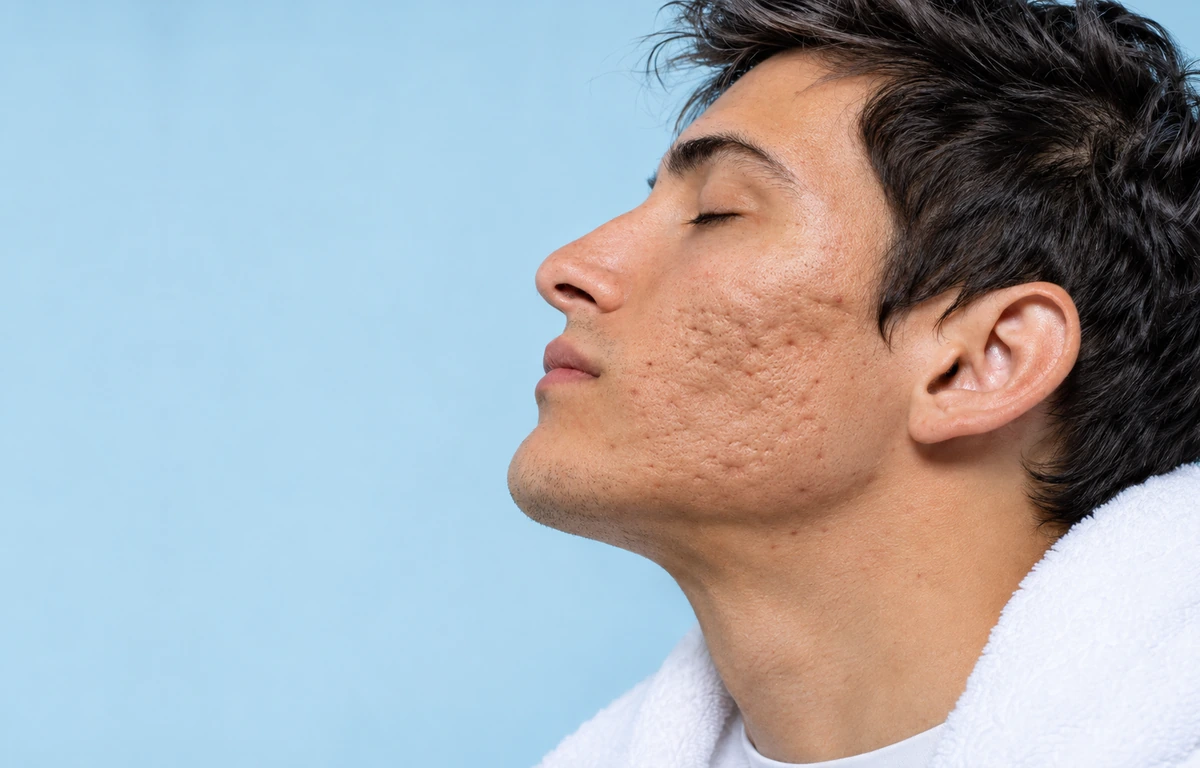
Inflammatory acne can damage the dermis. If, during healing, its supporting matrix — in particular collagen fibers — does not fully recover, there is less tissue in that area and a depression remains on the skin surface. This defect is called an atrophic scar.
Some scars have an additional feature: fibrous bands connect the base of the depression to the subcutaneous tissues and hold it down. This is often the case with rolling scars. Therefore, correction may sometimes require not only stimulating dermal remodeling, but also releasing the tissue being pulled by these bands.
Types of atrophic scars
- Rolling, or undulating: broad depressions with gently sloping edges. Fibrous bands may tether their base to deeper tissues.
- Boxcar, or rectangular: round or oval depressions with well-defined, almost vertical edges. They can be shallow or deep.
- Ice pick, or narrow deep scars: small openings that narrow as they extend deeper into the skin.
Several scar types may be present on the same face. During the examination, the doctor assesses their shape, depth, number, tethering to deeper tissues, and the risk of pigmentation.
How scar type relates to treatment method
| Type of defect | Methods considered | Course and recovery |
|---|---|---|
| Depressed areas held down by fibrous bands | Subcision | One session or a repeat procedure may be needed, depending on the degree of residual tethering. Swelling and bruising usually resolve within a few days. In a study of a combined protocol with a CO₂ laser, bruising lasted 1–2 weeks. |
| Individual narrow deep scars | TCA CROSS | Studies often used 3–4 procedures. Crusts usually fall off within a few days, sometimes within 5–10 days. |
| Superficial atrophic scars and overall uneven texture | Classic microneedling | Usually, 3–4 procedures are planned at intervals of about a month. Redness and sensitivity most often last a few days. |
| Uneven skin relief in atrophic scars | Non-ablative fractional laser | Several procedures are needed; in a randomized study, three monthly sessions were performed. Redness lasts from several days depending on the device and protocol. |
| More pronounced textural irregularities | Ablative fractional laser | The number of procedures depends on the laser and the treatment plan. In a study with a CO₂ laser, redness lasted an average of 11.5 days, while crusting and peeling lasted 7.4 days. |
| Individual deep boxcar or ice-pick defects | Punch excision or punch elevation | This method is used for individual scars; the wound is closed with a suture or adhesive strips. The healing period depends on the size and location of the defect. |
These are general reference points, not a ready-made course for every patient. Recovery time depends on the depth and intensity of the treatment, the specific device, and the skin’s response. For example, the timeframes given after subcision refer to a study where it was combined with a CO₂ laser, while the timeframes after ablative laser treatment refer to a specific clinical protocol.
RF microneedling is also used for atrophic scars, but it combines punctures with tissue heating. This is a separate technology with its own parameters and risk profile. Read more in the article about indications and patient selection for RF microneedling.
How the main methods work
Subcision
During acne healing, dense connective tissue bands may form under the skin. They attach the base of the scar to deeper tissues. During subcision, the doctor mechanically cuts these bands with a needle or cannula, releasing the depressed area.
Subcision changes the position of the tissue being pulled by the bands. By itself, it does not level the entire skin surface; after healing, the doctor assesses whether additional treatment is needed for any remaining irregularity.
TCA CROSS
During TCA CROSS, high-concentration trichloroacetic acid is applied directly inside an individual scar. The localized injury triggers healing and tissue remodeling. Precision of application is important: the acid must remain within the defect without damaging the surrounding skin.
In a study involving 31 people, TCA CROSS with concentrations of 50% and 80% was compared. Scars improved after both options; the difference in the degree of improvement between the sides of the face was not statistically significant, but adverse reactions with 80% were more severe.
Microneedling
Sterile needles create controlled micro-punctures in the skin. In response, healing begins and the dermal matrix is gradually remodeled. The result develops gradually.
Classic microneedling does not cut fibrous bands and does not act precisely inside a narrow deep defect. Its purpose is to stimulate remodeling in the treated area. Read more about the mechanism of classic microneedling and how it differs from RF in our article on facial microneedling.
Fractional laser
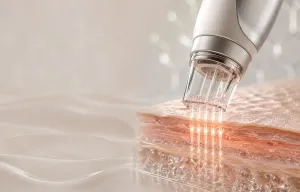
A fractional laser creates microzones of controlled treatment in the tissue, with intact skin left between them. Ablative lasers remove part of the tissue in these zones, while non-ablative lasers mainly heat it. This determines the depth of impact, recovery, and the risk of pigment changes.
In a head-to-head study of a 1340 nm non-ablative fractional laser and classic microneedling, both methods improved the appearance of atrophic scars; no statistically significant difference between the results was found. After the laser procedure, erythema lasted longer, and post-inflammatory hyperpigmentation was recorded in 13.6% of participants in the laser group; there were no such cases in the microneedling group.
Read more about the effectiveness and risks of fractional laser resurfacing and recovery after the procedure in separate articles.
What researchers found
In a 2025 network meta-analysis, 68 randomized studies involving 4,480 patients were pooled. The authors evaluated scar severity using the ECCA and Goodman–Baron scales, pain, patient satisfaction, and adverse reactions. The published meta-analysis showed:
- On the ECCA scale, the highest-ranked treatment was laser combined with PRP — platelet-rich plasma (SUCRA 98.4%).
- On the Goodman–Baron scale, it was laser combined with filler (SUCRA 72.1%).
- For patient satisfaction, it was laser combined with a chemical peel (SUCRA 89.6%).
- For pain tolerability, microneedling ranked highest (SUCRA 72.6%).
For erythema and post-inflammatory hyperpigmentation, the meta-analysis did not identify a convincing advantage of any single method.
SUCRA is a ranking measure used in network meta-analysis; it is not the percentage of scar improvement.
How a correction plan is developed
First, the doctor determines whether there is active acne, flat spots, atrophic depressions, or raised scars. Active inflammatory breakouts are usually treated before scar correction, because new lesions may leave new defects.
Next, each area is assessed: scar shape, depth, edge definition, and the presence of fibrous bands. If several types are present, procedures may be included in one plan but carried out in separate stages. The sequence is determined by which specific structure needs to be changed and by how the skin recovered after the previous treatment.
During the consultation, it is worth clarifying which type of scar the doctor plans to correct, why the chosen method is suitable for it, how many procedures the plan includes, and how long recovery will take. A realistic treatment goal is to reduce the visibility of scars and improve skin texture; the degree of change depends on their depth and structure.
Sources
- Tahiliani S, Mysore V, Ganjoo A, et al. Practical Aspects of Acne Scar Management: ASAP 2024. Cureus. 2024;16(3):e55897. doi:10.7759/cureus.55897.
- Wu B, Gao M, Zhang Y, Bai X. Optimal treatment options for acne scars in patients with historic acne: a systematic review and network meta-analysis. PeerJ. 2025;13:e19938. doi:10.7717/peerj.19938.
- Thuy LND, Trang VTT, Tran NN, Thao DTP. Comparing the Use of 80% Trichloroacetic Acid and 50% Trichloroacetic Acid for the Treatment of Ice Pick Acne Scars. Dermatol Surg. 2024;50(9):847–850. doi:10.1097/DSS.0000000000004228.
- Cachafeiro T, Escobar G, Maldonado G, Cestari T, Corleta O. Comparison of Nonablative Fractional Erbium Laser 1,340 nm and Microneedling for the Treatment of Atrophic Acne Scars: A Randomized Clinical Trial. Dermatol Surg. 2016;42(2):232–241. doi:10.1097/DSS.0000000000000597.
- Nilforoushzadeh MA, Faghihi G, Jaffary F, Haftbaradaran E, Hoseini SM, Mazaheri N. Fractional Carbon Dioxide Laser and its Combination with Subcision in Improving Atrophic Acne Scars. Adv Biomed Res. 2017;6:20. doi:10.4103/2277-9175.201332.
- Cho SB, Lee SJ, Cho S, Oh SH, Chung WS, Kang JM, Kim YK, Kim DH. Non-ablative 1550-nm erbium-glass and ablative 10 600-nm carbon dioxide fractional lasers for acne scars: a randomized split-face study with blinded response evaluation. J Eur Acad Dermatol Venereol. 2010;24(8):921–925. doi:10.1111/j.1468-3083.2009.03551.x.
- Melo MGDP, de Barros JM, Lima RA. Use of Trichloroacetic Acid in Treatment of Atrophic Acne Scars: A Scoping Review. J Cosmet Dermatol. 2026;25(8):e71110. doi:10.1111/jocd.71110.