





Why does a clinic say recovery takes 5–7 days, while two weeks later the face is still pink and sensitive? The reason is that these are different stages of the same process. The skin surface may already be healed, while redness, dryness, and increased reactivity can still persist. In addition, the skin recovers according to different scenarios after ablative and non-ablative laser treatments. So before comparing yourself with “day-by-day face after laser” photos, it is worth finding out exactly what type of procedure was performed.
After laser resurfacing, the skin may recover over several days or several weeks. The difference depends primarily on the type of treatment, as well as on the intensity of the procedure, the area treated, and the treatment zone. This article discusses resurfacing performed to correct skin texture, wrinkles, photodamage, and scars, mainly on the face. Vascular lasers, laser hair removal, and removal of pigmented lesions require different recovery protocols.
How fractional laser works, who the procedure is suitable for, and what risks it involves, we discussed in the article Fractional Laser Resurfacing Without Exaggeration: How It Works, Who It Suits, and Where the Risks Begin. Now let’s talk about the period after the procedure: how the skin changes, how long healing lasts, and when you can return to normal life.
Ablative and non-ablative resurfacing: two recovery scenarios
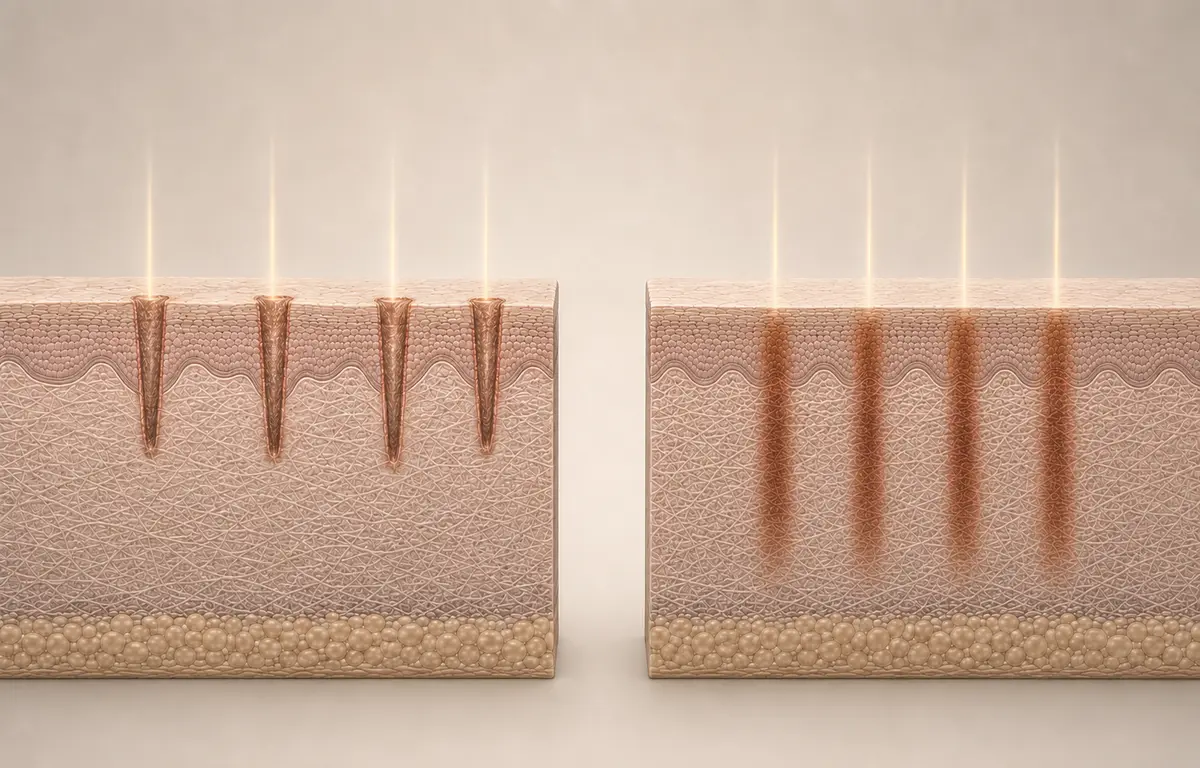
The terms “fractional laser,” “Fraxel,” or “laser rejuvenation” do not provide enough information to predict the course of recovery. Fractional treatment may be either ablative or non-ablative. During ablative resurfacing, the laser vaporizes part of the epidermis: in separate micro-areas during fractional treatment or continuously across the entire zone. The integrity of the skin surface is disrupted, so recovery includes healing and re-formation of the epidermal barrier.
A non-ablative laser does not vaporize the epidermis and does not create an open wound surface. It forms microzones of controlled heating in the tissues while leaving the skin surface intact. Therefore, recovery is usually faster, and its main manifestations are redness, swelling, a feeling of warmth, dryness, and peeling.
| Ablative resurfacing | Non-ablative resurfacing | |
|---|---|---|
| What happens | Part of the epidermis is removed. After fractional treatment, microchannels remain; after fully ablative treatment, the wound surface is much larger | The tissues are heated to a set depth, but the epidermis is not vaporized to form an open wound |
| What is visible after the procedure | Marked redness, swelling, burning, possible oozing, darkening, fine crusts, and peeling | Redness, warmth, moderate swelling, tightness; sometimes darkening of certain areas and fine peeling |
| Main goal of care | Help the surface heal safely and prevent infection | Reduce irritation, support the barrier, and protect the skin from the sun |
| Return to work and normal routine | Usually requires a break, especially after CO₂ laser and fully ablative treatment | Often possible immediately or within a few days, depending on the intensity of the procedure |
Even within ablative resurfacing, timelines vary. A fractional laser treats only part of the area, leaving intact zones between the microzones, from which the epithelium recovers faster. Fully ablative, or full-field, resurfacing affects the entire selected surface and requires longer healing. CO₂ and Er:YAG differ in depth of ablation and the extent of residual thermal damage, but recovery is also influenced by coverage density, the number of passes, and the treatment zone. According to the review Ablative Laser Resurfacing, an approximate return to work may take 4–10 days after fractional CO₂ and 14–21 days after full-field CO₂ resurfacing; after Er:YAG, these periods are often shorter.
The timeframes given above apply mainly to the face. The neck and décolletage are not assessed on the same calendar. For example, in an Er:YAG resurfacing study, the skin of the neck healed in 2–3 weeks, longer than facial skin.
If you do not know what type of treatment you received, do not try to determine it solely by the appearance of your face. In your discharge summary or at the clinic, you can clarify the name of the device and the wavelength, whether an ablative or non-ablative mode was used, whether the treatment was fractional or full-field, and when the doctor expects re-epithelialization to be complete. The answer “you had Fraxel” is not enough for planning your care.
Day-by-day face after ablative CO₂ or Er:YAG laser
After ablative resurfacing, several processes begin at the same time: an inflammatory reaction, restoration of the epidermis, and deeper tissue remodeling. Their timelines do not match. This is why three different concepts arise: surface healing, time until an acceptable appearance (you can go to work), and complete calming of the skin. When a clinic gives a single timeframe without clarification, it is useful to ask which of these is meant.
The first hours and days 1–2
Immediately after the procedure, the skin is usually bright red, hot, swollen, and painful to the touch. The sensation resembles a severe sunburn. After intensive ablative treatment, the surface may release clear or slightly yellowish tissue fluid. This is not necessarily pus: what matters are the color, smell, amount of discharge, and the overall dynamics.
By the second morning, the face may sometimes look worse than it did immediately after resurfacing. Swelling may increase, especially around the eyes, and the pattern of fractional treatment may become noticeable on the skin. Such a change does not in itself mean a complication. With a normal course, pain and burning gradually lessen. If they intensify, if sharp localized pain appears, or if the condition worsens after initial relief, you should contact your doctor.
Days 3–5
Swelling begins to go down, while tightness and itching become more pronounced. The treated surface may darken, take on a bronze shade, become covered with fine crusts, or look rough. This is a transitional stage: damaged superficial structures are separating, and new epithelium is forming underneath.
Pronounced peeling is not an indicator of the strength of the future result. Thick crusts also do not prove that the laser “worked better.” They should not be removed with fingers, a tissue, or a scrub. Premature removal damages the immature surface, prolongs inflammation, and increases the risk of infection, pigment changes, and scarring.
Days 5–14
Peeling and crusting gradually decrease, oozing stops, and the surface closes. After fractional Er:YAG, this often happens faster; after intensive fractional CO₂, it takes longer. In the Memorial Sloan Kettering Cancer Center guidance, the healing benchmark after fractional CO₂ is given as 1–2 weeks. Full-field resurfacing may require more time and closer medical supervision.
The new surface often looks pink, smooth, and somewhat shiny, and reacts easily to water, heat, and cosmetics. The absence of crusts does not yet mean the skin has returned to its usual state. You can return to normal washing, makeup, and application of a regular sunscreen after re-epithelialization is complete; until then, cleansing is carried out according to the clinic’s instructions.
The following weeks and months
The surface may already be intact, yet redness, dryness, and sensitivity persist. After fractional ablative treatment, a pink tone often remains noticeable for several weeks; after aggressive full-field resurfacing, erythema may last longer. During this time, remodeling continues in the dermis.
In the following weeks, post-inflammatory hyperpigmentation may appear — sometimes becoming noticeable only after the initial redness has started to fade. The risk is higher in people prone to pigmentation and those with darker phototypes, as well as after tanning, intensive treatment, and ultraviolet exposure during recovery. Darkening does not always mean a burn, but it should not be treated on your own with acids or brightening serums.
How recovery proceeds after non-ablative laser treatment
After non-ablative resurfacing, the epidermis does not need to close like a wound, so the timeline is shorter. In the first hours, warmth, redness, and moderate swelling are typical. The next day, the skin may be dry, tight, and sensitive to touch. After some fractional procedures, slight roughness, a bronze tone, or temporary darkening of pigmented areas may appear, followed by subtle peeling.
In most cases, the visible reaction subsides within a few days. The American Society for Dermatologic Surgery notes that after non-ablative rejuvenation, many people can return to work immediately, while the result develops gradually over the following months. After intensive fractional treatment, multiple passes, or work around the eye area, swelling and redness may remain noticeable for longer.
Oozing, an open painful surface, thick crusts, or pain that intensifies are not part of the usual scenario after a non-ablative procedure. In such a situation, there is no need to wait for the next day on the calendar — you need to contact the clinic. An intense reaction may be related to excessive treatment, contact dermatitis, infection, or the fact that the patient did not accurately understand what type of procedure was performed.
When you can return to your usual activities
| Question | After ablative resurfacing | After non-ablative resurfacing |
|---|---|---|
| When can you return to work? | After fractional treatment, at least several days are often planned; for fractional CO₂, a typical benchmark is 4–10 days. After full-field CO₂, 2–3 weeks may be needed. Pink skin sometimes remains even after returning to work | Often the same day or the next day, if swelling and redness are acceptable |
| When can you wash your face? | Cleansing is usually started early, but only in the way and with the product prescribed by the doctor. Prolonged “do not get your face wet” is not a universal rule | Usually gentle cleansing is allowed the same day or the next morning, without hot water or rubbing |
| When can you apply makeup? | Only after the surface has fully closed: with no oozing, erosions, or crusts. After fractional ablation, this is often 7–14 days, but the skin’s condition is decisive | Usually the same day or the next day, once the burning has passed |
| When is SPF needed? | While the surface is open, the main protection is avoiding the sun, staying in the shade, wearing a hat, and physical covering. The doctor determines which SPF to use and from what day to apply it to the treated area. After healing, photoprotection becomes an обязательная part of care | From day one, a broad-spectrum sunscreen with SPF 30+ is used |
| When can you exercise? | Intense physical activity is postponed at least until oozing and active healing have stopped. After noticeable ablation, this is often about 1–2 weeks | After warmth, marked redness, and swelling have subsided |
| When can you go to a pool or sauna? | No earlier than complete healing. For fractional CO₂, a common minimum benchmark is 1–2 weeks; after that, the decision depends on the skin’s condition | You can return to the sauna and pool after irritation, redness, and swelling have resolved |
Care after laser resurfacing: what you can do, what to avoid, and when a doctor is needed
While the ablative surface has not yet healed
At this stage, care resembles management of a controlled wound rather than a regular beauty routine. Clean hands, gentle cleansing according to the clinic’s instructions, and application of the prescribed product or dressing are needed. This may be an occlusive ointment, a special covering, or another regimen. Petroleum jelly, an antibacterial ointment, or a “regenerating” cream should not be copied from someone else’s aftercare sheet into your own routine.
A cool compress through a clean cloth can reduce discomfort and swelling, but ice should not be applied directly to the skin. The face should not be rubbed with a towel, scratched, or “cleaned” more quickly of peeling. Until complete healing, do not use scrubs, acids, retinoids, concentrated vitamin C, alcohol-based toners, essential oils, or homemade mixtures. Antiviral, antibacterial, antifungal, or hormonal agents should also not be started on your own.
A tendency to herpes should be reported before the procedure: reactivation is possible after laser treatment, and prophylaxis is prescribed in advance. If, during recovery, blisters, clusters of painful erosions, or unusual tingling near the lips appear, you should inform your doctor promptly. After resurfacing, a herpes infection does not always look like the usual “cold sore” on the lip.
After the surface has closed
When oozing and crusts are gone, care gradually shifts from wound care to basic cosmetic care: gentle cleansing, a simple moisturizer, and daily photoprotection. The label post-procedure does not by itself make a new serum appropriate for recently healed skin. Start with a minimal set of familiar products and monitor the reaction.
Acids, retinoids, exfoliating toners, and other active products are introduced later and one at a time. The benchmark is intact skin without crusts or active peeling that already tolerates cleansing, a basic cream, and SPF normally. Burning from a product on recently healed skin is not a useful “barrier training” exercise: the product should be washed off.
What is an expected reaction, and what requires evaluation
| Common during normal recovery | You should contact a doctor |
|---|---|
| Burning and soreness that lessen after the first hours or days | Pain intensifies, becomes throbbing, or is poorly controlled by the prescribed pain relief |
| Swelling in the first days, especially near the eyes | Swelling increases rapidly, returns after improvement, or is accompanied by visual disturbance |
| A small amount of clear or pale yellow tissue fluid after ablation | Thick yellow or green discharge, unpleasant odor, pronounced localized redness |
| Darkening, fine crusts, itching, and peeling within the timeframe specified by the doctor | New blisters, painful erosions, widespread pustules, or a rash that rapidly enlarges |
| Pink or reddish skin after the surface has closed | Redness sharply worsens after it had already begun to decrease, especially together with pain and swelling |
| Gradual smoothing of the surface | Individual areas do not close within the expected timeframe, become dense, raised, or pull on surrounding tissues |
Fever, chills, a marked worsening of general well-being, bleeding that does not stop, severe eye pain, or vision changes require urgent medical evaluation. For other suspicious changes, the best guide is the direction of the process. A vivid early reaction that weakens day by day often corresponds to normal healing. The return of pain, swelling, or oozing after improvement is much more concerning. Infectious complications after fractional CO₂ may begin without a classic presentation, so a photo and a short message to the clinic are more useful than trying to guess the diagnosis on your own; this feature is described in the review of complications of fractional CO₂ resurfacing.
So, the answer to the question “how long does the skin heal after laser treatment?” always has three parts. The damaged surface closes first. Later, the face becomes calm enough for work and normal life. Redness, sensitivity, the risk of pigmentation, and tissue remodeling may persist longer. Understanding these three timelines helps you not panic over an expected reaction, while also not missing the moment when recovery begins to deviate from the plan.
This material is for informational purposes only and does not replace a doctor’s examination or an individual post-procedure care protocol.
Sources
- Alexiades-Armenakas M. R., Dover J. S., Arndt K. A. The Spectrum of Laser Skin Resurfacing: Nonablative, Fractional, and Ablative Laser Resurfacing. Journal of the American Academy of Dermatology. 2008. Vol. 58, No. 5. P. 719–737.
- Metelitsa A. I., Alster T. S. Fractionated Laser Skin Resurfacing Treatment Complications: A Review. Dermatologic Surgery. 2010. Vol. 36, No. 3. P. 299–306.
- Angra K., Lipp M. B., Sekhon S., Wu D. C., Goldman M. P. Review of Post-Laser-Resurfacing Topical Agents for Improved Healing and Cosmesis. The Journal of Clinical and Aesthetic Dermatology. 2021. Vol. 14, No. 8. P. 24–32.
- Ramsdell W. M. Fractional CO₂ Laser Resurfacing Complications. Seminars in Plastic Surgery. 2012. Vol. 26, No. 3. P. 137–140.
- Guo H., Zhang X., Li H. et al. Dynamic Panoramic Presentation of Skin Function After Fractional CO₂ Laser Treatment. iScience. 2023. Vol. 26, No. 9. Article 107559.