






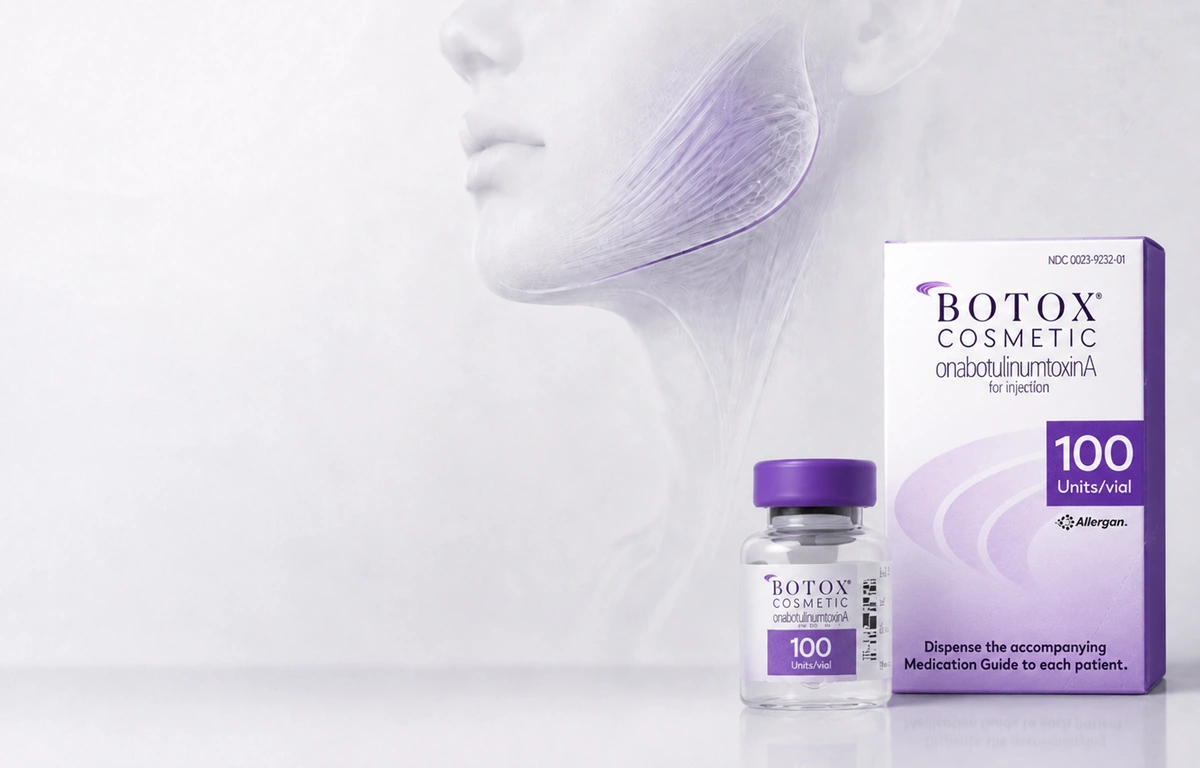
Allergan Aesthetics, an AbbVie company, announced on August 4, 2026, that the U.S. Food and Drug Administration (FDA) has accepted for review a supplemental Biologics License Application (sBLA) for BOTOX Cosmetic (onabotulinumtoxinA). The company wants to add a new aesthetic indication - the temporary improvement in the appearance of moderate to severe masseter muscle prominence associated with muscle activity in adults.
This is not yet an FDA approval. The regulator has agreed to review the application and the clinical data on which it is based. If the decision is positive, BOTOX Cosmetic will receive its fifth aesthetic indication in the U.S. and, according to Allergan Aesthetics, will become the first neurotoxin with an FDA-approved indication specifically for masseter muscle prominence.
What exactly has the FDA accepted for review?
This concerns the use of BOTOX Cosmetic for the temporary correction of the appearance of the lower third of the face in adults with moderate to severe masseter muscle prominence. The masseter is one of the main muscles involved in chewing. When it is noticeably enlarged, the lower third of the face may appear wider or more square.
In the U.S., BOTOX Cosmetic already has four aesthetic indications: glabellar lines, lateral canthal lines, horizontal forehead lines, and platysma bands. The new application differs from these in that its goal is related not so much to individual wrinkles as to changing the visual contour of the lower third of the face by affecting masseter muscle activity.
That is why the acceptance of the application for review is of broader interest than a routine label expansion. It reflects a shift from treating individual expression lines to a more comprehensive assessment of facial shape and proportions.
Why have the masseter muscles become a separate area of aesthetic correction?
The masseter forms part of the lateral contour of the lower jaw, so its volume can significantly affect the perceived width of the lower third of the face. For some patients, a prominent masseter is an individual anatomical feature, and the aesthetic concern is to achieve a narrower or more clearly defined contour.
In its release, Allergan Aesthetics links the application to growing interest in non-surgical facial contouring. The company views the new indication as part of a broader approach in which the physician assesses not one isolated area, but the relationship between different facial structures.
At the same time, it is important not to confuse this regulatory submission with other reasons for using botulinum toxin in the masseter area. The application concerns specifically the aesthetic appearance of masseter muscle prominence. The treatment of bruxism, pain, or temporomandibular joint disorders is not the subject of this FDA submission.
What data is the application based on?
Two Phase III studies
The sBLA included the results of two Phase III studies - M21-416 and M21-417. In both programs, BOTOX Cosmetic was compared with placebo in adults with moderate to severe masseter muscle prominence.
According to Allergan Aesthetics, both studies met their primary endpoints. In the BOTOX Cosmetic groups, statistically significant improvement in masseter muscle prominence was recorded compared with placebo. For study M21-416, the company reports a p-value of 0.0046; for M21-417, p=0.0014.
These results form the basis of the regulatory application, but the final assessment of the benefit-risk profile for the new indication must be made by the FDA during its review.
What is known about patient satisfaction and safety?
The release also presents treatment satisfaction results. Patients who received BOTOX Cosmetic were about twice as likely to report being “satisfied” or “very satisfied” with the result as participants in the placebo group.
According to the company, the safety profile in the two studies was consistent with the already known profile of onabotulinumtoxinA, and no new safety signals were identified. At the same time, this wording reflects the results of the clinical program submitted by the manufacturer. It is not an FDA conclusion regarding the new indication.
“This application builds on the breadth of BOTOX Cosmetic’s capabilities and reflects our continued investment in advancing aesthetic medicine,” said Darin Messina, head of Aesthetics R&D at AbbVie (editorial translation).
How does the U.S. application differ from the already known use in the masseter area?
The key issue here is regulatory status. The fact that a certain area is already known in aesthetic practice does not automatically mean that a specific product has an official indication for it. At the time of the application, masseter muscle prominence is not included in the list of FDA-approved aesthetic indications for BOTOX Cosmetic in the U.S.
In other countries, the situation may differ. In 2024, BOTOX Cosmetic received approval from China’s NMPA for the temporary improvement in the appearance of moderate to severe masseter muscle prominence in adults. At that time, Allergan Aesthetics called China the first market where the product was launched with this indication and stated its intention to develop this direction in other countries.
The U.S. sBLA is effectively the next stage of this global regulatory strategy. If the FDA approves the application, the use of BOTOX Cosmetic for masseter muscle prominence in the U.S. will move from the realm of off-label use for this indication to a separate official aesthetic indication with regulator-defined conditions of use.
What will change if the FDA approves the new indication?
For BOTOX Cosmetic, this will be the fifth aesthetic indication on the American market. But more important is the direction of the expansion itself: a product that for many years was associated primarily with the correction of expression lines is increasingly covering tasks related to shaping the contour of the face and neck.
In 2024, the FDA already approved BOTOX Cosmetic for the temporary improvement in the appearance of moderate to severe vertical platysma bands connecting the jaw and neck areas. The application concerning the masseter muscles continues this move toward the lower third of the face, but through work with a different anatomical structure and a different aesthetic goal.
For the market, this is also a telling signal: manufacturers view neuromodulators not only as a tool for individual wrinkles, but as part of a broader set of methods for non-surgical correction of facial proportions. At the same time, the future of this specific indication in the U.S. depends on the outcome of the regulatory review.
As of August 2026, the FDA has not yet approved BOTOX Cosmetic for masseter muscle prominence. Therefore, the news should be understood precisely as the beginning of a new regulatory stage, not as a report of an already authorized new use.
About Allergan Aesthetics
Allergan Aesthetics is part of AbbVie and develops a portfolio of products and technologies for aesthetic medicine. The company’s areas of focus include injectable facial products, body contouring, plastic surgery, professional skincare, and other aesthetics categories. The Allergan Aesthetics portfolio also includes BOTOX Cosmetic (onabotulinumtoxinA), for which the company continues to explore new aesthetic indications.