







HIFU lifting is often promoted as a way to tighten the facial oval, sharpen the jawline, and reduce skin laxity without surgery. Advertising descriptions may use even bolder claims: “non-surgical SMAS lift,” “a lift in one session,” or even “an alternative to plastic surgery.”
Behind these promises is a real medical technology. Focused ultrasound can indeed create controlled zones of heating in deeper tissues and trigger their gradual remodeling. However, it does not reposition tissues the way a surgeon does, it does not remove excess skin, and it cannot deliver the same result for every person.
To understand what HIFU can and cannot do, it is important to separate the physical mechanism of the procedure from marketing language and to examine what changes it is actually capable of producing.
How focused ultrasound works
Energy is concentrated not on the surface, but deeper in the tissues
HIFU stands for High-Intensity Focused Ultrasound. During the procedure, the device directs ultrasound waves into the tissues and concentrates their energy in small points at a predetermined depth.
The principle can be compared to a lens focusing sunlight into a single point. Along the path of the ultrasound, the tissues receive a relatively low load, while in the focal zone the temperature rises briefly. As a result, a small point of thermal coagulation is formed.
The skin surface should not be damaged, because the main heating occurs below it. It is precisely this ability to affect deeper structures without an incision that has made focused ultrasound popular in aesthetic medicine.
What happens after the tissues are heated
Thermal points do not create an instant mechanical lift. Their purpose is to trigger a controlled healing response. Some collagen fibers contract under the effect of heat, and over the following weeks the tissues gradually remodel.
The body responds to thermal exposure as it would to a micro-injury. Cellular processes involved in restoring the extracellular matrix, synthesizing collagen, and changing its structure are activated. As a result, the skin may become firmer and the contours somewhat more defined.
In simplified terms, this process can be described as a sequence: from focusing ultrasound energy at a specific point to the gradual remodeling of collagen fibers.
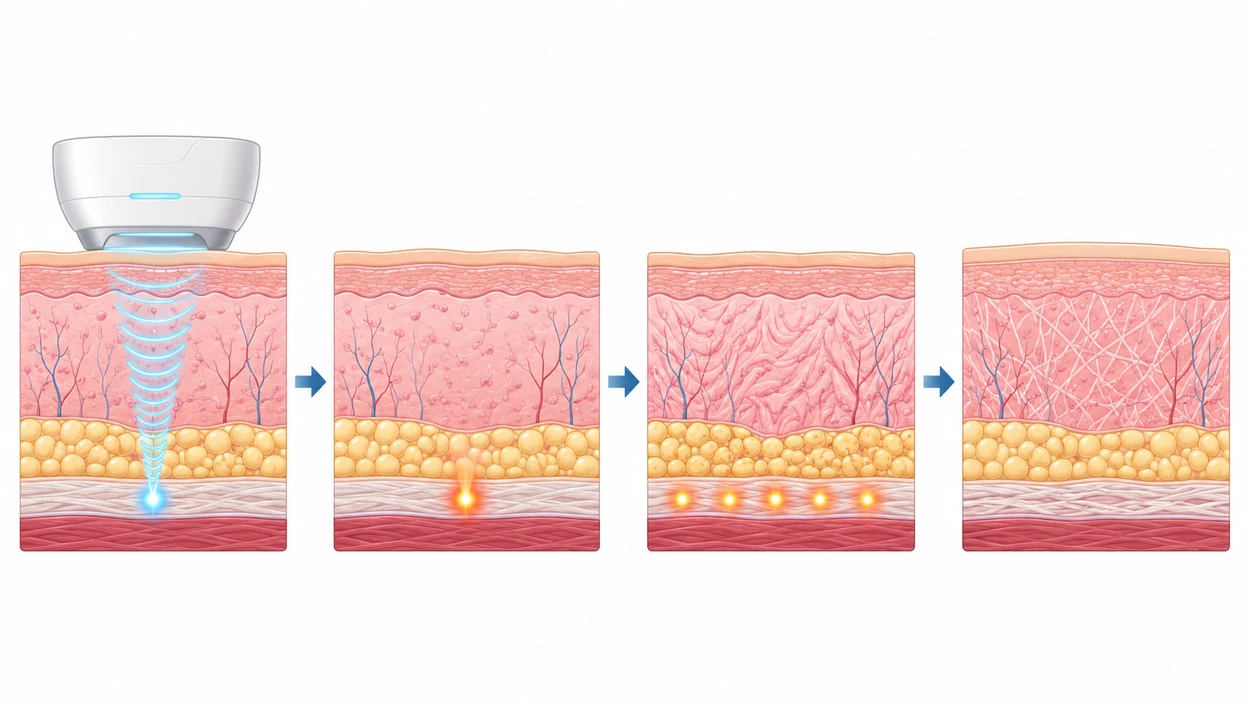
Schematic representation of HIFU action: the formation of thermal points in deeper tissues and gradual collagen remodeling. The actual depth and nature of the effect depend on the device, the transducer, and the procedure settings.
This is why HIFU results are not assessed immediately after the procedure. Visible changes usually develop gradually as the tissues remodel.
Why not all HIFU devices are the same
The term HIFU is used for a large group of ultrasound systems. They may differ in power, transducer design, focusing accuracy, available depths, pulse delivery method, and the ability to visualize tissues during the procedure.
Scientific publications also often use the terms MFU and MFU-V. MFU means microfocused ultrasound, while MFU-V means microfocused ultrasound with visualization. In the second case, the specialist can see tissue layers in real time and control the depth at which energy will be delivered.
“Visualization is needed to confirm the proper treatment depth and avoid treating bone.”
This distinction matters because a significant share of high-quality studies concerns specific systems with visualization, not every device marketed as HIFU. Results obtained with one piece of equipment cannot automatically be applied to any other device.
Can HIFU be called an SMAS lift?
Which structures the procedure can affect
The SMAS is the superficial musculoaponeurotic system, which helps support the soft tissues of the face. It consists of fibrous and muscular structures and is connected to deeper tissue layers.
Focused ultrasound can create thermal points at the level of the deep dermis, subcutaneous fibrous septa, and superficial fascial structures. Depending on the anatomical area and the transducer used, some of the energy may be delivered to a level associated with the SMAS.
However, the mere fact that energy reaches this depth does not make the procedure equivalent to a surgical facelift.
How an ultrasound procedure differs from surgery
During a surgical lift, the doctor gains direct access to the tissues. They can separate them, reposition them, tighten them, fix them in a new position, and remove excess skin.
HIFU does none of this. Ultrasound only forms small thermal zones, after which the tissues respond by contracting and remodeling. It does not eliminate significant excess skin, it does not return large volumes of tissue to their previous position, and it does not replace surgical fixation.
That is why the term “SMAS lift” may be misleading for patients. It is more accurate to describe HIFU as non-invasive ultrasound tissue tightening, which under certain conditions may provide moderate improvement in contours.
Who may be a good candidate for HIFU?
Age is not the only factor — the cause of the changes matters too
The best candidates for the procedure are generally considered to be people with mild to moderate skin laxity. This may include early loss of definition in the lower third of the face, mild tissue sagging along the jawline, reduced skin firmness on the neck, or slight brow descent.
However, age alone says little about whether HIFU is appropriate. Two people of the same age may have different skin thickness, different positions of fat compartments, different degrees of bony support, and different conditions of the ligamentous structures.
During a consultation, it is important to determine not merely the presence of a “blurred facial oval,” but the reason why it has changed.
Why the same appearance may have different causes
An indistinct jawline may result from skin laxity, displacement of fat compartments, swelling, excess subcutaneous fat, platysma activity, or changes in bony support.
Outwardly, these conditions may sometimes look similar, but they require different treatments. If the main issue is skin quality and moderate tissue weakening, HIFU may be appropriate. If the contour is changing because of significant excess skin, a large volume of fatty tissue, or pronounced soft-tissue displacement, the result will be limited.
When the procedure is unlikely to replace surgery
In cases of pronounced jowls, significant excess skin, heavy tissues in the lower third of the face, deep folds, or noticeable neck laxity, focused ultrasound cannot provide an effect comparable to surgery.
In such cases, the skin may become slightly firmer, but the main anatomical cause of the problem will remain. It is especially important to explain this to people who expect a rapid and dramatic change after a single procedure.
What HIFU studies show
Improvement is possible, but it is usually moderate
Clinical studies confirm that focused ultrasound can improve skin firmness and facial contours. The most consistent results have been described for the lower third of the face, the neck, and the area around the eyes.
In one systematic review published in 2025, changes in skin laxity according to the scales used by the researchers ranged from approximately 18% to 30%. Another review, focused on microfocused ultrasound with visualization, showed that some degree of improvement was recorded in most participants.
However, the phrase “some degree of improvement” may refer either to a noticeable change or to a minimal result that is visible only when standardized photographs are compared.
Why a high satisfaction rate does not always mean a pronounced effect
In some studies, most participants reported being satisfied with the procedure. However, the result depended significantly on exactly how the question was worded.
When the questionnaire allowed respondents to choose a neutral answer, the proportion of satisfied participants became lower. This suggests that some studies may have counted the absence of a negative assessment as a positive result.
“Counting neutral responses as positive may lead to an overestimation of treatment efficacy.”
Therefore, efficacy figures should be evaluated together with the study methodology, the scales used, and the duration of follow-up.
When results can be assessed
Immediately after the procedure, some people experience a feeling of mild tightness. This may be related to the initial contraction of collagen fibers or a temporary tissue response.
The main effect develops more slowly. Most often, results are assessed after two to three months, and in some cases after three to six months. This is the period during which gradual collagen remodeling takes place.
The duration of the changes depends on age, skin quality, facial anatomy, procedure settings, the device used, and ongoing tissue aging. There are still fewer long-term studies than short-term ones, so guarantees of an effect lasting a specific number of years do not have a sufficiently reliable basis.
What limitations the evidence base has
HIFU studies are difficult to compare with one another. They use different devices, different transducers, different numbers of pulses, and different assessment systems.
Some studies included only a small number of participants and had no control group. In many cases, results were assessed using before-and-after photographs, while the follow-up period did not exceed several months.
This does not mean that the method does not work. But the available data are not sufficient to accurately predict the result for every individual or to create a universal protocol that is equally effective for all face types.
Pain, side effects, and complications
The procedure is not always comfortable
HIFU is often described as a no-downtime procedure, but this does not mean it is completely painless. During pulse delivery, a person may feel warmth, tingling, brief pinpricks, or shooting sensations deep in the tissues.
Areas over bony prominences, the jawline, and the forehead may be especially sensitive. The intensity of sensation depends on the energy, treatment depth, number of pulses, and individual sensitivity.
In a meta-analysis of MFU-V studies, the average pain level was about five points out of ten. This corresponds to moderate discomfort, although in individual participants the sensations could be much milder or much stronger.
Excessive pain should not be considered a sign that the procedure is “working well.” It may occur when treatment is delivered near bone, a nerve, or another sensitive structure.
Which reactions are considered typical
After HIFU, redness, moderate swelling, tenderness to touch, tingling, or a temporary change in sensitivity may occur. Small bruises sometimes appear.
In most cases, these effects resolve on their own within a few hours or days. However, the absence of a long recovery period does not mean there is no risk at all.
Why serious complications are possible
Serious complications are rarely described in scientific publications. At the same time, adverse event databases contain reports of prolonged numbness, sensory disturbances, nerve injury, scarring, and unwanted loss of subcutaneous fat.
Such reports do not make it possible to determine the true frequency of problems and do not always prove that HIFU was the sole cause. However, they show that an error in selecting the depth, excessive energy, or insufficient knowledge of anatomy can have serious consequences.
When fat reduction becomes undesirable
Focused ultrasound is used not only for skin tightening. Some systems are also used to target subcutaneous fat.
For a person with a heavy lower third of the face, a small reduction in volume may sometimes look positive. But in a thin face with tissue deficiency, fat loss can accentuate hollows, make the features look gaunt, and visually intensify age-related changes.
That is why the entire face should not be treated according to one standard template. Areas that need tightening do not always coincide with areas where volume reduction is acceptable.
Contraindications and combination with other procedures
When HIFU is not performed
The exact list of contraindications depends on the specific system and its official instructions for use. The procedure is usually not performed in the presence of open wounds, active inflammation, or pronounced acne in the treatment area.
Restrictions may apply to people with active electronic devices, pacemakers, defibrillators, and metal implants in the treatment area.
Large blood vessels, nerves, the thyroid area, the trachea, the eyes, and tissues inside the orbital rim require particular caution. The safety of the procedure may be insufficiently studied during pregnancy, breastfeeding, and in certain systemic diseases.
Guidance should come not from general HIFU advertising, but from the instructions for the specific device that will be used for the procedure.
HIFU after dermal fillers
If dermal fillers are already present in the treatment area, the procedure must be planned with particular care. The specialist needs to know which product was injected, exactly when the injections were performed, into which plane the material was placed, and what volume was used.
There is no universal interval that applies between all types of fillers and all HIFU systems. The decision depends on the product, the anatomical area, the depth of injection, and the ultrasound treatment settings.
How HIFU differs from radiofrequency procedures
Both focused ultrasound and radiofrequency systems heat tissues, but they do so in different ways.
HIFU creates separate points of heating at a predetermined depth. Radiofrequency energy usually heats a broader area, and the nature of the effect depends on the device design, the placement of electrodes, the presence of needles, and the temperature control system.
There is no technology that is universally better for everyone. The choice depends on skin thickness, the condition of the subcutaneous tissue, the degree of laxity, the presence of fat deficiency or excess, and the desired treatment depth.
How to assess the clinic, device, and expected result
The name HIFU is not enough
Before the procedure, it is important to find out the exact trade name of the device, the manufacturer, and the official indications for its use. Phrases such as “Korean HIFU,” “new-generation device,” or “certified system” without the model name do not allow the equipment to be evaluated.
It is also worth asking whether the device has tissue visualization, which depths will be used, and how the specialist plans to take into account the location of fat compartments, nerves, vessels, and implants.
The specialist’s qualifications matter no less than the device
Even high-quality equipment does not guarantee safety if the person performing the procedure has a poor understanding of anatomy or uses the same standard protocol for every patient.
Before HIFU, tissue thickness, areas of volume deficiency, the degree of laxity, and the reason for contour changes should be assessed. The procedure settings should be selected according to these features.
Questions to ask before the procedure
The patient should understand exactly which problem is planned to be corrected with HIFU and why the specialist considers this method appropriate. It is important to clarify what result can realistically be expected, when it should be assessed, and what will happen if the changes are minimal.
It is also important to report fillers, threads, implants, and previous surgeries in the treatment area. Separately, patients should discuss which post-procedure reactions are considered normal and whom to contact in the event of prolonged numbness, asymmetry, or severe pain.
HIFU without exaggeration
Focused ultrasound is not an invented technology and not an empty marketing term. It can genuinely affect deeper tissues, trigger their remodeling, and moderately improve skin firmness.
HIFU works best not as a “lift for everyone,” but as a tool for a properly selected patient with mild to moderate laxity. The result is usually gradual, natural, and much less pronounced than after surgery.
The main problem is that different devices, protocols, and levels of professional qualification are sold under the same name. Therefore, the result depends not only on the physics of ultrasound, but also on equipment accuracy, anatomical knowledge, correct depth selection, and an honest assessment of indications.
HIFU should be viewed as one option for non-invasive correction, not as a guaranteed way to return tissues to where they were ten years ago. In some cases the method will be appropriate; in others, a radiofrequency procedure, injectable treatment, or surgery may provide a better result.
This material is for informational purposes only and does not replace an individual consultation with a doctor or review of the official instructions for use of a specific medical device.