







The question “Radiesse or Sculptra?” is not entirely correct. These are not two versions of the same product where it is enough to choose the better-known brand or the longer-lasting effect. CaHA and PLLA differ in composition, preparation before injection, and the nature of the changes after the procedure.
That is why the decision starts not with the trade name, but with the clinical objective. The doctor needs to understand whether the tissues lack support, whether lost volume needs to be restored, or whether the main issue is skin quality. It is also important to know how quickly the patient expects to see changes.
CaHA and PLLA: what is the fundamental difference?
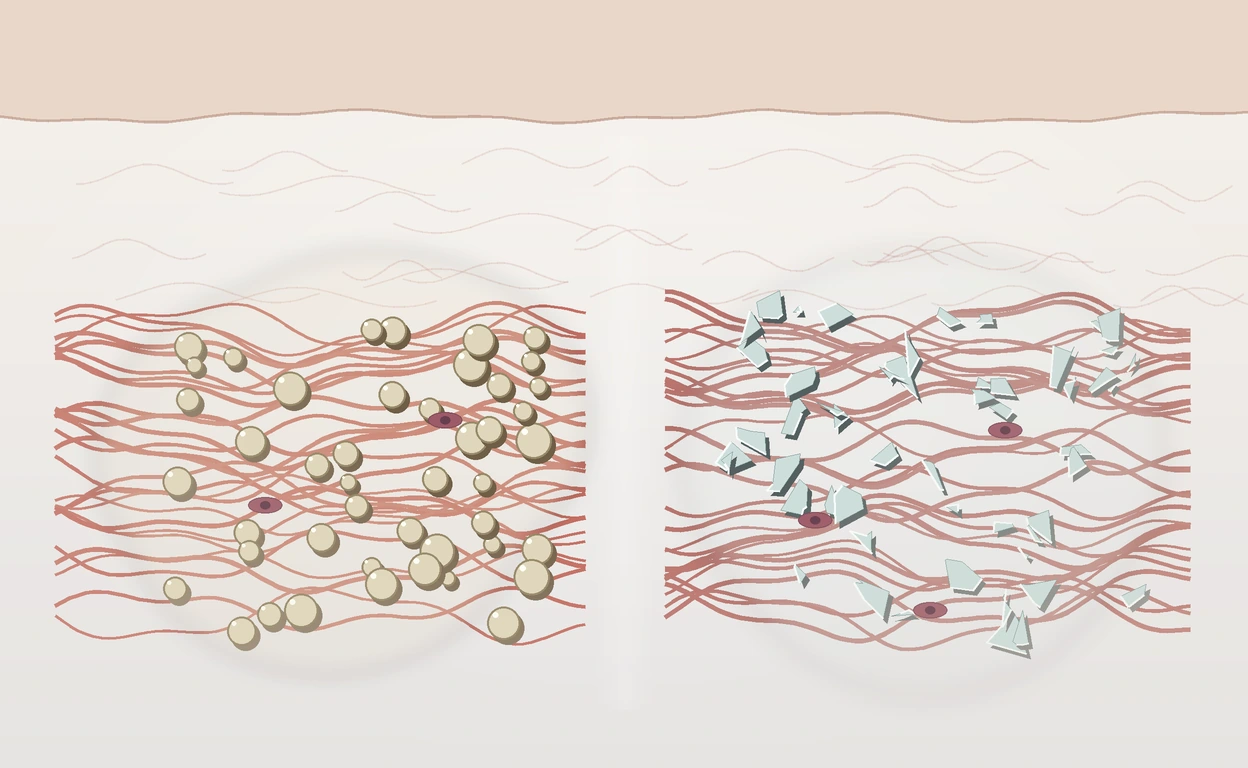
CaHA- and PLLA-based products belong to non-hyaluronic injectable implants with a biostimulating effect. However, they have different physical forms, so the initial appearance after the procedure and the subsequent tissue response are not the same.
CaHA: microspheres in a gel carrier
In Radiesse, calcium hydroxylapatite is presented as synthetic microspheres in a gel carrier. The carrier can immediately provide the tissues with a certain degree of support, so the first changes are sometimes noticeable right after injection.
The appearance in the first hours or days is not yet the final result. It is influenced by post-procedure swelling, the amount of product used, the depth of injection, and how it is distributed. Once swelling decreases, it becomes clearer what part of the initial change was provided by the material itself.
For CaHA, the degree of dilution is essential: it changes the concentration of particles, the way the product spreads, and the clinical goal of the procedure. For example, the current U.S. instructions for Radiesse separately include a 1:2 dilution for correcting décolleté wrinkles. Other options should be assessed according to the instructions for the specific product, the selected area, and the regulations of the country where the procedure is performed.
PLLA: a suspension with gradual action
Sculptra is a PLLA-based product supplied as a lyophilized material containing microparticles. Before the procedure, it is reconstituted with sterile water into a suspension according to the instructions.
Immediately after injection, the treated area may look fuller. However, a significant part of this change is caused by the fluid, swelling, and the injection response. When these subside, the patient may sometimes feel that the effect has disappeared. For PLLA, this is an expected intermediate stage, not a sign of an unsuccessful procedure.
Stable changes appear later. That is why the initial fullness after PLLA is not used as a reference point for assessing the final result.
What biostimulation actually means
Biostimulation is not simply the filling of space with an injected product. The body responds to the material particles; a local tissue response forms around them, and fibroblasts take part in remodeling the extracellular matrix and producing new collagen fibers.
At the same time, not all visible effects are created solely by “one’s own collagen.” In the early stage, the physical properties of the product, the CaHA gel carrier, the water used to reconstitute PLLA, swelling, and the precise placement of the material all matter. Biological changes develop according to a different timeline.
Histological studies help show the tissue response around the particles, but by themselves they do not provide an exact prediction of how visible the result will be in a particular patient. Clinical assessment takes into account not only fiber formation, but also tissue condition, the treatment area, technique, and the visible dynamics after the procedure.
The exact dynamics of how particles remain in tissues should also not be described as a single predictable schedule for all products. In particular, for Sculptra, the exact resorption kinetics in the human body have not been established. This is another reason not to extrapolate data from one product to the entire PLLA or CaHA class.
How the result develops and why the number of procedures is determined step by step
| Practical question | CaHA | PLLA |
|---|---|---|
| What can the patient see in the first few days? | Initial tissue support, which is also influenced by post-procedure swelling | Temporary fullness, mainly related to fluid, swelling, and the injection response |
| Why should the next stage not be rushed? | The result needs to be assessed after swelling decreases to determine whether the first correction was sufficient | It is necessary to wait for gradual changes so that additional material is not added before the effect of the previous injection has appeared |
| What does the further plan depend on? | The degree of dilution, the area, the volume used in the first procedure, and the tissue response | The initial objective, the time since the previous injection, and the changes that have already had time to form |
| When may the method fail to meet expectations? | When the patient expects the same result regardless of dilution and injection technique | When the patient expects a complete effect immediately after one visit |
An injectable result rarely develops in a straight line. The initial appearance changes after swelling decreases, and the stable effect may appear later. This dynamic is discussed in more detail in the article “Why results in cosmetology are not linear: how the effect of procedures changes over time”.
Why there is no universal number of sessions
PLLA is often associated with a series of procedures, but this does not mean that everyone needs the same number of injections. The next stage is planned after assessing how the tissues have changed and whether there is still an issue that needs correction.
CaHA also does not guarantee a complete result after one visit. A repeat procedure may be needed because of the scale of correction, the selected volume, the degree of dilution, or the need to first assess the changes after the initial stage.
Therefore, a pre-sold “standard course” without an explanation of the criteria for completing it raises questions. It is important for the patient to know not only the planned number of procedures, but also the signs by which the doctor will decide whether to continue or stop the correction.
How a doctor chooses between CaHA and PLLA
The formula “CaHA for small areas and PLLA for the whole face” does not work. Diluted CaHA can be distributed over a large area, and PLLA does not become the right choice simply because the correction covers a broad region.
First, the doctor determines what problem lies behind the patient’s words. The request “I want to make my skin denser” may mean loss of support and blurred contours, or it may refer to thin skin without a noticeable volume deficit. Similar wording on the surface can lead to different treatment plans.
Expectations also differ. Two patients may have similar age-related changes, but one wants to see a noticeable difference after one visit, while the other is willing to wait several months. Preferences do not replace clinical indications, but without discussing them, even a technically correct procedure can be disappointing.
During the consultation, the doctor assesses:
- what exactly needs to be changed: supporting contours, restoring lost volume, or improving skin quality;
- the thickness, mobility, and quality of tissues in the selected area;
- how important it is to see changes after the first visit;
- the patient’s readiness for a gradual effect and several stages;
- the presence of previously injected fillers and biostimulators;
- device-based procedures performed previously and their possible impact on the plan.
Age alone does not determine the product. People of the same age can differ significantly in skin thickness, distribution of subcutaneous fat, the condition of the ligamentous support structures, photodamage, and the consequences of previous procedures.
What is known about duration and effectiveness
Does PLLA really last longer?
In some studies, changes after PLLA were observed for up to 25 months, while for CaHA a period of about 12–18 months was often described. At first glance, this seems to offer a simple answer, but these figures were not obtained in one large trial under identical conditions.
The studies differed in products, areas, number of procedures, volumes, techniques, and assessment methods. In addition, the duration of follow-up does not always mean that the effect remained equally pronounced throughout the entire stated period.
A longer-lasting effect alone does not make a product the better choice. If the material does not match the anatomical objective or the patient’s expectations, the additional months of its action are not an advantage.
Why direct comparisons do not provide a definitive answer
A systematic review of CaHA and PLLA studies showed that both materials can improve skin elasticity, wrinkle severity, and facial volume. At the same time, the authors worked with heterogeneous data, so the results do not prove an overall advantage of one product class over the other.
There are few direct comparisons. In one study involving five women, PLLA was injected into one arm and hyperdiluted CaHA into the other. After the first stage, the CaHA-treated side received better ratings in some participants, while at the end of the course, the PLLA-treated side did so in certain participants.
Because of the small sample size and the fact that the study examined arms rather than the face, these observations cannot be applied to all patients. This work only shows that the speed with which changes appear and the result at the end of a course are not identical criteria.
Product, indications, and off-label use
The material and the trade name are not the same thing
CaHA and PLLA are the names of materials, whereas Radiesse and Sculptra are specific commercial products. Other products based on the same material may differ in auxiliary components, concentration, particle properties, preparation method, and officially registered indications.
Therefore, the phrase “this is also CaHA” or “this is also PLLA” does not confirm full interchangeability. A protocol developed for one product cannot automatically be transferred to another solely because the main substance has the same name.
Before the procedure, it should be clear exactly which product will be used, how it will be prepared, and whether the proposed method of use is included in the official instructions.
What off-label use means
The popularity of a certain area on social media does not mean that a specific product is officially registered for that use. Indications depend on the product, the country, and the current local instructions.
Use outside registered indications is called off-label. The term itself does not prove that the procedure is wrong, but the patient should understand that the proposed area, method, or treatment scheme differs from what is stated in the official instructions.
In such a situation, it is reasonable to ask:
- why the doctor is proposing this particular method of use;
- what data and professional experience the decision is based on;
- what alternative options exist;
- what limitations and uncertainties are associated with the chosen protocol.
Non-standard anatomical areas, unusual injection planes, and dilution schemes that are not included in the instructions for the specific product require particular attention.
Risks and symptoms that must not be ignored
Expected early reactions
After CaHA or PLLA, soreness, redness, swelling, bruising, tenderness, and temporary unevenness may occur. These manifestations usually gradually subside. Their intensity depends on the area, the extent of the procedure, and the individual response.
Even an expected reaction requires attention if it does not decrease but intensifies, lasts longer than the timeframe predicted by the doctor, or is accompanied by new symptoms.
Delayed complications
Papules, nodules, induration, and inflammatory reactions may appear weeks or months later. After PLLA, such subcutaneous formations are particularly well described, but similar problems are also possible after CaHA.
After Sculptra, the doctor may prescribe post-procedure massage according to a specific scheme. It should be performed exactly as recommended. If a new area of induration, a visible nodule, redness, or soreness appears later, the patient should not independently intensify, prolong, or resume massage without consulting the doctor.
When urgent help is needed
Unusual or severe pain during or shortly after the procedure, sudden skin blanching, vision changes, or signs of impaired cerebral circulation require immediate medical attention.
Such symptoms may be associated with material entering a blood vessel. Vascular occlusion can cause ischemia, necrosis, visual impairment, and other serious consequences. The term “biostimulator” does not reduce the requirements for knowledge of anatomy, injection technique, and the clinic’s readiness to act in an emergency.
CaHA and PLLA cannot be rapidly dissolved with hyaluronidase in the way hyaluronic acid fillers can. If the material is injected into an unsuitable area, in an excessive volume, or in the wrong plane, correction can be difficult and prolonged. The possibilities and limitations of the enzyme are discussed in more detail in the article “Hyaluronidase: when it is needed and why you should not be afraid of dissolving fillers”.
If a person does not remember the names of previously injected products, has induration, prolonged swelling, or a complex injection history, ultrasound diagnostics may provide additional information. Its use is discussed in the article “Ultrasound before fillers: how the safety of injectable cosmetology is changing”.
What to ask and what to keep after the procedure
Questions for the doctor
- What is the exact commercial name of the product, and why was it chosen?
- What does the doctor plan to change: contours, lost volume, or skin quality?
- What CaHA dilution or PLLA reconstitution scheme is planned?
- What changes may be visible immediately, and when will the stable result be assessed?
- How many stages does the initial plan include?
- What criteria will be used to determine the need for the next procedure?
- Is the proposed use included in the official instructions?
- How do previous injections and device-based procedures affect the choice?
- What symptoms require urgent medical attention?
- How does the clinic manage vascular and inflammatory complications?
Information worth keeping
After the procedure, it is useful for the patient to ask for and keep precise information about the injected product. It may be needed during future correction, if an adverse reaction occurs, during ultrasound diagnostics, or when consulting another doctor.
This information includes:
- the commercial name of the product;
- the series or batch number, if the clinic provides these details;
- the date of the procedure;
- the injected volume;
- the degree of CaHA dilution or the PLLA reconstitution scheme;
- the anatomical injection areas;
- the recommended timeframe for a follow-up visit;
- the clinic’s contact details in case of an adverse reaction.
CaHA and PLLA should be compared not by the principle of “which is stronger,” but by how well the behavior of a specific product matches the clinical objective. If the plan cannot be explained without generic promotional wording about collagen, rejuvenation, and long-lasting effects, the decision is not yet sufficiently justified.
The product name should be only part of the answer. It is just as important to understand what exactly is being injected, why it is being done, when the result will be assessed, and how the clinic will act if the procedure does not develop as planned.